Which Language Should I Learn? A Complete Guide to Choosing Your Next Language
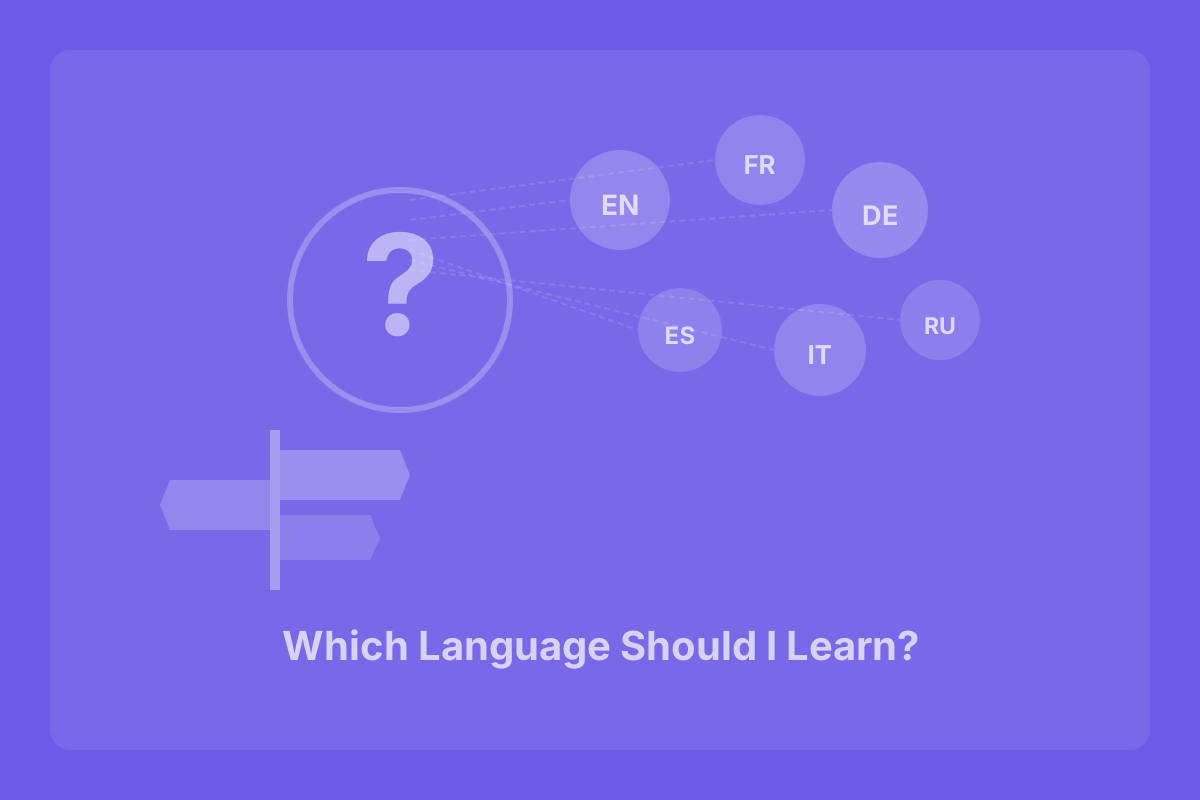
A colleague of mine, Sara, spent three months agonizing over which language to learn. She made spreadsheets. She polled friends. She read forum threads until two in the morning. She watched YouTube videos with titles like "The BEST Language to Learn in 2026" and came away more confused than before. Every creator had a different answer. Spanish was the obvious choice. No, Mandarin was the future. Actually, French was underrated. Wait, German pays the most.
By the time Sara finally picked a language, she had wasted a full quarter of the year doing research instead of studying. And here is the irony: she chose Spanish, which was her gut instinct from the very beginning.
Sara's story is more common than you might think. "Which language should I learn?" is one of the most searched questions in language education. It is also one of the most personal. There is no single correct answer, because the right language for you depends on a tangle of factors: your career goals, where you want to travel, who you want to talk to, how much time you have, how much complexity you can tolerate, and what genuinely excites you.
This guide will not tell you which language to learn. Instead, it will give you a framework for making that decision yourself, grounded in data about difficulty levels, career returns, language families, and real-world demand. By the end, you should be able to narrow your list to one or two strong candidates and start learning with confidence.
The Factors That Actually Matter
Before comparing languages head to head, it helps to understand what drives a good language choice. Most people fixate on one factor, usually career value or difficulty, and ignore the rest. But a language you find boring will never stick, no matter how lucrative it is. And a language you love but never use will fade within a few years of finishing your course.
Here are the factors worth weighing, roughly in order of importance.
Personal Connection
The strongest predictor of language-learning success is emotional investment. If you have a partner who speaks Italian, you will learn Italian faster than any other language on Earth, because every conversation is a lesson and every mistake is immediately corrected with a smile (or a laugh). If your grandmother speaks Russian and you want to understand her stories before they are lost, that motivation will carry you through months of case endings and verb aspects.
Personal connection also includes cultural fascination. If you have watched every French film on the streaming platforms and dream of walking through Paris understanding every conversation around you, that pull is worth more than a salary survey. People who learn languages out of love tend to stick with them longer than people who learn them out of obligation. This is not just anecdotal. Studies on language learning motivation consistently show that intrinsic motivation, the kind that comes from genuine interest rather than external pressure, produces better outcomes across every measure: retention, fluency, pronunciation accuracy, and long-term maintenance of the language after formal study ends.
Career and Economic Value
That said, money matters. Some languages open more professional doors than others, and the difference can be significant. The value of a language in the job market depends on three things: how many employers need it, how few people in your market speak it, and how high-paying the industries that use it tend to be.
In North America and the United Kingdom, Spanish is the most commonly requested second language in job postings, but because so many people already speak it, the salary premium is modest. German, on the other hand, appears in fewer job listings but carries a higher premium per speaker because the demand-to-supply ratio favors learners. French sits somewhere in the middle, with strong demand in international organizations, diplomacy, and across Africa, where French-speaking economies are among the fastest growing in the world.
Russian, Arabic, and Mandarin Chinese tend to command the highest premiums in government, intelligence, and certain pockets of international business, but they also require far more study time to reach a professional level.
Time Investment and Difficulty
Not all languages take the same amount of time to learn, and the differences are not small. The U.S. Foreign Service Institute (FSI) has tracked how long it takes English speakers to reach professional proficiency in dozens of languages. Their data, refined over decades, breaks languages into rough categories.
Category I languages are the closest relatives of English. Spanish, French, Italian, Portuguese, Dutch, and the Scandinavian languages fall here. The FSI estimates 600 to 750 classroom hours to reach professional working proficiency. For a learner studying five hours a week, that translates to roughly two and a half to three years.
Category II includes German, which needs about 900 hours. German grammar is more complex than its Romance cousins, with four cases, gendered nouns, and a word order that takes some getting used to.
Category III covers languages like Russian, Greek, Hindi, and Turkish. These require approximately 1,100 hours. They introduce unfamiliar grammar systems, new alphabets, or both.
Category IV is reserved for the hardest languages for English speakers: Arabic, Mandarin Chinese, Japanese, and Korean. The FSI estimates 2,200 hours for these, nearly three times as long as Spanish. The combination of unfamiliar writing systems, tonal distinctions (in Mandarin), and radically different grammar makes these languages a serious long-term commitment.
These numbers are averages for professional diplomats studying intensively. Your personal timeline will vary based on your aptitude, motivation, and learning methods. But the ratios hold. If you have limited time and want to see results quickly, a Category I language will reward your effort much sooner.
Where You Want to Go
Geography matters more than people give it credit for. A language is most useful when you can practice it regularly, and travel is one of the best ways to do that. If you spend two weeks every summer on the Italian coast, Italian makes far more sense than Mandarin. If your company has offices in Frankfurt and you fly there quarterly, German is the practical choice.
Think about where you travel now and where you want to travel in the next five to ten years. Think about where your industry is expanding. A language tied to a place you actually visit will develop faster and last longer than one you study in isolation.
Personal Learning Style
Some languages suit certain personalities better than others. If you love music and rhythm, the melodic flow of Italian or Portuguese might click faster. If you enjoy solving puzzles and working through logical systems, the precise rules of German grammar might appeal to you. If you thrive on memorization challenges and visual learning, the character systems of Japanese or Mandarin can be deeply satisfying once you get past the initial overwhelm.
This is not about which language is objectively better. It is about which language will keep you coming back to your textbook, your app, or your tutor day after day. Pay attention to what draws you naturally. If you find yourself watching Italian cooking videos for fun, that is data. If you keep gravitating toward German engineering documentaries, that is a signal. Your unconscious interests are often a better guide than any strategic analysis.
Language Comparison: What the Data Shows
Let us compare the most commonly studied languages across several dimensions. This is not an exhaustive list of every language in the world, but it covers the ones that most readers are choosing between.
Spanish
Spanish is the most popular second language in the Americas and one of the most studied globally. It has over 500 million native speakers across more than 20 countries. The grammar is regular, the pronunciation is phonetic, and the vocabulary shares significant overlap with English thanks to Latin roots.
Career value: strong in healthcare, education, social work, law enforcement, and any customer-facing role in the Americas. The salary premium is modest in markets where Spanish speakers are plentiful, but the sheer volume of opportunities compensates.
Difficulty for English speakers: Category I. One of the fastest languages to learn.
Best for: beginners, travelers, people in the Americas, anyone wanting quick wins.
French
French is spoken by roughly 300 million people worldwide, with growing populations in Africa expected to push that number significantly higher by 2050. It remains a working language of the United Nations, the European Union, NATO, and the International Olympic Committee.
Career value: strong in diplomacy, international development, luxury goods, fashion, gastronomy, and African markets. French speakers are in demand at NGOs, international organizations, and multinational companies with operations in Francophone Africa.
Difficulty for English speakers: Category I. Pronunciation can be tricky, but grammar and vocabulary are accessible.
Best for: internationally minded learners, people interested in diplomacy or development, anyone drawn to French culture.
German
German is the most spoken native language in Europe, with about 100 million native speakers. Germany has the largest economy in Europe and the fourth largest in the world. Austria, Switzerland, and Luxembourg also use German.
Career value: very strong in engineering, automotive, manufacturing, science, technology, and academic research. Germany offers many positions that require German even in international companies. The salary premium for German speakers in technical fields is among the highest of any European language.
Difficulty for English speakers: Category II. The grammar is more demanding than Romance languages, but German and English share Germanic roots, so vocabulary often feels familiar.
Best for: engineers, scientists, anyone interested in the EU job market, people who enjoy systematic grammar.
Italian
Italian has around 65 million native speakers, primarily in Italy, but also in Switzerland, San Marino, and diaspora communities worldwide. Italy has the eighth largest economy in the world and is a powerhouse in design, fashion, food, automotive (luxury segment), and tourism.
Career value: more niche than Spanish or French, but valuable in design, luxury brands, culinary arts, art history, music, and tourism. Italian companies like Fiat, Ferrari, Gucci, and Prada operate globally.
Difficulty for English speakers: Category I. Italian pronunciation is remarkably consistent, and the grammar, while it has its quirks, follows clear patterns.
Best for: lovers of culture, food, and design, travelers to the Mediterranean, beginners looking for a musical and rewarding language.
Russian
Russian has about 250 million speakers (native and second language) across Russia, Central Asia, the Caucasus, and significant diaspora communities. It is the most spoken Slavic language and one of the six official languages of the United Nations.
Career value: strong in energy, aerospace, defense, diplomacy, translation, and certain academic fields. The supply of Russian speakers in Western markets is relatively low, which increases the premium for those who reach professional proficiency.
Difficulty for English speakers: Category III. The Cyrillic alphabet can be learned in a few days, but the case system (six cases), verb aspects, and word formation patterns require sustained effort.
Best for: ambitious learners, people interested in literature and history, anyone with connections to the post-Soviet world, those who enjoy grammar challenges.
English (Advanced Level)
If English is not your native language and you already speak it at an intermediate level, pushing to advanced or near-native proficiency may offer the single highest return on investment of any language decision you make. English remains the global lingua franca of business, science, technology, entertainment, and the internet. The difference in career opportunities between B1 English and C1 English is enormous.
Even native English speakers can benefit from formal advanced study: professional writing, public speaking, and industry-specific vocabulary all have measurable career impact.
Language Families and Transferable Skills
One of the most underappreciated aspects of language choice is how your first foreign language sets you up for future ones. Languages belong to families, and learning one member of a family makes the others significantly easier.
The Romance family includes Spanish, French, Italian, Portuguese, and Romanian. Learn one, and you will understand 40 to 60 percent of the vocabulary in the others on day one. The grammar systems are similar enough that switching between them requires adaptation, not starting from scratch.
The Germanic family includes English, German, Dutch, Swedish, Norwegian, and Danish. English speakers already have a head start in this family, and adding German opens the door to Dutch (which many German speakers describe as "German on easy mode") and the Scandinavian languages.
The Slavic family includes Russian, Ukrainian, Polish, Czech, Serbian, Bulgarian, and others. Russian is the largest member and shares significant vocabulary and grammar patterns with the rest of the group.
If you think you might want to learn multiple languages over your lifetime, your first choice matters strategically. Picking a language that serves as a gateway to a larger family gives you a multiplier effect on every hour you invest.
The ROI Question: Which Language Pays the Most?
Career-focused learners often want a direct answer: which language will boost my salary the most? The honest answer is that it depends on your field, your location, and your existing skill set. But some general patterns emerge from salary data and job market analysis.
In the United States, the languages associated with the highest salary premiums (controlling for other factors) tend to be Arabic, Mandarin, German, and Russian. These languages are in high demand and relatively short supply among the workforce. However, the premiums vary dramatically by industry. German is worth the most in engineering and manufacturing. Arabic and Mandarin pay best in government and intelligence. Russian carries value in energy and defense.
In Europe, the calculation is different. English is the highest-value second language in nearly every non-English-speaking country. After English, German tends to carry the strongest premium, especially in Central and Eastern Europe. French is valuable across the EU institutions and in neighboring regions. Spanish is increasingly valuable as trade links with Latin America grow.
The important thing to remember is that language skills rarely stand alone. A German-speaking engineer earns more than a German-speaking barista, not because of the German, but because of the engineering plus German combination. Languages are multipliers: they amplify the value of whatever other skills you bring to the table.
Regional Demand: Where Are Languages Growing?
Language demand shifts over time. Twenty years ago, Japanese was the hot language for business. Today the conversation has moved elsewhere. Looking at current trends and demographic projections helps identify which languages are gaining value.
French is experiencing a surge in global relevance thanks to population growth in Francophone Africa. The African Development Bank projects that French speakers will number over 700 million by 2050, making French one of the most spoken languages on the planet. This growth is driving demand for French speakers in international development, business, and diplomacy.
Spanish continues to grow in the United States, where the Hispanic population is projected to reach 100 million by 2060. Spanish-English bilingualism is increasingly treated not as a bonus but as a baseline expectation in healthcare, education, and public services in large swaths of the country.
German remains stable and valuable, anchored by Europe's largest economy and Germany's role as the industrial heart of the EU. It is unlikely to surge in speaker numbers, but the economic weight behind it keeps demand steady.
Russian maintains strategic importance in energy markets, geopolitics, and across Central Asia, where it serves as a lingua franca for countries with small national languages.
Personality and Language Fit
This might sound unscientific, but experienced language teachers will tell you that personality and language fit is real. Some people gravitate naturally toward certain languages, and when the fit is right, motivation and retention both improve.
Social, outgoing learners who love conversation often thrive in Spanish or Italian. These languages have vibrant spoken cultures, relatively simple entry points, and enormous communities of speakers who are generally delighted when foreigners make an effort. The emphasis is on communication over perfection.
Detail-oriented, systematic thinkers often enjoy German or Russian. Both languages have complex grammatical systems that reward precision. There is a satisfaction in mastering case endings and getting verb conjugations exactly right that appeals to the type of person who also enjoys chess, coding, or mathematics.
Creative and aesthetic learners often find themselves drawn to French or Italian. The connection to art, cinema, fashion, literature, and music gives these languages a cultural richness that provides endless study material beyond textbooks.
Ambitious, goal-driven learners who want a genuine challenge often gravitate toward Russian, Arabic, or Mandarin. These languages take longer to learn but provide a sense of accomplishment proportional to the difficulty. They also tend to be the languages where proficiency opens the most doors, precisely because fewer people make it to fluency.
Myth Busting: Things People Get Wrong About Language Choice
"Some languages are useless"
No language is useless. Every language connects you to a culture, a literature, a way of thinking, and a community of speakers. The claim that a language is "useless" usually means "I cannot immediately monetize it," which is a narrow and often incorrect way to think about value. A person who learns Finnish may never use it in a job interview, but they gain access to one of the world's best education systems, a rich literary tradition, and a community that is genuinely thrilled when outsiders learn their language.
"You should learn the hardest language to stand out"
Difficulty for its own sake is not a strategy. If you spend five years learning Mandarin to a basic conversational level but could have reached professional fluency in Spanish in two years, the Spanish would have been the better investment for most practical purposes. Choose a language whose difficulty matches your available time and motivation level.
"Children learn languages faster, so adults should not bother"
This is one of the most persistent myths in language education. Children are better at acquiring native-like pronunciation, but adults are faster at learning grammar, vocabulary, and reading. An adult with good study habits and clear motivation will reach conversational ability in a new language far faster than a child. The idea that there is a "critical period" after which language learning becomes impossible has been repeatedly challenged by research. People learn new languages successfully at every age.
"English is enough"
English is indeed the most widely used global language, but "English is enough" is only true if you want to stay in English-speaking bubbles. In business negotiations, the person who speaks the client's language has an advantage over the person who insists everyone speak English. In travel, speaking the local language transforms your experience from tourist to participant. In personal relationships, language is intimacy. English may be sufficient, but it is rarely optimal.
"Online resources mean you do not need a teacher"
Apps and online courses are valuable tools, but they cannot replicate the real-time feedback, cultural context, and accountability that a good teacher provides. The most successful language learners typically combine self-study with regular instruction. An experienced tutor can identify your specific weaknesses, adapt to your learning style, and push you past plateaus that self-study alone cannot resolve.
Making the Final Decision
You have read the data. You have considered your career, your travel plans, your personal connections, your time budget, and your personality. Now it is time to decide. Here is a simple process that works for most people.
Step 1: Eliminate the Obvious Mismatches
If you have less than five hours a week and want results within a year, cross Category III and IV languages off your list. If you have zero interest in a region, cross its languages off regardless of their career value. If a language bores you when you hear it spoken, cross it off too. No amount of career potential will sustain you through hundreds of hours of studying a language you find dull.
Step 2: Rank Your Remaining Options
Take your shortlist and rank the languages by how excited you feel about each one. Not how useful, not how impressive, but how excited. Excitement is the fuel that carries you through the hard middle months when the initial enthusiasm fades and fluency still feels far away.
Step 3: Try Before You Commit
Before investing in a full course, spend two weeks with your top choice. Use a free app, watch a few videos, learn the basics. Notice how you feel. Are you looking forward to your study sessions, or are they a chore? Do you find yourself practicing phrases in the shower, or forgetting about the language until your next scheduled session? Two weeks will not make you fluent, but they will tell you whether a language fits you.
Step 4: Get a Professional Assessment
A trial lesson with a qualified tutor can shortcut months of uncertainty. A good tutor will assess your starting point, discuss your goals, and give you an honest timeline. They can also help you understand whether a language is a realistic fit for your schedule and learning style. At ProLang, we offer trial lessons in every language we teach for exactly this reason.
Step 5: Commit and Stop Second-Guessing
Once you pick a language, commit to it for at least three months before evaluating your choice. The first few weeks of any language feel either thrilling or overwhelming, and neither feeling is a reliable predictor of long-term success. Give yourself enough time to get past the novelty phase and see how the language settles into your routine.
The biggest mistake people make is not picking the wrong language. It is spending so long choosing that they never start at all. Any of the major languages will enrich your life, expand your career options, and connect you to millions of new people. The best language to learn is the one you will actually study.
What If You Want to Learn More Than One?
If reading through this guide has left you excited about two or three languages, that is not a problem. Many successful language learners study more than one, either simultaneously or in sequence.
If you want to learn two languages from the same family, such as Spanish and Italian, consider learning one to at least B1 level before starting the second. This gives you a solid foundation and reduces the risk of mixing them up.
If your two languages are from different families, such as German and Spanish, you can study them in parallel from the beginning, as long as you have enough time (at least three hours per week per language) and keep your study sessions separate.
Whatever path you take, the point is to start. Language learning is one of the few investments that pays dividends in every area of your life: career, travel, relationships, cognitive health, and personal satisfaction.
There is also a cognitive benefit that many people overlook. Research consistently shows that bilingual and multilingual individuals demonstrate better executive function, stronger problem-solving skills, and greater mental flexibility than monolingual peers. Learning a second language changes the physical structure of your brain, strengthening the neural pathways responsible for attention and memory. These benefits persist throughout life and may even delay the onset of age-related cognitive decline by several years. The language you choose matters less than the act of choosing one and committing to the process.
Some learners worry about starting "too late" or picking the "wrong" language. Both concerns are unfounded. Adults learn languages differently from children, but not worse. And there is no wrong language, only languages that fit your life better or worse at this particular moment. Your circumstances will change. Your interests will evolve. But the foundational skill of learning how to learn a language, the study habits, the ear training, the comfort with ambiguity, stays with you forever and makes every subsequent language easier.
At ProLang, our trial lessons are designed to help you test the waters before committing. You get to work with a native-speaking tutor, assess your starting point, and experience what real structured learning feels like. Many students who walk into a trial lesson uncertain about their language choice walk out with complete clarity, not because the tutor told them what to learn, but because the experience itself made the answer obvious.
The question is not whether you should learn a language. The question is which one you will begin with today.
Book your free trial lesson
One to one with a native teacher, on Zoom.
Times shown in your zone: Europe/Madrid
Loading the timetable…
3. Your email for the confirmation and the Zoom link
One-to-one lessons with a native teacher
On Zoom with a qualified teacher from Spain who also speaks English.