How Learning a Language Can Boost Your Career in 2026

Jake Morrison spent six years doing the same job at a mid-size logistics company outside Columbus, Ohio. He was reliable, consistent, the kind of person who never missed a deadline. But promotions kept going to other people. Then in 2021, out of boredom more than ambition, he signed up for Portuguese lessons twice a week after work. He had no grand plan. He just wanted a hobby that got him away from screens.
Eighteen months later, his company announced it was opening a distribution hub in Sao Paulo. Management needed someone who understood the existing systems and could also communicate with the new Brazilian team without routing every conversation through a translator. Jake raised his hand. He was not the most senior person in the department. He was not the obvious choice on paper. But he was the only one in the building who could sit in a meeting with the Brazilian logistics manager and actually follow the conversation. Within three months, Jake went from a mid-level operations role to a project lead on an international expansion. His salary jumped 22 percent.
Stories like Jake's used to sound unusual. They do not anymore. The global economy has changed the rules around career advancement, and language skills have gone from a nice line on a resume to a factor that genuinely moves people up. Whether you are angling for a raise, trying to break into a new industry, or hoping to work abroad, the ability to communicate in more than one language has become one of the most practical advantages a professional can develop. This article walks through the evidence, the strategies, and the specific steps you can take to turn language learning into career results.
How Learning a Language Can Boost Your Career
The connection between language skills and career growth is not abstract. It shows up in hiring decisions, promotion timelines, and the kinds of opportunities that land on your desk.
Consider what happens inside a company that expands internationally. Somebody needs to handle the communication. Somebody needs to fly to the new office, sit across the table from local partners, and work through contracts, supply chain details, or client relationships in the local language. The people who can do that become more valuable overnight. They do not just keep their jobs. They get pulled into strategic conversations that would otherwise be above their pay grade.
Maria Santoro, a marketing coordinator at a consumer goods company in Chicago, saw this firsthand. She had studied French in college but never used it professionally. When her company acquired a smaller brand based in Lyon, France, Maria mentioned her French skills to her manager almost as an afterthought. Within a week, she was on calls with the French team, helping to align the two brands' social media strategies. Six months later, she was promoted to international marketing manager, a role that had not existed before she demonstrated that she could fill it.
This is a pattern that repeats across industries. Language skills do not just make you more qualified for your current job. They create new jobs, new roles, and new pathways that would not exist if everyone in the building spoke only one language.
Employers see this clearly. The reasoning was straightforward: it is easier to teach someone the technical parts of a job than to teach them a language from scratch.
Beyond promotions and new roles, language skills change how colleagues and clients perceive you. When you walk into a meeting and greet a client in their language, something shifts. It signals effort, respect, and cultural awareness. Those are soft qualities, hard to measure, but they influence who gets trusted with high-stakes projects, who gets invited to dinners with visiting executives, and who gets remembered when a new opportunity opens up.
Language ability also strengthens cognitive skills that employers value. Research from the University of Edinburgh published in 2024 showed that bilingual professionals scored higher on measures of problem-solving flexibility and working memory than monolingual peers with comparable education levels. These are not abstract academic findings. They translate into better performance in fast-moving environments where you need to juggle priorities, process conflicting information, and make quick decisions under pressure.
The bottom line is simple. Learning a language does not guarantee a promotion. But it puts you in rooms you would not otherwise enter, and it gives you advantages that are difficult to replicate with any other single skill.
Which Languages Are Most Valuable for Business
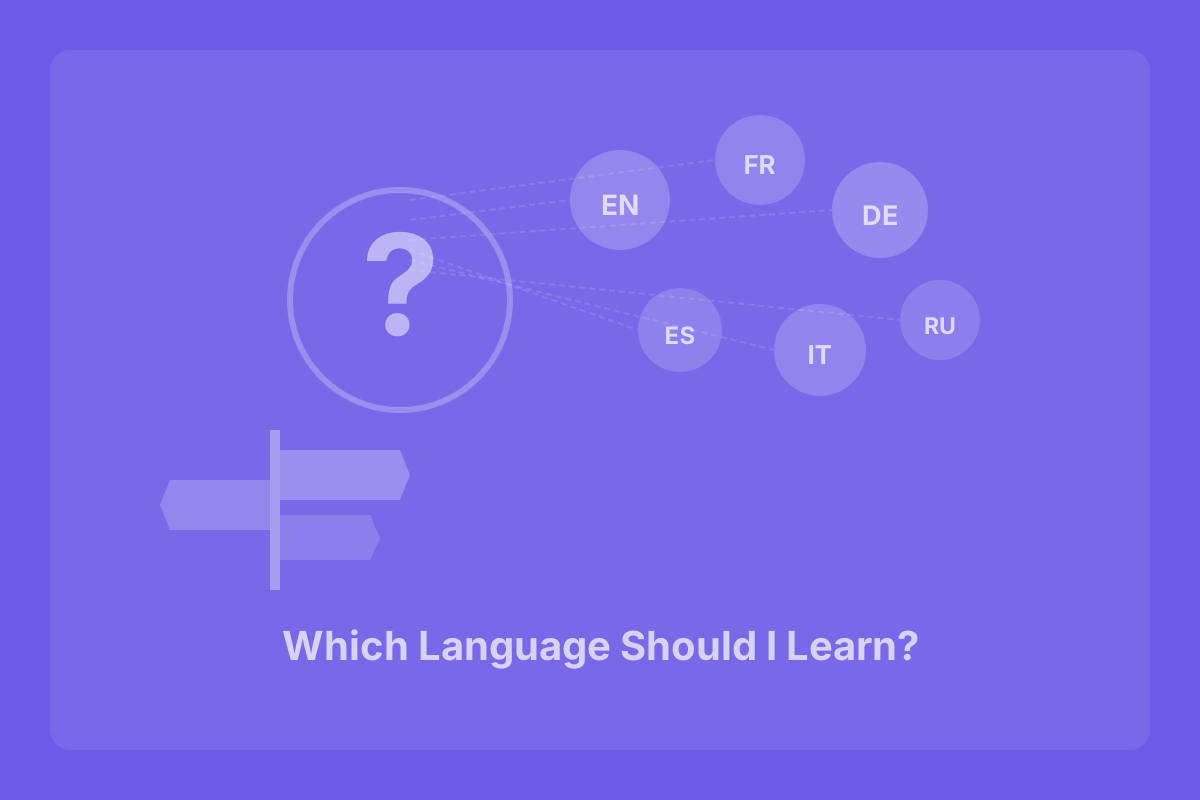
Not all languages carry the same weight in the job market, and the answer to "which language should I learn?" depends heavily on your industry, your location, and where you want your career to go.
That said, some languages consistently show up at the top of employer demand lists.
English remains the global default for international business. If it is not your first language, it is almost certainly the highest-return language you can learn. Roughly 1.5 billion people worldwide use English for work, and it dominates in technology, finance, aviation, science, and diplomacy. For non-native speakers, strong business English is often the single biggest differentiator in career advancement.
Mandarin Chinese has grown steadily in employer demand over the past decade. China's role as a manufacturing hub, technology investor, and trading partner means that professionals who can handle Chinese-language negotiations or read Chinese contracts have a clear advantage in supply chain management, international trade, and tech partnerships. The challenge is that Mandarin takes significantly longer to learn for speakers of European languages, so starting early matters.
Spanish is one of the most broadly useful languages for professionals in the Americas and increasingly in Europe. With over 500 million native speakers and fast-growing economies across Latin America, Spanish opens doors in healthcare, education, retail, real estate, and financial services. In the United States, bilingual English-Spanish professionals are in high demand in virtually every state.
German punches above its weight in career value relative to the number of speakers. Germany is the largest economy in Europe and a major player in engineering, automotive manufacturing, pharmaceuticals, and renewable energy. Professionals who speak German find it significantly easier to work with or within German companies, which still conduct a large share of internal operations in German despite widespread English proficiency among their employees.
French remains critical for careers involving Africa, where French-speaking economies are among the fastest-growing in the world. It is also essential for roles in international diplomacy, luxury goods, hospitality, and food industries. With over 300 million French speakers globally and that number projected to rise sharply due to demographic growth in West and Central Africa, French is becoming more valuable, not less.
Arabic, Japanese, Korean, and Portuguese each hold strong value in specific industries and regions. Arabic opens doors across the Gulf states' booming construction, energy, and finance sectors. Japanese and Korean are essential for anyone working in electronics, automotive, or gaming industries with East Asian partners. Portuguese, particularly Brazilian Portuguese, is increasingly important in agribusiness, mining, and technology, given Brazil's economic scale.
The smartest approach is not to pick the "most popular" language but to pick the one that intersects with your career ambitions. If you work in automotive supply chains, German will take you further than Mandarin. If you are in international development, French or Arabic may be the key that unlocks your next role. Look at the companies you want to work for, the markets your industry is expanding into, and the clients your company struggles to serve. That intersection is where your language investment will pay off fastest.
Language Skills and Salary: What the Data Shows
The salary premium for language skills is real, measurable, and growing. But the size of that premium depends on which language you speak, how well you speak it, and what industry you work in.
A 2025 analysis by the Economist Intelligence Unit found that bilingual employees in the United States earned an average of 5 to 20 percent more than monolingual peers in the same roles. The gap was widest in industries with heavy international exposure, such as finance, consulting, logistics, and technology. For certain language-role combinations, the premium was even higher. Bilingual investment bankers who could handle deals in Mandarin or Japanese, for instance, earned up to 35 percent more than their English-only counterparts.
In Europe, the picture is slightly different because multilingualism is more common. But even there, specific language combinations carry significant premiums. A German-speaking sales professional working in Italy, for example, typically earns 10 to 15 percent more than an Italian-only competitor covering the same territory, because German-speaking markets represent a large share of Italian exports.
The premium was consistent across seniority levels, from entry-level customer service roles (where bilingual agents earned roughly $3,000 to $5,000 more per year) to senior management positions (where the gap could reach $20,000 to $40,000 annually).
It is worth noting that the salary premium is not automatic. Simply listing "conversational Spanish" on your resume does not change your paycheck. The premium kicks in when your language skills are functional enough to add real value, meaning you can conduct meetings, write emails, handle negotiations, or manage teams in that language without constant support. This is why investing in genuine proficiency, rather than surface-level familiarity, makes a financial difference.
There is also a compounding effect. Language skills tend to accelerate career progression, which means the salary gains stack over time. A professional who earns a 10 percent premium at age 30 because of language skills and then gets promoted two years earlier than peers without those skills can end up earning significantly more over the course of a career, not just because of the initial premium but because of the faster trajectory.
Freelancers and independent professionals see similar patterns. Translators, interpreters, and bilingual consultants command higher hourly rates, and professionals who can pitch their services in multiple languages reach larger client pools. A web developer in Berlin who can market services in both German and English, for example, has access to a client base roughly four times the size of one who works only in German.
The data points in one direction: language skills pay, and they pay more as you get better at using them in professional contexts.
How to Add Language Skills to Your Resume
Putting language skills on your resume sounds simple, but most people do it wrong. They write "Spanish: intermediate" or "French: basic" and leave it at that. This tells a recruiter almost nothing useful and can sometimes hurt more than it helps, because it raises questions without providing answers.
The most effective approach is to be specific about what you can do in the language, not just how well you think you speak it.
Start by using recognized proficiency frameworks. The Common European Framework of Reference for Languages (CEFR) is the most widely understood system, particularly in European and international companies. It runs from A1 (beginner) to C2 (mastery). If you can honestly place yourself at B2 or above, that is worth stating. Below B2, the practical value to an employer drops significantly for most professional contexts.
However, frameworks alone are dry. Supplement them with concrete examples. Instead of writing "German: B2," try "German: B2, conducted quarterly business reviews with Munich-based clients in German." Instead of "Mandarin: conversational," try "Mandarin: led supplier negotiations in Mandarin across three factory visits in Guangdong province." These specifics turn an abstract label into evidence of real capability.
Place your language skills strategically on the resume. If the job posting specifically mentions language requirements, your language skills should appear near the top, either in a summary statement or in a dedicated skills section above your work experience. If language is not a stated requirement but could be a differentiator, place it in a skills section lower on the page or weave it into the descriptions of roles where you used it.
Certifications add credibility. If you hold a recognized certificate (DELE for Spanish, DELF/DALF for French, TestDaF for German, HSK for Mandarin, JLPT for Japanese), include it with the level and date. Certifications give recruiters a standardized reference point and signal that you took your language learning seriously enough to sit for a formal exam.
Do not overstate your abilities. Claiming fluency when you actually have intermediate skills is a trap that catches up with people fast. If a recruiter calls you for a phone screen in the language you claimed to speak fluently and you stumble through it, you lose credibility on everything else on your resume. Be honest, be specific, and let the concrete examples do the heavy lifting.
For LinkedIn profiles, the same principles apply with one addition: use the language settings to indicate your proficiency levels, and consider writing parts of your profile or posting occasional updates in your second language. This gives potential employers and clients a live sample of your ability rather than just a self-assessment.
Cover letters are another opportunity. If you are applying to a company where the language you speak is relevant, consider writing a paragraph of your cover letter in that language. It is a bold move that immediately separates you from other candidates and proves your skills in a way no certification number ever could.
Industry-Specific Language Requirements
Language needs vary dramatically by industry, and understanding what your field specifically demands can help you focus your learning where it will have the most impact.
In healthcare, bilingual professionals are in massive demand. Hospitals, clinics, and mental health practices across the United States report persistent shortages of Spanish-speaking nurses, physicians, therapists, and administrative staff. In the UK, NHS trusts in diverse urban areas actively recruit staff who speak Urdu, Bengali, Polish, or Arabic. The ability to communicate with patients in their native language is not just a career booster in medicine. It is a patient safety issue, and employers treat it with corresponding urgency.
The technology sector values language skills differently depending on the company's market. A software company expanding into Japan needs product managers and support engineers who speak Japanese. A fintech startup targeting Latin America needs customer success teams fluent in Spanish and Portuguese. Cloud computing giants like AWS and Azure have built entire divisions around localization, requiring linguists, technical writers, and engineers who can work across languages. In tech, language skills combined with technical ability create a profile that is extremely difficult for competitors to match.
Finance and banking have long placed a premium on multilingual talent. Trading desks that handle Asian markets need Mandarin, Japanese, or Korean speakers. Wealth management firms serving international clients look for advisors who can discuss complex financial products in the client's preferred language. Compliance and regulatory roles in European banks frequently require proficiency in two or three EU languages, because financial regulations are published and enforced in national languages, not just in English.
International law is another field where language skills are not optional. Cross-border contracts, arbitration proceedings, and regulatory filings often require attorneys who can work in the language of both jurisdictions. A corporate lawyer in New York who speaks fluent Portuguese can handle Brazilian M&A deals without relying on outside translators for every document, saving the firm money and building a reputation as the go-to person for Latin American work.
In hospitality and tourism, language skills directly affect customer experience and revenue. Hotel chains, airlines, and tour operators actively recruit staff who speak the languages of their highest-spending guest demographics. A hotel concierge in Dubai who speaks Russian and Mandarin in addition to English and Arabic is dramatically more valuable than one who speaks only English, because those language skills directly correlate with the ability to serve the guests who spend the most.
Education is undergoing its own shift. International schools, language academies, and universities with global student bodies need instructors and administrators who can operate across languages. Online education platforms targeting non-English-speaking markets need content creators, curriculum designers, and support staff in dozens of languages.
Manufacturing and supply chain management round out the list. Global supply chains run on relationships, and relationships are stronger when you speak the same language as your suppliers. A procurement manager who can discuss quality standards in Mandarin with a Shenzhen factory or negotiate shipping terms in Spanish with a Mexican logistics partner adds value that goes well beyond what spreadsheets can capture.
Learning a Language While Working Full-Time
The biggest objection people raise about language learning for career growth is time. "I work 50 hours a week. When am I supposed to study Portuguese?" It is a fair question, and the answer is not to pretend that time appears out of nowhere. The answer is to build language learning into routines you already have.
Start with your commute. The average American spends about 27 minutes each way getting to work. That is nearly an hour a day, five days a week, that could be spent listening to podcasts, audio lessons, or news broadcasts in your target language. You do not need to sit at a desk with a textbook to make progress. Consistent listening, even passive listening, trains your ear to recognize patterns, pick up vocabulary, and internalize pronunciation.
Lunch breaks are another overlooked window. A 30-minute session with a language learning app, a conversation exchange partner over video call, or even reading an industry article in your target language can compound into serious progress over months. The key word is consistency. Thirty minutes a day, five days a week, adds up to more than 125 hours a year. That is enough to move from beginner to intermediate in most languages, or from intermediate to advanced if you are already on your way.
Online tutoring has made it possible to take high-quality language lessons at times that fit around a work schedule. Platforms that connect you with native-speaking tutors across time zones mean you can book a 45-minute lesson at 7 a.m. before work, at 8 p.m. after dinner, or even during a long lunch. The flexibility that was unimaginable a decade ago is now standard.
Make your existing work double as language practice. If you receive emails in your target language, read them before reaching for the translator. If your company has international colleagues, volunteer for projects that put you in contact with them. If industry reports or white papers are available in your target language, read those instead of the English version. This kind of integrated practice is more effective than isolated study because it connects language learning to real professional stakes.
Set milestones tied to your career goals, not abstract grammar targets. Instead of "finish Chapter 12 by March," try "deliver a five-minute project update in Spanish at the next team meeting" or "write the first draft of a client proposal in French by the end of Q2." Career-anchored goals keep you motivated because the payoff is visible and immediate.
Find an accountability partner, ideally someone at work who is also learning a language or someone in your target language who wants to practice yours. Language exchange partnerships, where you spend half the time in each language, are free, effective, and create a social commitment that makes you less likely to skip sessions.
Finally, be patient with the discomfort. Learning a language as a working adult means making mistakes in front of colleagues, sounding less polished than you would in your native language, and sometimes feeling like a beginner when you are anything but. That discomfort is normal and temporary. The professionals who push through it are the ones who end up with a skill that most of their competitors simply do not have.
Language Certifications That Employers Value
Not all language certifications are created equal, and knowing which ones carry weight with employers can save you time and money.
For Spanish, the DELE (Diplomas de Espanol como Lengua Extranjera) issued by the Instituto Cervantes is the gold standard. It is recognized by employers and educational institutions worldwide. Levels B2 and C1 are the most commonly requested for professional roles. The SIELE is a newer alternative that offers a single score rather than pass/fail levels and is gaining traction, particularly in Latin American markets.
For French, the DELF (Diplome d'Etudes en Langue Francaise) and DALF (Diplome Approfondi de Langue Francaise) are the benchmarks. DELF B2 is the minimum most employers look for in professional contexts, while DALF C1 is expected for academic, legal, or senior management roles. The TCF (Test de Connaissance du Francais) is a computer-based alternative that provides a score valid for two years, making it a good option for people who need quick proof of proficiency.
For German, the TestDaF (Test Deutsch als Fremdsprache) and Goethe-Zertifikat are the two main credentials. The Goethe-Zertifikat is available at every CEFR level and is widely recognized across German-speaking countries. TestDaF is particularly valued for academic and technical roles. For business contexts specifically, the telc Deutsch certificates are worth considering, as they are designed around workplace scenarios.
For Mandarin Chinese, the HSK (Hanyu Shuiping Kaoshi) is the standard. HSK levels 4 through 6 are generally what employers look for, with HSK 5 or 6 expected for roles that involve reading contracts, writing reports, or conducting complex negotiations in Mandarin. The test was restructured in recent years, so make sure you are preparing for the current format.
For Japanese, the JLPT (Japanese-Language Proficiency Test) is universally recognized. N2 is the minimum for most professional roles, and N1 is expected for positions that require reading complex business documents or participating in formal meetings. The test is offered only twice a year, so planning ahead is important.
For English, non-native speakers should consider the Cambridge C1 Advanced (formerly CAE), IELTS, or TOEFL. Among these, the Cambridge certificate is often preferred by European employers because it does not expire, while IELTS and TOEFL scores are valid for only two years. The Cambridge Business English certificates (BEC) are specifically designed for professional contexts and can be a strong signal to employers.
Beyond formal certifications, some industries have their own language assessments. Aviation uses the ICAO Language Proficiency Rating. The legal profession in some countries requires specific language exams for court interpreters. Medical professionals may need to pass language components as part of licensing exams when practicing in a foreign country.
The most important thing about certifications is timing. Get certified when your skills are strong enough to score well. A low score on a respected test can be worse than not taking it at all, because it creates a permanent record of limited proficiency. Prepare thoroughly, take a practice test under real conditions, and sit for the exam only when you are confident you can achieve the level you need.
How Multilingual Employees Stand Out in the Workplace
Speaking more than one language at work does not just check a box on a job application. It changes the way you operate daily, and it creates advantages that compound over time in ways that are hard for monolingual colleagues to match.
The most obvious advantage is access to information. Multilingual employees can read industry reports, news articles, regulatory updates, and competitor analyses in multiple languages, giving them a wider view of the market. A product manager at a consumer electronics company who reads Japanese tech blogs alongside English-language publications will spot trends weeks or months before colleagues who rely solely on English-language sources. That informational edge translates directly into better strategic decisions.
Multilingual employees also tend to be better communicators overall. The process of learning to express ideas in a second language forces you to think more carefully about word choice, sentence structure, and clarity. Research from Northwestern University showed that bilingual individuals are better at filtering irrelevant information and focusing on key messages, a skill that pays dividends in meetings, emails, and presentations regardless of which language they are conducted in.
There is a relationship-building dimension that goes beyond language itself. When you speak a colleague's or client's language, you access a layer of rapport that is simply unavailable through translation. Inside jokes, cultural references, and the subtle warmth that comes from someone making the effort to speak your language all create stronger working relationships. In sales, this translates into higher close rates. In management, it translates into better team cohesion. In client services, it translates into higher retention and satisfaction scores.
Multilingual employees frequently end up as informal bridges between teams, offices, or departments that would otherwise struggle to coordinate. They become the person who clarifies a miscommunication between the Tokyo and London offices, or who explains the cultural context behind a confusing email from a partner in Riyadh. These bridging roles are often informal and unpaid, but they dramatically increase visibility within the organization. The people who connect disconnected parts of a company tend to be noticed by senior leadership.
There is also a resilience factor. Professionals who have gone through the discomfort of learning and working in a second language tend to be more adaptable when faced with other kinds of professional challenges. They have already practiced being a beginner, making mistakes in public, and pushing through confusion to reach understanding. That experience builds a kind of professional resilience that shows up in performance reviews and promotion discussions, even when language itself is not the topic.
Companies are beginning to recognize and formally reward these advantages. Some multinational corporations now include language proficiency as a factor in performance evaluations and promotion criteria. Others offer language learning stipends or paid study leave for employees who commit to reaching specific proficiency levels. The trend is clear: multilingual employees are not just useful, they are increasingly seen as essential.
Remote Work and the Growing Need for Language Skills
The shift toward remote and hybrid work, which accelerated dramatically during the pandemic and has become permanent for millions of professionals, has reshaped the demand for language skills in ways that many people have not yet fully appreciated.
When everyone worked in the same office, language diversity was a local concern. You hired people who spoke the language of the city where the office was located, and any international communication flowed through a small number of people in specialized roles. Remote work blew that model apart. Now, a company in Austin can hire a developer in Warsaw, a designer in Buenos Aires, and a project manager in Seoul. The team is global by default, and the communication challenges that come with that are constant, not occasional.
This creates two kinds of language demand. The first is demand for English as a working language. English has become the de facto operating language of most distributed teams, even when no one on the team is a native speaker. A developer in Lisbon, a marketer in Bangkok, and a product owner in Berlin might all conduct their daily standups, write their Slack messages, and document their code in English. For professionals in non-English-speaking countries, the ability to work fluently in English is no longer optional for remote roles at international companies. It is a hard requirement.
The second kind of demand is for professionals who can bridge language gaps within global teams. Even when English is the team's official language, communication friction is constant. Messages get misunderstood. Nuance is lost. Instructions that seem clear to a native English speaker confuse a colleague who learned English as a third language. The professionals who can operate across multiple languages, clarifying, translating, and adapting communication style for different cultural contexts, become invaluable connectors.
Remote work has also expanded the freelance and consulting markets in ways that reward multilingual professionals. A marketing consultant who can pitch services in English, Spanish, and Portuguese has access to clients across North America, Latin America, Spain, and Brazil. A UX researcher who speaks Japanese can offer usability testing services to Japanese companies from anywhere in the world. The geographic constraints that once limited the value of language skills have largely disappeared.
Video conferencing, which is now the standard for most professional meetings, adds another layer. In-person meetings allow you to rely on body language, shared documents, and the general context of being in the same room. Video calls strip away many of those cues. Language proficiency matters more, not less, when communication is happening through a screen. The ability to express yourself clearly, pick up on subtle verbal cues, and navigate cultural norms in a video call is a skill that remote employers are learning to value highly.
Asynchronous communication, another hallmark of distributed work, places a premium on written language skills. When your primary communication channel is Slack, email, or project management tools, the quality of your written expression in the working language becomes a core professional competency. Professionals who can write clearly, concisely, and persuasively in a second language have a tangible advantage over those who struggle to express complex ideas in writing.
The remote work revolution has made language skills relevant to a far larger segment of the workforce than ever before. Five years ago, language skills mattered mainly to people in international business, diplomacy, or tourism. Today, they matter to anyone who works on a distributed team, serves clients in multiple markets, or competes for remote roles at global companies.
Creating a Career-Focused Language Learning Plan
A career-focused language learning plan is fundamentally different from a general one. You are not trying to pass a school exam or order food on vacation. You are trying to build a specific, measurable skill that makes you more effective and more valuable in your professional life. That means your plan needs to be built around your career goals, not around a textbook's table of contents.
Start by defining your career target. What role do you want in two to three years? What company or industry are you aiming for? What languages do the people in those roles speak? These questions should drive your language choice if you have not already committed to one. If you have, they should drive your learning priorities. A financial analyst aiming for a role at a German bank needs different German vocabulary than an architect hoping to work on projects in Munich. Both are learning German, but the content of their study should diverge sharply from the beginning.
Next, audit your current level honestly. Take a practice test for the CEFR level, or book a trial lesson with a professional tutor who can assess your speaking, listening, reading, and writing. You need a baseline, not a guess. The gap between your current level and the level your target role requires tells you how much time and investment your plan needs.
Build your plan around the four skills in the order that matters for your career. For most professionals, the priority order is: speaking, listening, reading, writing. You will be judged first on whether you can hold a conversation, then on whether you can follow what others say, then on whether you can read professional documents, and finally on whether you can produce written work. If your target role involves heavy correspondence (like law or consulting), writing moves up the priority list. If it involves attending meetings or conducting calls, speaking and listening dominate.
Schedule your learning like you schedule meetings. Block specific times in your calendar for language study, tutoring sessions, and practice. Treat those blocks as non-negotiable. The most common reason professionals fail to learn a language is not lack of ability or motivation. It is lack of structure. When language learning competes with everything else for whatever time is left at the end of the day, it always loses.
Invest in a professional tutor who understands your industry. General language courses are fine for beginners, but once you reach intermediate level, you need someone who can teach you the vocabulary, register, and communication patterns specific to your field. A tutor who has experience preparing professionals for business negotiations in French will get you to career-relevant fluency faster than a general French course ever will.
Immerse yourself in professional content in your target language. Subscribe to industry newsletters, follow thought leaders on LinkedIn who post in that language, listen to podcasts about your field, and read trade publications. This kind of targeted immersion is more efficient than consuming general-interest content because every hour of exposure builds vocabulary and fluency that you can immediately apply at work.
Set quarterly milestones and review them honestly. Did you have that conversation with the Berlin office in German? Did you write that client email in Spanish without using a translation tool? Did you follow the Japanese supplier's presentation without needing the English summary? These real-world benchmarks are more meaningful than test scores because they measure exactly what you are trying to build: the ability to use language as a professional tool.
Plan for setbacks. You will hit plateaus where progress feels invisible. You will have weeks where work swallows your study time. You will make embarrassing mistakes in front of colleagues. All of this is normal. The professionals who succeed in learning a language for career growth are not the ones with the most talent. They are the ones who keep going when progress is slow, when motivation dips, and when the payoff feels distant.
Finally, connect your language learning to your professional network. Tell your manager you are learning Spanish for work. Volunteer for projects that require the language. Attend industry events in that language. Join professional associations in the country where the language is spoken. The more you embed your language learning into your professional life, the faster it progresses and the more visible the results become.
Language learning for career growth is not a shortcut. It is a long-term investment that requires consistency, patience, and strategic focus. But the professionals who make that investment consistently report the same thing: it was one of the best career decisions they ever made. The data backs them up, the market rewards them, and the doors that open, once you can speak the language on the other side, tend to stay open for good.
Book your free trial lesson
One to one with a native teacher, on Zoom.
Times shown in your zone: Europe/Madrid
Loading the timetable…
3. Your email for the confirmation and the Zoom link
One-to-one lessons with a native teacher
On Zoom with a qualified teacher from Spain who also speaks English.