Spanish lessons for adults: online, near you, free or paid
You are forty-three, or twenty-nine, or sixty-one. The last time you sat in a language class there was a blackboard and a verb table, and what stayed with you was the feeling of being bad at it. Now you have a reason: a move to Spain, a partner's family in Valencia, a job that suddenly has clients in Madrid, or simply a promise you made to yourself two holidays ago. You type "Spanish lessons" into a search box and get eleven million results, most of them promising fluency in three months.
This guide is the sorting you would do yourself if you had a free week. It covers what Spanish lessons for adults should look like, what a beginner really needs in the first month, how to choose between online lessons and a class near you, what free lessons can and cannot do, and how long the whole thing takes when you count honestly. It is written by a school, so read the parts about paid lessons with that in mind. The parts about free resources are the same ones we give our own students.
The short version: adults learn Spanish perfectly well, usually faster than children in the first year. What stops them is almost never ability. It is lessons built for someone else, a plan with no speaking in it, and a schedule that collapses in week five.
Spanish lessons for adults: what is different when you are not a student any more
Search interest in "Spanish lessons for adults" has more than doubled over the past five years. That says something about who is learning now. It is not teenagers cramming for an exam. It is people with jobs, children, mortgages and forty minutes of real attention on a good evening.
Adults bring three advantages to a language. You already know how one language works, so when a teacher says "this verb changes with the person", you have a place to put that fact. You can study on purpose: read an explanation, notice a pattern, correct yourself. And you know why you are there, which matters more than any method.
Adults also bring three problems, and a good course is built around them.
The first is time. A course that needs ten hours a week is a course you will abandon. Two or three lessons a week plus ten minutes a day is a plan a working adult keeps.
The second is the fear of sounding stupid. A child will say a wrong sentence forty times without noticing. An adult says it once, sees someone smile, and goes quiet for a month. This is why the format of the lesson matters so much: you need a place where being wrong is the normal state of affairs and nobody is watching.
The third is that adults forget faster when nothing is repeated. Not because of age, but because adult life has no built-in repetition. A schoolchild hears the same word six times in a week of lessons. You hear it once on Tuesday and next see it nine days later. A course for adults has to bring the same material back on purpose.
So when you look at Spanish lessons for adults, look for these things:
- Speaking from the first lesson. Not after "the basics". The basics are speaking.
- Topics from adult life. Booking an appointment, explaining a problem to a landlord, small talk with a colleague. Not "my pencil case is blue".
- Explanations you can use. Adults want to know why. A teacher who answers "that is just how we say it" every time is wasting your best tool.
- A schedule you can keep for six months. Ask yourself the question in advance, not in week five.
- Corrections that do not stop you. A good teacher lets you finish the sentence, then fixes the one mistake that matters.
One more point, because it is rarely said out loud. If you are an English speaker, Spanish is one of the kindest languages you could have picked. The alphabet is the same. Thousands of words are near twins: importante, posible, hospital, restaurante, información. Spelling is regular, so once you know the rules you can read aloud anything you see. The United States Foreign Service Institute, which trains diplomats, puts Spanish in its easiest group of languages for English speakers. The hard parts are real (verb endings, two verbs for "to be", the subjunctive later on), but the door is wide.
Spanish lessons for beginners: what the first month should contain
A beginner does not need grammar first. A beginner needs to say twenty useful things and understand the twenty most likely answers. Grammar is what explains those sentences afterwards.
Here is what a sensible first month covers, whether you learn with a teacher, in a group or alone.
Week one: sounds and survival. Spanish has five vowel sounds, and they never change. Learn them properly in the first week and you avoid the accent that makes people switch to English. Add greetings, please and thank you, and the three sentences that rescue every conversation:
- No entiendo. I don't understand.
- ¿Puede repetir, por favor? Can you repeat that, please?
- Más despacio, por favor. More slowly, please.
Week two: yourself. Name, where you are from, what you do, where you live, who is in your family. This is the conversation you will have a hundred times, so it is worth getting smooth.
- Me llamo Anna y soy de Manchester. My name is Anna and I'm from Manchester.
- Vivo en Alicante desde enero. I've lived in Alicante since January.
- Trabajo desde casa. I work from home.
Week three: wanting and asking. Quiero (I want), necesito (I need), ¿tiene...? (do you have...?), ¿cuánto cuesta? (how much is it?), numbers, days, times. With these you can shop, order, book and ask for directions.
Week four: the present tense, looked at properly. By now you have used fifteen or twenty verbs without thinking about them. This is the moment to see the pattern: three groups of verbs, six endings each, and a handful of irregular ones you already know by ear (soy, tengo, voy, quiero). Grammar lands much better on sentences you already own.
What a beginner course should not do in the first month: forty-word vocabulary lists with no sentences, a full lesson on the alphabet, the difference between ser and estar in all its detail, or any past tense. All of those have their time. It is not week two.
How do you tell a good beginner lesson from a bad one? Count who talks. If the teacher speaks for forty minutes of a fifty-minute lesson, you had a lecture. In a good beginner lesson the student speaks for roughly half the time, mostly in short, slightly wrong sentences, and leaves a little tired.
And check the level honestly before you begin. Many adults who call themselves beginners are not: they did two years at school, or they have picked up restaurant Spanish over ten summers. They need a different start from someone who has never heard the language. A short level test or a trial lesson settles it in half an hour and saves you a month of boredom.
Online Spanish lessons: how they work and who they suit
"Online Spanish lessons" and "Spanish lessons online" are the steadiest searches in this whole field. They have grown a little every year, with no spike and no collapse. Online stopped being a second-best option some time ago. For adults it is often the first choice, for a plain reason: it removes the journey.
An online lesson is a video call with a teacher, usually on Zoom, with a shared screen for texts, pictures and notes. That covers a wide range of products, and they are not the same thing.
Live one-to-one lessons. You and a teacher, at an agreed time. The whole lesson is your level, your pace, your mistakes. This is the fastest format and the most expensive per hour. It suits people with an irregular schedule, a specific goal (a move, an exam, a job) or a strong dislike of speaking in front of others.
Live small-group lessons. Three to six students and a teacher. Cheaper, and you hear other people make the mistakes you were about to make, which is oddly useful. You speak less per lesson than in a private class, and the group moves at an average pace. It suits people who like company and a fixed timetable.
Recorded courses. Video lessons you watch when you like. Good for explanations, weak for speaking: nobody answers back, and nobody notices when you stop. The completion rates of self-paced courses are low everywhere, not only in languages.
Apps. Short daily exercises on a phone. Excellent for building a habit and a base of vocabulary, poor at turning that vocabulary into speech. More on this in the section on free lessons.
The four formats side by side:
| Format | You speak | Cost | Best for |
|---|---|---|---|
| Live one-to-one | About half the lesson | Highest per hour | A deadline, a specific goal, an irregular schedule |
| Live small group | A few minutes each | Medium | Company and a fixed weekly rhythm |
| Recorded course | Not at all | Low | Clear explanations at your own pace |
| App | Hardly at all | Free or low | A daily habit and basic vocabulary |
What online lessons do well:
- No travel. A sixty-minute lesson costs you sixty minutes, not two hours.
- Any teacher, anywhere. You are not limited to whoever teaches within twenty minutes of your house. You can learn from a qualified native teacher in Spain while sitting in Leeds or Toronto.
- Everything is written down. The teacher types the new words and corrections into a shared document. After the lesson you have notes you did not have to take.
- Easy to keep going. Travelling for work, a sick child, a move: the lesson comes with you.
What they do less well:
- You need a quiet place and a decent connection. A lesson taken in a car park on phone data is half a lesson.
- The screen is tiring. After a day of video meetings, one more call is hard. Morning or lunchtime lessons solve this for many people.
- No corridor. In a physical school you chat before and after class. Online, the lesson is the whole contact, so the speaking has to happen inside it.
A practical test for any online teacher or school: ask how much of the lesson you will spend speaking, what happens between lessons, and whether you can see a sample of the notes a student gets afterwards. Clear answers to those three questions tell you more than any testimonial.
Spanish lessons near me: when a local class is the better choice
Searches for "Spanish lessons near me" have grown faster than almost anything else on this list. After years of screens, plenty of people want a room, a table and other humans. That is a legitimate preference, not nostalgia.
A local class is the better choice when:
- You need the appointment to exist. Some people simply turn up more reliably to a place than to a link.
- You want the social side. Classmates become the people you practise with, and later the people you have a drink with in Spanish.
- You are already in Spain. A class in your town gives you local vocabulary, local accents and a teacher who knows which office you need for which paper.
- You spend all day at a computer. If one more hour of screen will finish you off, do not sign up for it.
A local class is the worse choice when the nearest good one is forty minutes away, when the only timetable is Tuesday at 11 a.m., or when the group is fifteen people and you say four sentences a week.
Online and local lessons compared on the points adults ask about most:
| Question | Online lesson | Class near you |
|---|---|---|
| Time per lesson | The lesson itself | The lesson plus the journey |
| Choice of teachers | Anyone, in any country | Whoever teaches in your area |
| Notes afterwards | Typed by the teacher as you go | Whatever you wrote down |
| Social contact | Only inside the lesson | Before, during and after |
| If you travel or move | The lesson comes with you | You start again somewhere else |
If you are looking for lessons near you, these are the usual options.
Private language academies. The most common. Quality varies enormously. Ask about group size and the teacher's qualifications, and ask to sit in on one lesson before paying for a term.
Adult education and community colleges. Evening classes run by local councils or colleges. Usually cheap, usually one lesson a week, which is slow but sociable.
Universities. Many run evening language courses open to the public. More structured, sometimes more academic than you need.
The Instituto Cervantes. Spain's official cultural institute has centres in dozens of cities around the world and teaches Spanish to a recognised standard. Not cheap, but reliable.
If you live in Spain: the public options. The Escuelas Oficiales de Idiomas (EOI) are state language schools, and many teach Spanish for foreigners at very low fees, with places allocated at fixed times of year. Adult education centres (centros de educación de personas adultas) and many town halls run free or nearly free Spanish classes for foreign residents, as do organisations such as the Red Cross in some towns. Availability depends entirely on where you live, so ask at your town hall. These classes are a real resource, and almost nobody tells newcomers about them.
A private tutor in your town. Comes to you or meets you in a café. As good as the tutor is, which you find out in the first lesson.
The honest comparison is this. "Near me" limits you to the teachers who happen to live near you. In a big city that is a wide choice. In a small town it may be one academy and one retired teacher. Online gives you the whole country to choose from. Many adults end up with a mix: a live online lesson with a qualified teacher for the structured work, and something local, a conversation exchange or a class at the town hall, for the human contact.
Free Spanish lessons online: what they give you and where they stop
"Free Spanish lessons" is one of the most searched phrases about the language, and it keeps growing. Let us take it seriously, because the free material available today is better than the paid courses of twenty years ago.
What is worth your time, and what each thing is good for:
Language apps. Duolingo is the best known. Ten minutes a day builds a habit and a few hundred words, and the habit is worth more than the words. Its limit is that you mostly recognise and tap, and rarely produce a sentence of your own.
Audio courses. Language Transfer's Complete Spanish is a free audio course that explains how the language is built, using what English speakers already know. It is one of the best explanations of Spanish structure available at any price. It is all listening and thinking, with no real conversation.
Video for listening. Dreaming Spanish on YouTube offers hours of Spanish spoken slowly and clearly, sorted by level, with a large free library. This is the single best way to train your ear. Spain's public broadcaster RTVE puts series, news and documentaries online, useful from an intermediate level.
Dictionaries and reference. SpanishDict gives conjugations, example sentences and clear grammar notes. WordReference has forums where native speakers have already answered the question you are about to ask.
Official material. The Instituto Cervantes publishes its curriculum and sample exams, so you can see exactly what A1 or B1 means in practice.
Conversation exchanges. An intercambio is a swap: half an hour of your English for half an hour of someone's Spanish. Free, sociable and uneven, since your partner is a friendly stranger, not a teacher.
The same list as a quick reference:
| Free resource | Good for | What it cannot do |
|---|---|---|
| Language apps | A daily habit, first vocabulary | Make you build your own sentences |
| Audio courses | Understanding how Spanish is built | Give you a real conversation |
| Slow Spanish video | Training your ear | Answer you back |
| Online dictionaries | Conjugations, examples, quick answers | Tell you which of your sentences sound wrong |
| Conversation exchange | Speaking with a real person | Correct you the way a teacher does |
That is a great deal of free learning. A disciplined person could reach a solid elementary level on it alone. So where does it stop?
Nobody corrects you. An app tells you a tapped answer is wrong. It cannot hear that you pronounce pero and perro the same, or that you have built every sentence on English word order for six months. Mistakes nobody corrects become habits, and habits are far harder to fix than gaps.
Nobody answers back. Understanding a slow video is one skill. Understanding a real person who answers your question with a different question, at normal speed, is another. Only conversation trains the second.
Nobody notices when you stop. This is the big one. Free resources have no appointment. The typical story is three enthusiastic weeks, a busy fortnight and then nothing. It is not a character flaw. It is what happens to anything with no fixed time and no other person expecting you.
There is no order. Free material is a library without a librarian. Beginners spend weeks on the wrong things, usually vocabulary lists and the alphabet, because nothing tells them what to skip.
There is a middle path, and it is how most successful adult learners do it: use the free resources for everything a machine does well, which means listening, vocabulary, repetition and reference, and pay for the one thing a machine cannot do, which is a qualified person who listens to you speak and corrects you. One or two live lessons a week, supported by free practice in between, costs far less than a full course and works far better than either half alone.
Free Spanish lessons for beginners: a plan that costs nothing
If you want to start without spending anything, this is a workable plan for the first four weeks. It takes about thirty minutes a day.
Every day, ten minutes. One app session. Do not chase points. Say every sentence aloud, even alone in the kitchen.
Every day, ten minutes. One video for absolute beginners in slow Spanish. Do not translate. Watch the pictures and let the meaning arrive.
Three times a week, twenty minutes. One lesson of an audio course. Pause and answer aloud before the recording does. That pause is where the learning happens.
Once a week, fifteen minutes. Write five sentences about your week. Look up what you need. Read them aloud. Keep them in one notebook, because in a month the first page will show you how far you have come.
From week three. Find a conversation exchange, online or in your town, and say your five sentences to a human being.
After four weeks of this you will know several hundred words, recognise the present tense, and understand slow, clear Spanish about familiar things. You will also have found the limit described above: you can understand more than you can say, and you have no idea which of your sentences are wrong.
That is the right moment to book a trial lesson with a teacher. Not because the free month was wasted. On the contrary, it means the lesson starts at sentence level instead of at "hola", and the teacher can spend the time on what only a teacher can do.
Be careful with one common trap. "Free Spanish lessons" in an advert often means a free first lesson or a free week of a paid subscription. There is nothing wrong with a free trial, and we offer one ourselves. Just check what you are entering your card details for.
How to learn Spanish: an honest timeline
"How to learn Spanish" and "learn Spanish" are the broadest searches of all, and the broad answer is unsatisfying: regularly, with speaking, for longer than the adverts say. Here is the more useful version, with numbers.
The Foreign Service Institute estimates around 600 to 750 class hours for an English speaker to reach professional working proficiency in Spanish. That is full-time diplomats in intensive training. You are not aiming for a posting at an embassy, and you do not need that level to live, travel or work in the language.
A more practical scale is the European one, A1 to C2. Rough guided-learning figures used across the industry look like this, counting lessons and self-study together:
| Level | What you can do | Hours in total | At 4.5 hours a week |
|---|---|---|---|
| A1 | Survive: greet, ask, order, give your details | 60 to 100 | 4 to 5 months |
| A2 | Hold simple everyday conversations | 180 to 200 | About 10 months |
| B1 | Run your own life in Spanish | 350 to 400 | About a year and a half |
| B2 | Work in Spanish and follow fast speech | 500 to 600 | Two to two and a half years |
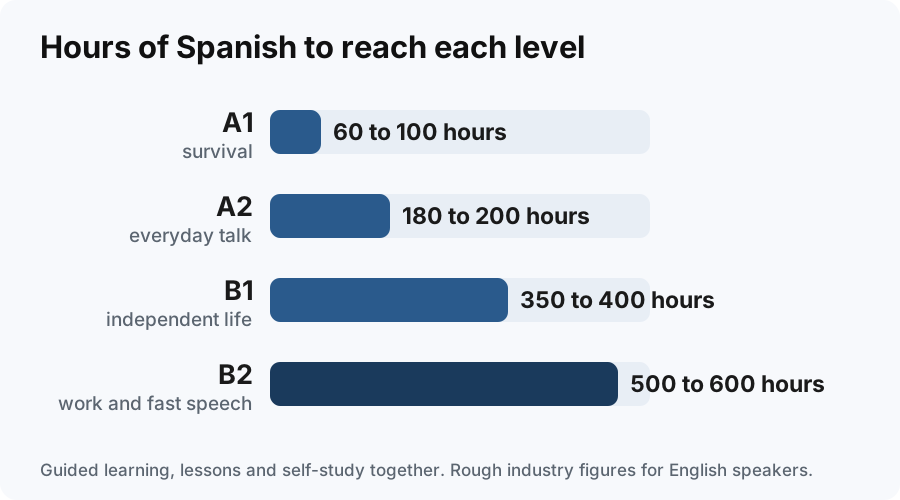
Turn that into weeks. Two one-hour lessons a week plus twenty minutes of practice a day is roughly four and a half hours a week. On that schedule A1 takes about four to five months, A2 about ten months, B1 about a year and a half. If you live in Spain and use the language daily, cut those figures noticeably. If you study one hour a week with nothing in between, double them.
Anyone who promises fluency in three months is selling the first three months.
What makes the timeline shorter:
- Regularity over intensity. Twenty minutes every day beats three hours on Sunday. Memory needs the gaps.
- Speaking early. The people who speak from week one reach conversation level months before the people who "want to learn the grammar first".
- Listening a lot. Half an hour of Spanish audio a day, even in the background while you cook, trains the ear faster than any exercise.
- One teacher, one thread. Jumping between five apps and three courses feels productive and is not. Pick a spine and add extras around it.
- A reason with a date. A trip in June, a meeting in October, an exam in November. A deadline does more than motivation.
What makes it longer: waiting until you feel ready to speak, studying only by reading, changing method every month, and taking the whole summer off.
A realistic first three months for a busy adult looks like this. Month one: sounds, survival sentences, yourself, basic questions. Month two: the present tense, daily routine, shopping and ordering, numbers and times, first short conversations. Month three: plans (voy a plus a verb), likes and dislikes, describing people and places, a first past tense. At the end you can hold a slow five-minute conversation about your life. It is not fluency. It is the point where Spanish stops being a subject and starts being something you use.
Lessons in Spanish: should the class be taught entirely in the language
Many people search for "lessons in Spanish", and it can mean two things: lessons that teach Spanish, or lessons taught in Spanish from the first minute. The second is a real question, and schools argue about it.
The case for full immersion is strong. Every minute of the lesson is listening practice. You stop translating in your head sooner. You learn the classroom language, ¿cómo se dice?, otra vez, no entiendo, simply by needing it. With a skilled teacher who uses gesture, pictures and simple words, a complete beginner can follow an hour of Spanish, and it is a small thrill when you notice that you did.
The case against it, for adults, is also strong. An adult beginner in a Spanish-only lesson often understands the activity but not the explanation. Twenty minutes go on miming the difference between two past tenses that one English sentence would have settled. And when you are tired after work and lost in the first five minutes, you do not think "wonderful, immersion". You think "I am not good at this", and that thought ends more courses than any grammar point.
What works for most adult beginners is a sensible mixture:
- Spanish for everything that can be said in Spanish. Greetings, instructions, questions, practice, small talk. That is most of the lesson, and the share grows every month.
- English for the two-minute explanation. Why the verb changed. What the difference is. What that word your landlord keeps saying means. A short, clear explanation in your own language, and then straight back to Spanish.
- A steady move towards all Spanish. By A2 the explanations themselves are in Spanish. By B1 English has left the room.
This is why it matters whether a native teacher can explain in English. A native speaker gives you the real sounds, rhythm and usage of the language. A teacher who also speaks your language can catch the exact moment you are lost and fix it in one sentence instead of ten minutes. For an English-speaking adult beginner, a qualified native teacher who can step into English when needed is close to the ideal: you get the accent and the explanation.
If you are already past the beginner stage, the answer changes. From a solid A2 onwards, ask for lessons entirely in Spanish and resist the urge to check things in English. The discomfort is the training.
English to Spanish translation: why a translator will not teach you
Look at what people search for around this topic and one thing stands out. The translation searches ("English to Spanish", "translate English to Spanish", "Spanish to English translation") are by far the largest. More people ask a machine to turn a sentence into Spanish than ask how to learn the language.
That is reasonable. A translation app on your phone is a wonderful tool, and anyone living in Spain should have one. Use it for a rental contract, a letter from the tax office, a medicine leaflet, the menu in a village restaurant. Understanding a text you have time to read is exactly what it is for.
It is worth knowing what it cannot do, because many people stay at the translator stage for years.
It does not work at the speed of conversation. By the time you have typed your sentence and held out the phone, the moment has gone. A pharmacist will wait. A group of colleagues at lunch will not.
It hides the choices Spanish makes you take. "You" is tú or usted, and picking wrongly is noticed. "I was" is era, estaba or fui, and they mean different things. A translator chooses one silently, and you never learn there was a choice.
It translates words, not situations. Type "I'm excited to meet you" and you may get estoy excitado, which in Spanish suggests something quite different from enthusiasm. Type "I'm embarrassed" and a careless guess gives embarazada, which means pregnant. These are the famous ones. The quiet ones, where the sentence is correct and simply not what anyone would say, are far more common.
It answers, so you never remember. Looking a word up six times is not the same as learning it. The effort of pulling a word out of your own memory is what fixes it there, and a translator removes that effort.
It cannot listen for you. The other half of a conversation is understanding the reply, in a real accent, at real speed, with a coffee machine in the background.
The useful way to combine the two: translate to understand, learn to speak. And when you do use a translator for something you want to say, do not just read the result off the screen. Say it aloud twice, notice how it is built, and next time try before you type. That turns a crutch into a tutor of sorts.
One-to-one or group: which Spanish lessons to choose
Once you have decided on live lessons, the last practical choice is between a private teacher and a group.
One-to-one lessons suit you if you have a deadline, an irregular timetable, a specific need (medical Spanish, a job interview, a citizenship exam), or if you know you will not speak in front of strangers. You talk for most of the lesson, the pace is exactly yours, and a missed week does not leave you behind. The price per hour is higher, and the progress per hour is also higher.
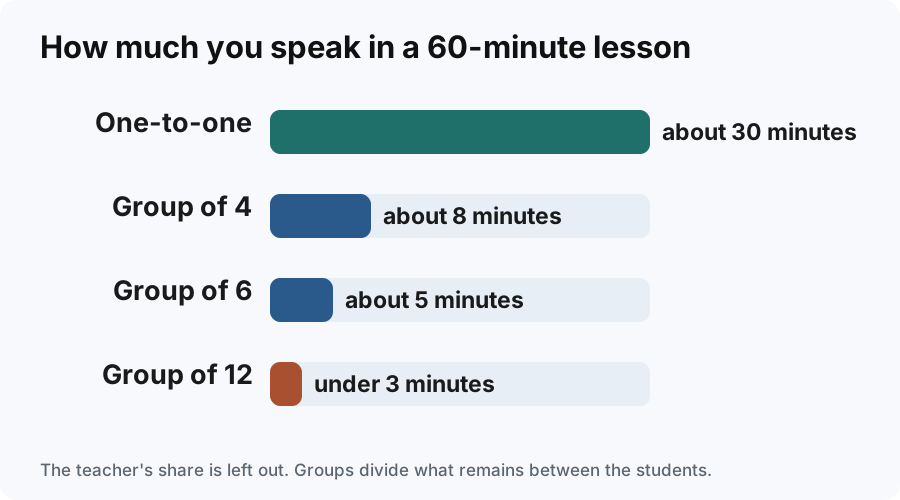
Group lessons suit you if you like company, want a fixed weekly rhythm and are comfortable at an average pace. A good group has no more than six people. Above that, the arithmetic turns against you: in a sixty-minute class of twelve, your share of the speaking is under five minutes.
Whichever you choose, check four things before you pay:
- Who teaches. A native speaker is not automatically a teacher. Ask about qualifications: a teaching degree, or specific training in teaching Spanish as a foreign language.
- Whether there is a trial lesson. A free first lesson costs a serious school very little and tells you almost everything.
- What happens between lessons. Homework that gets corrected, notes from the lesson, something to listen to. A course that exists only during the lesson is half a course.
- How progress is measured. "You'll feel it" is not an answer. A level check every couple of months is.
Where to start this week
If you have read this far, you do not need more information. You need a first step small enough to take today.
- Tonight. Spend ten minutes on the five Spanish vowels and the three rescue sentences from the beginner section.
- Tomorrow. Watch one slow video and say five sentences about yourself aloud.
- This week. Find out your real level, with a level test or, better, a short conversation with a teacher.
- This month. Fix two lesson times in your calendar and protect them like any other appointment.
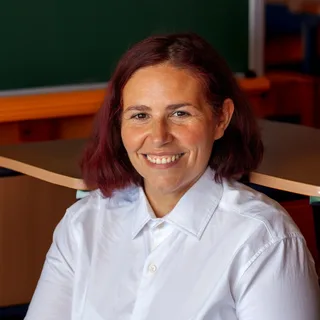
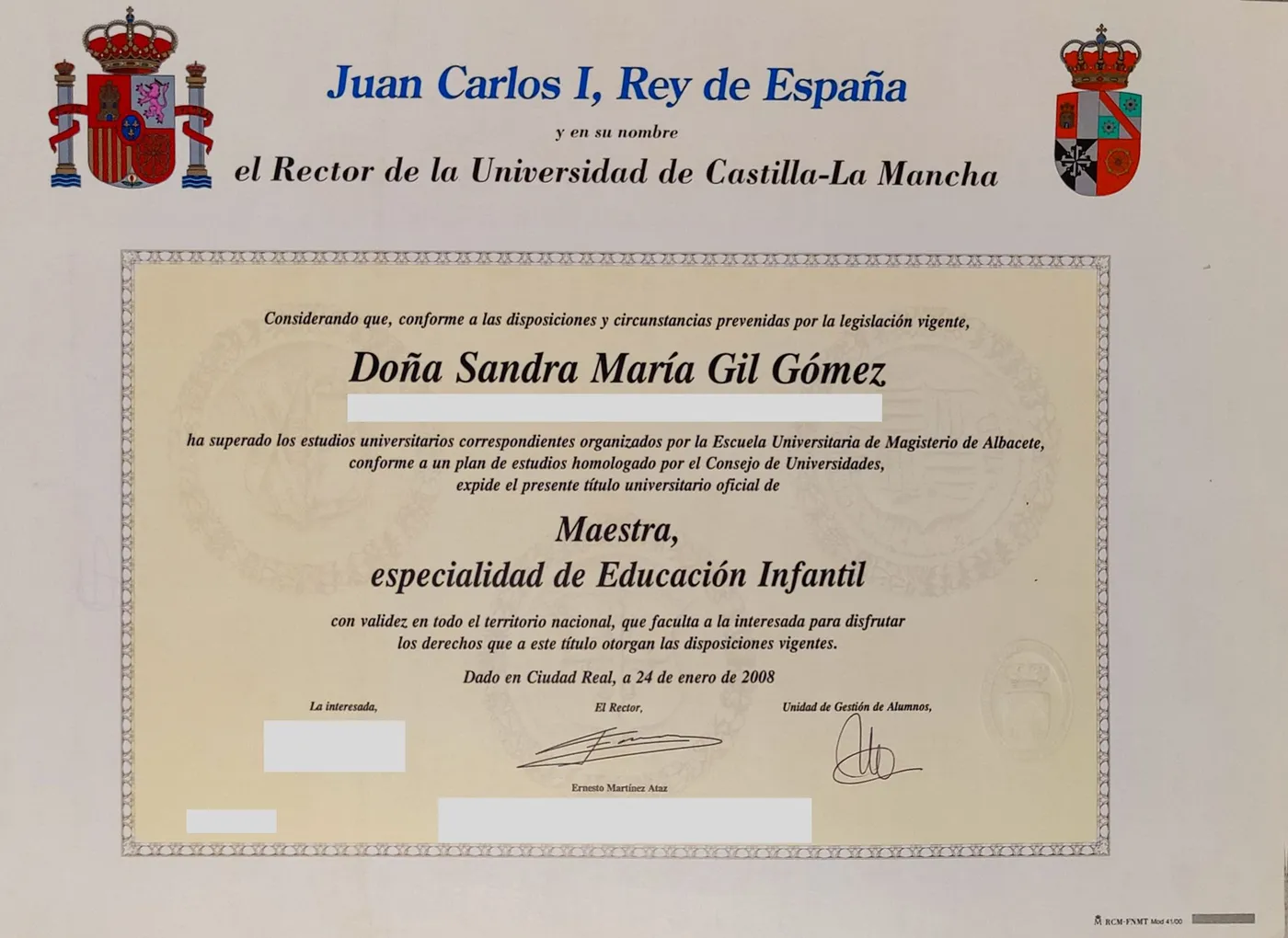
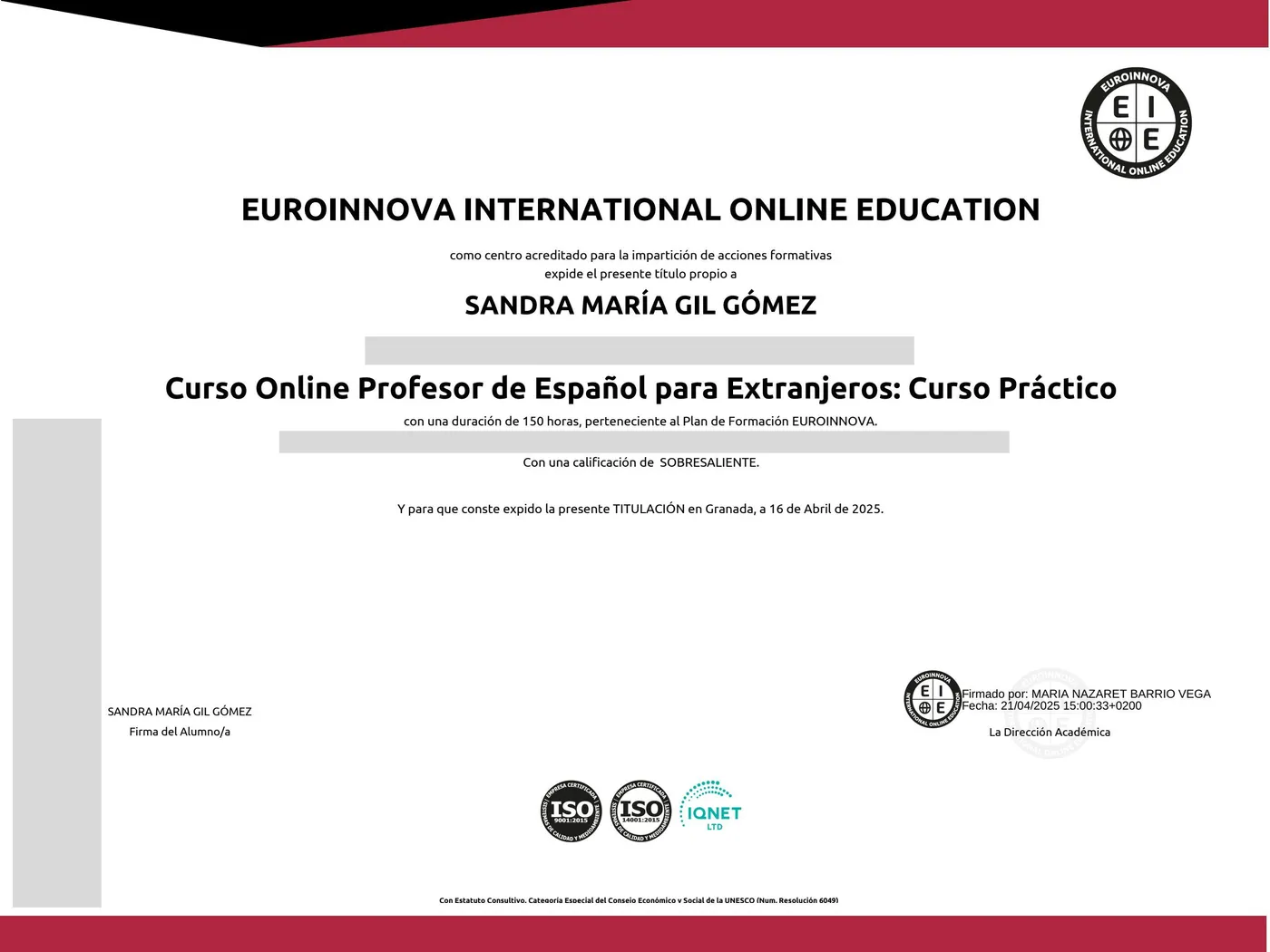
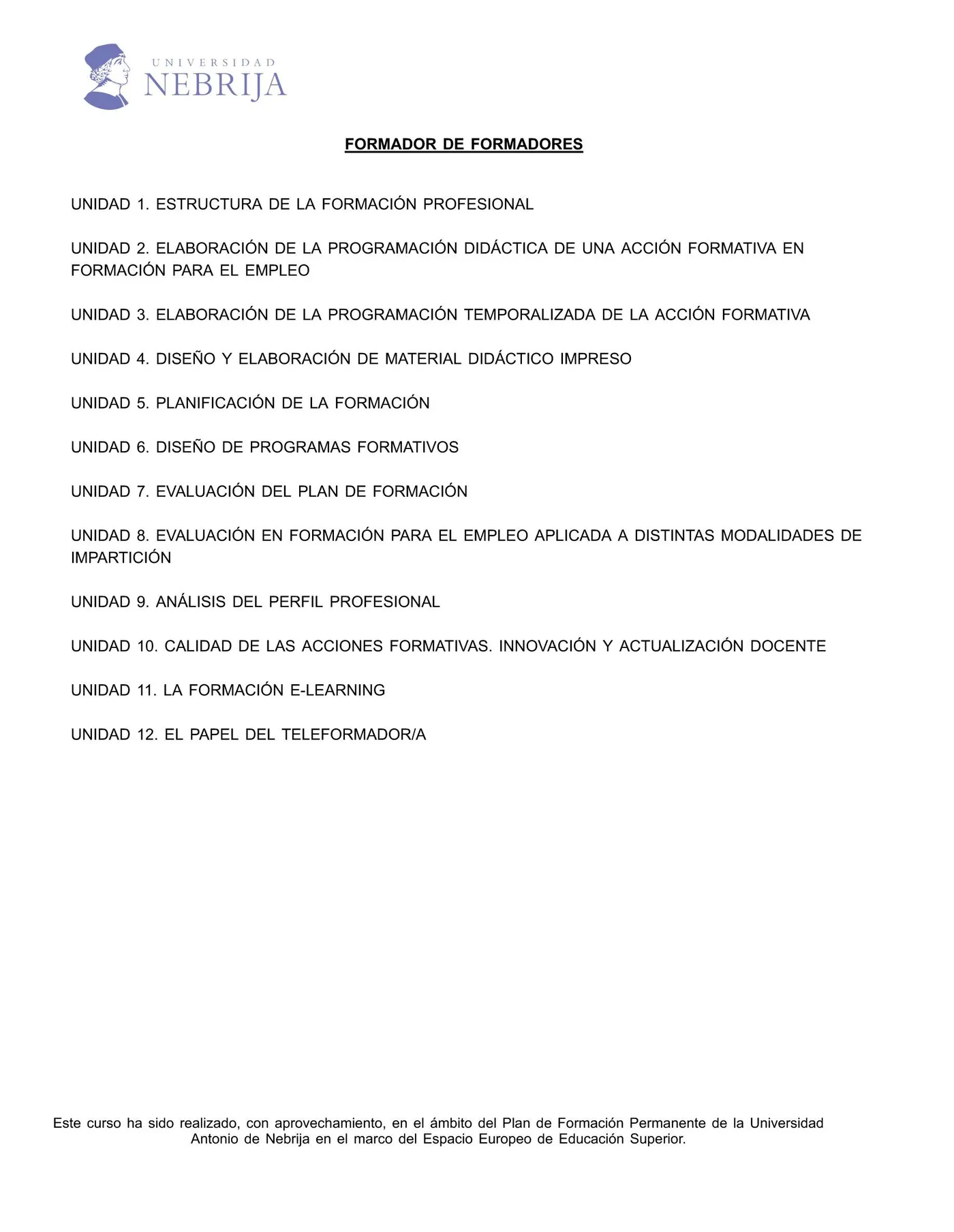
At ProLang the first lesson is free. It is a one-to-one session on Zoom with a native Spanish teacher from Spain who holds a state teaching degree and a separate qualification in teaching Spanish to foreigners. She speaks English, so nothing you need explained gets lost. In that lesson we find your level, hear what you need the language for, and tell you honestly how long it is likely to take. If the answer is that free resources are enough for you for now, we will say that too.
The best time to start was the holiday two years ago when you made the promise. The second best time is this week.
Frequently asked questions
Can adults really learn Spanish from scratch?
Yes. Adults usually progress faster than children in the first year because they can study on purpose and already know how a language works. What stops adults is rarely ability: it is lessons with no speaking in them and a schedule that is too heavy to keep.
Are online Spanish lessons as good as a class near me?
For most adults a live online lesson with a qualified teacher is as effective as a classroom and easier to keep up, because there is no journey. A local class is the better choice if you need a physical appointment to turn up, want the social side, or already live in Spain.
Can I learn Spanish with free lessons only?
You can reach a solid elementary level with free apps, audio courses and slow Spanish videos. Free resources stop at three things: nobody corrects your speech, nobody answers you at real speed, and nobody notices when you stop. Many learners combine free practice with one or two live lessons a week.
How long does it take an English speaker to learn Spanish?
With two lessons a week and about twenty minutes of practice a day, expect roughly four to five months for A1, around ten months for A2 and about a year and a half for B1. Living in Spain and using the language daily shortens this noticeably.
Should Spanish lessons for beginners be taught only in Spanish?
For adult beginners a mixture works best: Spanish for everything that can be said in Spanish, and a short explanation in English when a point of grammar would otherwise take ten minutes. The share of Spanish grows every month, and from A2 the lesson can be entirely in Spanish.
How many Spanish lessons a week does an adult need?
Two lessons a week plus about twenty minutes of practice a day is a schedule most working adults can keep for six months, and keeping it matters more than intensity. One lesson a week with nothing in between roughly doubles the time each level takes.
Is a native Spanish teacher better for a beginner?
A native teacher gives you real pronunciation, rhythm and usage from the first lesson. For an adult beginner the best combination is a qualified native teacher who can also explain a point in English when you are stuck, so no lesson time is lost.
Book your free trial lesson
One to one with a native teacher, on Zoom.
Times shown in your zone: Europe/Madrid
Loading the timetable…
3. Your email for the confirmation and the Zoom link
One-to-one lessons with a native teacher
On Zoom with a qualified teacher from Spain who also speaks English.