CCSE and DELE A2: the two exams for Spanish nationality

The gestoría hands you the list for your nationality file: birth certificate, criminal record, padrón, a clean sheet from Hacienda. Two lines on it are not documents you can request. CCSE and DELE A2 are exams, and no number of years in Spain replaces them.
Both are run by the Instituto Cervantes: you register on its website and sit them at accredited centres. No academy certificate or app substitutes for either.
Two exams, two different things
CCSE - Conocimientos Constitucionales y Socioculturales de España - is a knowledge test: how the country is governed, your rights and obligations, plus history, geography and everyday culture. It is written in Spanish and takes under an hour.
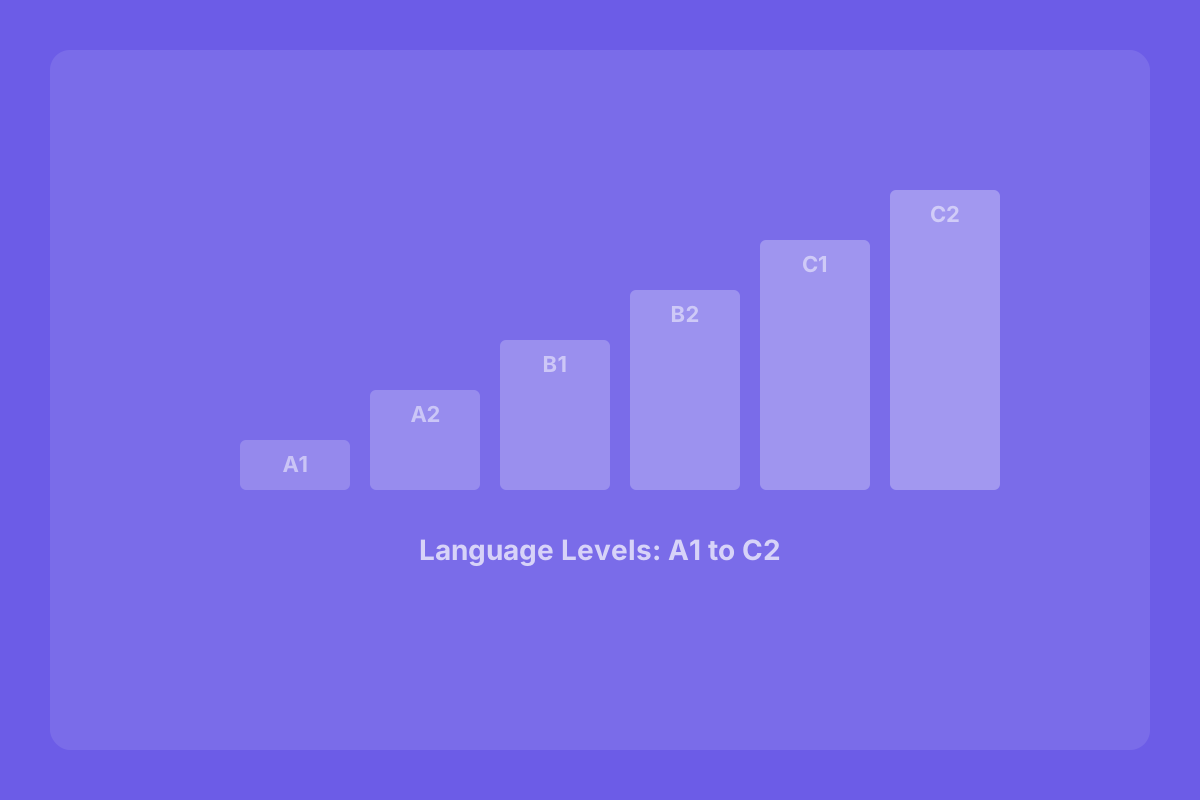
DELE A2 is the language proof: the ordinary A2 exam, the same one everyone else sits. A2 is the minimum, and a higher DELE counts too - a B1 or B2 already closes this half.
Who does not sit DELE
Nationals of countries where Spanish is an official language are exempt from the language exam: the Spanish-speaking countries of Latin America, and Equatorial Guinea. A Colombian, Argentinian or Cuban passport takes DELE off your list.
A Spanish school or university qualification can also exempt you; minors follow a different route. Confirm with your Registro Civil before paying for anything.
The exemption covers DELE only. Everyone sits CCSE. And since CCSE is written in Spanish, a weak level turns the knowledge test into a language test as well.
What is inside CCSE
Twenty-five questions on an answer sheet, in two blocks: government, legislation and citizen participation - the larger one - then culture, history and society. The result is apto or no apto, with no grade.
Every question comes from a manual the Instituto Cervantes publishes and updates, and the bank is public - nothing on the day is a surprise:
- ¿Cuántas comunidades autónomas hay en España? - How many autonomous communities does Spain have? (Seventeen, plus Ceuta and Melilla.)
- ¿En qué año se aprobó la Constitución española? - When was the Spanish Constitution approved? (1978.)
- ¿Cómo se llama el parlamento español? - What is the Spanish parliament called? (Las Cortes Generales.)
- ¿Dónde se solicita el certificado de empadronamiento? - Where do you request proof of address? (En el ayuntamiento.)
- El voto en España es obligatorio: ¿verdadero o falso? - Is voting compulsory in Spain? (No.)
Work through the manual out loud: you are reading Spanish either way.
What DELE A2 consists of
Four tests in two groups.
Group 1 - reading and writing. Comprensión de lectura: notices, adverts, emails, a blog post, with matching and multiple choice - the longest test, around an hour. Expresión e interacción escritas: two short texts - one practical (a form, a reply), one personal (your day, your plans, a trip).
Group 2 - listening and speaking. Comprensión auditiva: announcements, voice messages, short conversations, each played twice. Expresión e interacción orales: with an examiner, after preparation time - a monologue, a photo to describe, a role play where you book, ask or sort something out.
You must reach the minimum in each group: strong reading does not rescue a weak oral. Task counts and timings are in the exam specifications on the Instituto Cervantes site.
What A2 means in practice
Not "conversational Spanish". A2 is the level at which you run the ordinary business of your own life - these, without rehearsing:
- Llevo cuatro años viviendo en Valencia. - I've lived in Valencia for four years.
- Trabajo de camarera en un restaurante del centro. - I work as a waitress in the centre.
- Quería pedir cita con el médico de cabecera. - I'd like an appointment with my GP.
- Me duele la espalda desde hace una semana. - My back has hurt for a week.
- Vengo a recoger un certificado, tengo cita a las diez. - I've come for a certificate, my appointment is at ten.
- Perdone, ¿me lo puede repetir más despacio? - Sorry, can you repeat that more slowly?
- No entiendo esta palabra. ¿Qué significa? - I don't understand this word. What does it mean?
- Mi hijo está en tercero de primaria. - My son is in year three.
- ¿Cuánto cuesta el abono mensual del autobús? - How much is the monthly bus pass?
- Quiero devolver esta camisa, es demasiado pequeña. - I want to return this shirt, it's too small.
- No he traído el pasaporte, ¿puedo enviarlo por correo electrónico? - I haven't brought my passport, can I email it?
- El año pasado fuimos a Granada en agosto. - Last year we went to Granada in August.
- Los fines de semana comemos en casa de mis suegros. - At weekends we eat at my in-laws'.
- Voy a empezar un curso de español en septiembre. - I'm starting a Spanish course in September.
- Estoy aprendiendo español porque quiero solicitar la nacionalidad. - I'm learning Spanish to apply for nationality.
What A2 does not ask of you: the subjunctive, defending an opinion, or following four people talking at once in a bar.
How long preparation takes
From zero. Two lessons a week plus homework: six to nine months before you sit A2 with margin. Hours shorten that; willpower does not.
Years here, getting by. Shop, neighbours, school gate - all fine, but you never studied. Usually three to four months, almost all on writing and exam format; the speaking you already own.
Around B1. A few weeks of format work. Do not skip it: at B1 points go on answering a question the task did not ask.
CCSE. Two to six weeks with the manual, at any level, provided you read Spanish reasonably.
What order to sit them in
Start from the DELE calendar: fixed dates a few times a year, registration closing well before the exam. Everything else fits around it. CCSE sessions are far more frequent and the material finite, so many take that one first - a certificate in hand and a real deadline to work to. Check on the Instituto Cervantes site how long each certificate takes to issue, and file your application with room to spare.
If you fail one part
DELE keeps no partial passes: if one group falls below the minimum, you sit all four tests again at a later session. The second attempt is easier - you know the room, the clock and the tasks. For CCSE you register for a later session; the conditions are on the Instituto Cervantes site.
A fail also shows where the gap is. Points are rarely lost on vocabulary; they go on writing against a clock and on the fifteen minutes of speaking - practise exactly that, out loud, with someone who answers back.
Frequently asked questions
Is DELE A2 enough for Spanish nationality, or do I need B1?
A2 is the minimum level accepted for nationality by residence. A higher DELE diploma - B1, B2 or above - also counts, so if you already hold one you do not need to sit A2 as well. Only DELE diplomas issued by the Instituto Cervantes serve this purpose.
Do Latin Americans have to take the CCSE exam?
Yes. The exemption for nationals of Spanish-speaking countries applies only to the DELE language exam. CCSE covers Spanish institutions, rights, history and culture, and everyone applying for nationality by residence sits it.
Can I take CCSE and DELE A2 on the same day?
They are separate exams with separate registrations and separate calendars, and the dates rarely fall together. Check both calendars on the Instituto Cervantes site and plan them as two appointments, usually a few weeks or months apart.
What happens if I fail the speaking part of DELE A2?
DELE does not keep partial passes. If the group containing listening and speaking falls below the minimum, you retake the entire exam - all four tests - at a later session. The result sheet shows which group failed, so you know what to work on.
Book your free trial lesson
One to one with a native teacher, on Zoom.
Times shown in your zone: Europe/Madrid
Loading the timetable…
3. Your email for the confirmation and the Zoom link
One-to-one lessons with a native teacher
On Zoom with a qualified teacher from Spain who also speaks English.