Language Proficiency Levels: From A1 to C2 Explained
You have just landed a job interview at a company you have been eyeing for months. The posting says "B2 level of English required." You stare at the screen and think: is that me? You took classes in school, you watch Netflix without subtitles sometimes, and you can order coffee in London without panicking. But does that make you a B2? Or are you still hovering around B1? And what do those letters and numbers even mean in the first place?
If you have ever felt confused by language levels, you are not alone. Millions of people around the world encounter these labels on job postings, university applications, visa forms, and language school brochures. Yet surprisingly few people understand what each level actually represents in practical, everyday terms. This guide will walk you through every stage of the Common European Framework of Reference for Languages, from the very first words you learn at A1 all the way to the near-native fluency of C2. By the end, you will know exactly where you stand, what each level lets you do in real life, and how to move forward.
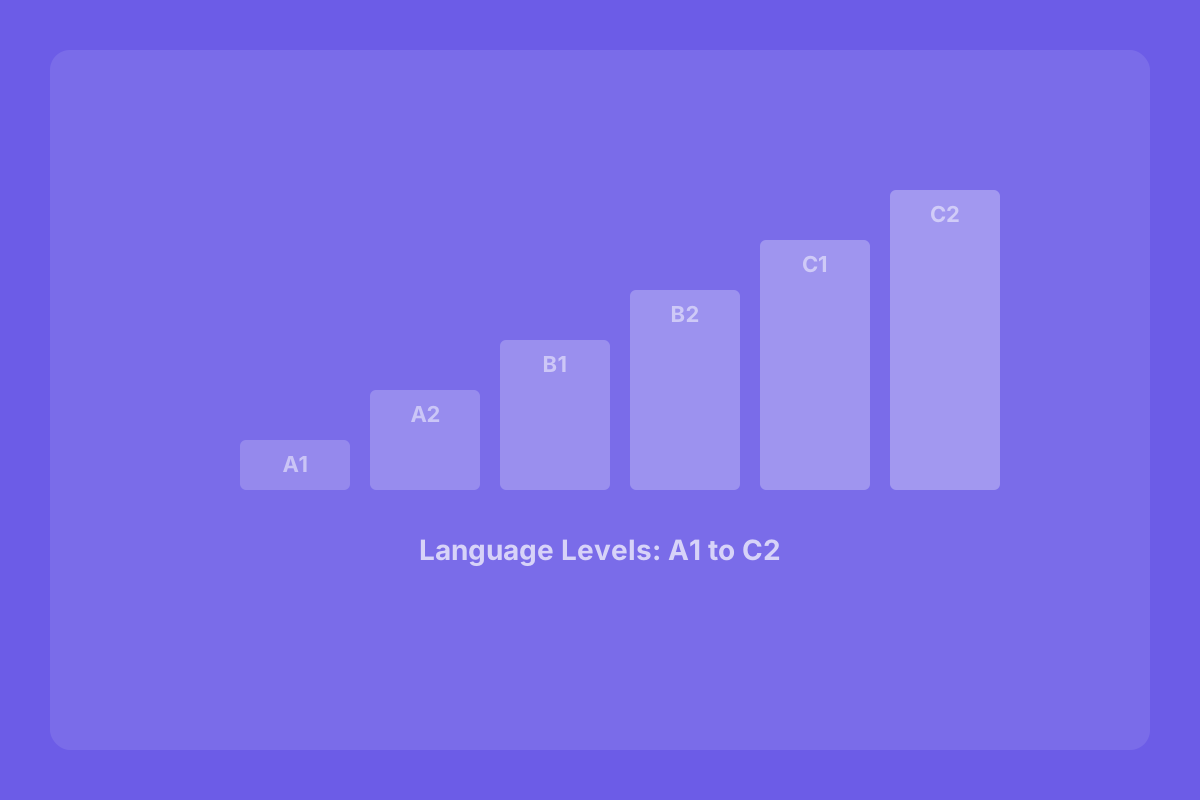
CEFR Language Levels Explained: A1 to C2
The Common European Framework of Reference for Languages, known as the CEFR, is a standardized system created by the Council of Europe in 2001. Its purpose was simple but ambitious: to provide a universal way of describing language ability that would work across borders, across languages, and across educational systems.
Before the CEFR existed, comparing language skills was a mess. A "Level 3" in one country's school system meant something completely different from a "Level 3" in another. Universities had their own scales, employers had vague requirements like "fluent" or "conversational," and nobody could agree on what those words actually meant. The CEFR changed all of that by establishing six clearly defined levels grouped into three broad bands.
The first band is A, which covers basic users. This includes A1 (Breakthrough) and A2 (Waystage). These are your starting points, where you go from knowing nothing to being able to handle simple, predictable situations.
The second band is B, which covers independent users. B1 (Threshold) and B2 (Vantage) represent a significant jump. At these levels, you can function independently in the language, handle unexpected situations, and express your own opinions with increasing sophistication.
The third band is C, which covers proficient users. C1 (Effective Operational Proficiency) and C2 (Mastery) are where the language becomes a fully functional tool. You can use it for academic work, professional purposes, and complex social interactions with ease.
One important thing to understand is that these levels apply to any language, not just English. Whether you are learning French, German, Spanish, Japanese, or Arabic, the CEFR framework describes your abilities in the same way. A B1 in Spanish represents roughly the same communicative competence as a B1 in German, even though the specific challenges of each language differ enormously.
The framework also breaks language ability into four skills: reading, writing, listening, and speaking. It is entirely normal to be at different levels in different skills. You might read French at a B2 level but speak it at B1, especially if you have learned primarily through books rather than conversation. This is why a thorough free assessment is so valuable. It gives you a clear picture of where each skill stands, rather than a single label that might not tell the whole story.
At ProLang, every student begins with a placement test that evaluates all four skills separately. This means your study plan targets your actual weak points rather than forcing you through material you have already mastered. It is one of the reasons the CEFR framework is so useful: it does not just label you, it gives you a roadmap.
What Can You Do at Each Language Level
Numbers and letters are abstract. What matters is what you can actually do with the language in real life. Let's walk through each level with concrete, everyday examples that will help you recognize where you are right now.
At A1, you are at the very beginning. You can introduce yourself, say where you are from, ask someone their name, and understand very slow, clearly spoken phrases. You can read simple signs, fill in a basic form with your name and address, and write a short postcard. Think of the tourist who has memorized a handful of phrases from a guidebook. You can survive, but only in the most predictable situations. Your vocabulary at this stage is roughly 500 to 600 words.
At A2, you can handle routine tasks. You can go shopping, order food at a restaurant, ask for directions, and understand short, simple messages. You can describe your family, your job, and your daily routine in simple terms. You can read short texts like menus, timetables, and simple personal letters. Imagine you are living abroad and can manage your daily errands without too much stress, but a conversation about politics or your feelings about a movie would still be out of reach. Your vocabulary has grown to around 1,000 to 1,200 words.
At B1, something important happens. You cross what linguists call the "threshold." You can deal with most situations that come up while traveling. You can describe experiences, events, dreams, and ambitions. You can give reasons and explanations for your opinions. You can understand the main points of clear standard speech on familiar topics like work, school, and hobbies. You can write simple connected text on topics that are familiar or of personal interest. This is the level where you stop being a tourist and start being a participant. Your vocabulary is approximately 2,000 to 2,500 words.
At B2, you become truly independent. You can interact with native speakers with enough fluency and spontaneity that the conversation flows naturally for both sides. You can understand the main ideas of complex text on both concrete and abstract topics, including technical discussions in your field. You can produce clear, detailed text on a wide range of subjects and explain a viewpoint on a topical issue, giving the advantages and disadvantages. This is often described as the "professional working proficiency" level. You can function effectively in a workplace that uses the language, attend meetings, write reports, and engage in professional networking. Your vocabulary reaches roughly 4,000 to 5,000 words.
At C1, the language becomes a flexible, powerful tool. You can express yourself fluently and spontaneously without much obvious searching for expressions. You can use the language effectively for social, academic, and professional purposes. You can produce clear, well-structured, detailed text on complex subjects, showing controlled use of organizational patterns, connectors, and cohesive devices. At this level, you rarely encounter a situation where your language skills hold you back. You can follow fast-paced conversations, understand implicit meanings, and pick up on humor, irony, and cultural references. Your vocabulary is approximately 6,000 to 8,000 words.
At C2, you have reached mastery. This does not mean you are identical to a native speaker. It means you can understand virtually everything you hear or read with ease. You can summarize information from different spoken and written sources, reconstructing arguments and accounts in a coherent presentation. You can express yourself spontaneously, very fluently, and precisely, differentiating finer shades of meaning even in the most complex situations. At this level, your vocabulary exceeds 10,000 words, and you have an intuitive grasp of the language's nuances, idioms, and register shifts.
To put this in perspective: most people who "studied English in school" for several years and then stopped using it actively are somewhere between A2 and B1. Those who use the language regularly at work typically land around B1 to B2. And those who have lived in the country or worked in the language for years often reach C1, though C2 remains rare even among long-term residents.
How Long Does It Take to Reach Each CEFR Level
This is the question everyone asks, and the honest answer is: it depends. Your starting point, the intensity of your studies, the quality of instruction, how much you practice outside of class, your native language, and even your age all play a role. However, the CEFR and various language institutes have published general guidelines that give you a realistic ballpark.
For A1, expect to invest approximately 60 to 100 hours of guided learning. For someone studying two to three hours per week, that translates to roughly four to six months. This is the "quick win" stage where progress feels rapid because everything is new, and every lesson gives you tools you can use immediately.
For A2, the cumulative total reaches about 180 to 200 hours. So after reaching A1, you need another 100 or so hours to get to A2. At a pace of two to three sessions per week, this takes another four to six months. Progress still feels encouraging because you are building on a foundation that grows more useful every day.
For B1, the total climbs to roughly 350 to 400 hours. This is where many learners hit their first serious plateau. The grammar becomes more complex, the vocabulary more abstract, and the "easy wins" of the beginner stage are behind you. Many people describe B1 as the level where learning starts to feel like real work. At ProLang, this is where our communicative method makes the biggest difference, because it keeps you engaged through real conversation rather than endless grammar drills.
For B2, you are looking at a cumulative 500 to 600 hours. The jump from B1 to B2 is one of the biggest in the entire framework. It is the difference between getting by and being genuinely comfortable. Many learners spend a year or more at B1 before breaking through to B2, which is perfectly normal. Consistent practice, exposure to authentic materials, and regular speaking practice are the keys to making this transition.
For C1, expect a total of roughly 700 to 800 hours. At this level, progress becomes harder to measure because the gaps in your knowledge are more scattered and subtle. You might be perfectly fluent when discussing your work but stumble when talking about philosophy or medicine. Targeted practice and exposure to a wide range of topics become essential.
For C2, the total reaches approximately 1,000 to 1,200 hours, and many learners find that no amount of classroom instruction alone will get them there. Reaching C2 typically requires extensive immersion, whether through living in the country, working in the language daily, or consuming vast quantities of authentic media. This is the level where reading literature, watching films without subtitles, and engaging in debates about abstract topics become your primary learning tools.
Keep in mind that these estimates assume quality instruction and regular practice. Self-study with poor materials might take twice as long. Intensive immersion programs can cut the time dramatically. A student at ProLang who takes three group classes per week plus one private session and practices daily at home will progress significantly faster than someone who attends a single weekly class and does nothing between sessions.
Another factor that matters enormously is the distance between your native language and the language you are learning. An English speaker learning Dutch or Swedish will progress faster than the same person learning Mandarin or Arabic, simply because of shared vocabulary, grammar structures, and cultural context. The hour estimates above are general averages that assume a moderate degree of linguistic distance.
A1 and A2: The Beginner Stages
The beginner stage is where everything starts, and it is arguably the most exciting part of the journey. Every single lesson gives you something new you can use in real life. After your first week, you can greet people. After your first month, you can introduce yourself, talk about your family, and count to a hundred. The sense of progress is intoxicating.
At A1, your world in the new language is small but growing. You learn the present tense, basic question words, numbers, colors, family members, and common everyday objects. You can understand very simple sentences, especially when the speaker talks slowly and is willing to repeat things. Written texts at this level include signs ("Exit," "Open," "Closed"), simple forms, and short messages like "See you at 3."
A typical A1 student can walk into a shop in the target country and buy bread. They can check into a hotel, ask where the bathroom is, and tell a taxi driver an address. They cannot, however, have a real conversation. Interactions at this level are transactional: you give information, you receive information, and that is about it.
At A2, the world expands significantly. You start learning the past tense, which unlocks the ability to talk about what happened yesterday, last week, or last year. You can describe your home, your neighborhood, and your job. You can understand and use common expressions related to shopping, local geography, and employment. Reading becomes more functional: you can understand restaurant menus, train schedules, and short newspaper articles about familiar topics.
The A2 student can do more than survive. They can have short conversations about familiar topics, understand the gist of a simple phone call, and write a short email or message. Imagine an A2 speaker at a dinner party: they can follow along when the conversation is about simple, everyday topics, but they get lost when it shifts to something unfamiliar or abstract. They smile and nod a lot.
One of the biggest challenges at the beginner stages is managing expectations. Many adults come to language learning with the assumption that progress should be linear and fast. In reality, the first hundred words come quickly, but each subsequent hundred takes a bit longer. Grammar rules that seemed simple at first start developing exceptions and complications. And speaking, which is the skill most people care about most, tends to lag behind reading and listening because it requires you to produce language under time pressure.
ProLang's beginner courses are designed with this psychology in mind. Lessons at the A1 and A2 levels focus heavily on practical communication. You practice ordering coffee, asking for directions, making phone calls, and introducing yourself, not because these are the most linguistically interesting topics, but because they are the situations you will encounter first and most often. Early success in real situations builds the confidence that keeps you going through the harder stages ahead.
A practical tip for beginners: label things in your house with sticky notes in your target language. Your refrigerator, your door, your mirror, your desk. This simple trick exposes you to vocabulary dozens of times a day without any effort. Also, change the language settings on your phone. It is uncomfortable for the first few days, but you will be amazed at how quickly you learn words like "settings," "notifications," and "battery low."
Another strategy that works remarkably well at the beginner stage is focusing on high-frequency words. In any language, the 100 most common words account for roughly 50% of everyday speech. The top 1,000 words cover about 85% of casual conversation. By targeting these high-frequency words first, you maximize your comprehension in the shortest possible time. Most A1 and A2 courses at reputable language schools are already built around this principle, but it is worth being intentional about it in your self-study as well.
B1 and B2: The Intermediate Breakthrough
If you have made it to B1, congratulations. You have crossed a major threshold. But now comes the hard part. The intermediate levels are where most language learners get stuck, and there is even a name for it: the intermediate plateau.
At B1, you can handle most situations that arise while traveling in a region where the language is spoken. You can enter a conversation about topics that are familiar, personally interesting, or related to everyday life such as family, hobbies, work, travel, and current events. You can describe experiences, events, dreams, hopes, and ambitions. You can briefly give reasons and explanations for opinions and plans.
Here is what B1 looks like in practice. You are at a dinner party with native speakers. You can follow the main thread of conversation, contribute your own stories and opinions, and ask follow-up questions. But when the conversation gets fast, when people talk over each other, when someone tells a joke that relies on a play on words, you miss things. You can express your ideas, but you sometimes feel like you are driving with the parking brake on. The thoughts are there, but getting them out in the right order with the right words takes effort.
At B2, the parking brake comes off. You can interact with a degree of fluency and spontaneity that makes regular interaction with native speakers quite possible without strain for either party. You can understand the main ideas of complex text, including technical discussions in your field of specialization. You can produce clear, detailed text on a wide range of subjects.
B2 is often considered the "sweet spot" for practical purposes. At this level, you can work in the language, study at a university, watch movies without subtitles (most of the time), and read novels (with occasional dictionary checks). Many employers who require a second language are satisfied with B2. Many universities accept B2 as sufficient for enrollment.
The jump from B1 to B2 is, for many learners, the hardest transition in the entire framework. Why? Because at B1, you already know enough to communicate. The motivation to push further can wane because you can already "get by." The grammar at B2 level involves nuances: subjunctive moods, conditional structures, passive voice in all tenses, reported speech. The vocabulary becomes more specialized and abstract. And the listening comprehension required at B2 means understanding natural-speed speech, not the slow, carefully enunciated recordings from your beginner textbooks.
To break through the intermediate plateau, you need strategies beyond the classroom. Here are some that work.
First, consume authentic media. At B1, start watching TV shows, listening to podcasts, and reading news articles in your target language. At B2, move to movies without subtitles, longer podcasts, and books. The key is to choose material that is just slightly above your current level, what linguists call "comprehensible input plus one."
Second, find conversation partners. Regular speaking practice with native speakers or advanced learners is essential at the intermediate levels. If you cannot find partners locally, online language exchange platforms connect you with speakers all over the world. At ProLang, our group classes are deliberately kept small to maximize speaking time for every student.
Third, start writing. Keep a journal in your target language. Write emails, social media posts, or short essays. Writing forces you to think about grammar and vocabulary in a way that speaking does not, because you have time to consider your choices and notice your mistakes.
Fourth, learn collocations and chunks rather than individual words. At the intermediate level, vocabulary learning should shift from single words to phrases and expressions. You do not just learn "make," you learn "make a decision," "make progress," "make an effort," and "make sense." This is how native speakers actually use the language, and learning these combinations makes your speech sound much more natural.
Fifth, get feedback on your errors. At the beginner level, communication is the goal, and errors are secondary. At the intermediate level, those fossilized errors, the mistakes you make so consistently that they feel natural, need to be addressed. A skilled teacher can identify your most common errors and help you correct them before they become permanent habits. This kind of targeted feedback is one of the biggest advantages of structured courses over pure self-study.
C1 and C2: Advanced and Mastery
Reaching C1 is a genuine achievement. At this level, you can use the language flexibly and effectively for social, academic, and professional purposes. You can produce clear, well-structured, detailed text on complex subjects. You can understand a wide range of demanding, longer texts and recognize implicit meaning. You do not need to search obviously for expressions and can use language flexibly and effectively.
What does C1 look like in daily life? You can follow a fast-paced group conversation with multiple native speakers, even when they interrupt each other and use slang. You can give a presentation at work, handle tough questions from the audience, and navigate heated discussions with colleagues. You can read a newspaper editorial and not only understand the argument but also detect the writer's bias and rhetorical techniques. You can write a detailed report, a persuasive essay, or a formal complaint letter with appropriate register and structure.
At C1, people sometimes mistake you for a native speaker, at least briefly. You still have an accent, you still make occasional grammatical mistakes, and there are still cultural references you do not catch. But your communication is effective, nuanced, and appropriate for virtually any situation.
C2 is the summit. The CEFR describes it as the ability to "understand with ease virtually everything heard or read" and to "express himself/herself spontaneously, very fluently and precisely, differentiating finer shades of meaning even in the most complex situations."
Let's be honest about what C2 is and what it is not. C2 does not mean you are indistinguishable from a native speaker. It does not mean you know every word in the dictionary. It means you have mastered the language to the point where it is a fully functional tool for any purpose. You can read academic papers, understand stand-up comedy, write poetry, negotiate contracts, and argue philosophy, all in your second language.
Very few learners reach C2 through classroom instruction alone. It typically requires years of immersion, extensive reading across many genres and disciplines, and constant engagement with the language in its most demanding forms. At ProLang, our advanced courses are designed to support the C1 to C2 journey through intensive discussion seminars, academic writing workshops, and exposure to a wide range of authentic materials from different fields and registers.
One important distinction between C1 and C2 is the concept of "productive range." A C1 speaker can handle any common situation effectively, but might struggle with highly specialized or unusual contexts. A C2 speaker has such a broad command of vocabulary, idiom, and register that they can adapt to virtually any communicative situation, from casual banter to formal debate, from technical writing to creative expression.
For most practical purposes, including work, study, and immigration, C1 is more than sufficient. C2 is typically pursued by translators, interpreters, academics, writers, and individuals who want to achieve the highest possible command of the language for personal or professional reasons. If your goal is to function effectively in a multilingual workplace, conduct research, or integrate fully into a new country, C1 should be your target.
That said, the journey from C1 to C2 is one of the most rewarding in all of language learning. It is the stage where you stop seeing the language as a skill you have learned and start experiencing it as a part of who you are. Words carry emotional weight. Humor lands naturally. You dream in the language. That transformation is something no test score can fully capture, but it is profoundly real for those who experience it.
How to Test Your Current Language Level
Knowing your level is the first step toward improving it, but how do you actually find out where you stand? There are several approaches, ranging from quick online tools to formal examinations.
The simplest option is an online placement test. Many language schools and educational platforms offer free tests that give you a rough estimate of your CEFR level. These tests typically assess grammar, vocabulary, and reading comprehension. They take 15 to 30 minutes and provide an instant result. They are useful as a starting point, but they have limitations: most online tests cannot assess speaking or listening skills, which are often the skills that matter most.
A more thorough option is a professional placement test administered by a language school. At ProLang, our free assessment includes a written component and a spoken interview with a qualified teacher. This gives you a much more accurate picture because it evaluates all four skills, reading, writing, listening, and speaking, and identifies specific strengths and weaknesses within each one.
For official purposes, such as university admissions, visa applications, or professional certification, you will need a formal language examination from a recognized testing body. These exams are standardized, internationally recognized, and provide a certificate that proves your level. We will cover the specific exams in the next section.
There is also the self-assessment approach. The Council of Europe publishes a self-assessment grid that describes what you "can do" at each level in each skill. You can find this grid on the Council of Europe's website. Reading through the descriptors and honestly evaluating your own abilities can give you a surprisingly accurate result, especially if you have experience using the language in real-life situations.
A few practical self-assessment questions can help you roughly place yourself. Can you watch a news broadcast in your target language and understand the main stories? If yes, you are probably at least B1 or B2. Can you read a novel in the language and enjoy it without constantly checking a dictionary? That suggests B2 or C1. Can you give a 15-minute presentation on a complex topic with no preparation? That is likely C1 or above.
The key with self-assessment is honesty. Most people tend to overestimate their speaking and writing skills and underestimate their reading and listening skills. An objective assessment from a qualified teacher remains the most reliable option, which is why ProLang offers free placement evaluations for all prospective students.
If you have been away from the language for several years, be prepared for a result that is lower than what you remember. Language skills, especially speaking and listening, deteriorate without regular use. The good news is that reactivating dormant skills is much faster than learning from scratch. Your brain has not deleted the information; it has just filed it away in a harder-to-reach drawer.
CEFR Levels and International Exams
The CEFR framework is the common reference point, but each language has its own family of recognized exams. Understanding how these exams map to CEFR levels is essential if you need a certificate for work, study, or immigration.
For English, the major exams include the Cambridge suite, IELTS, and TOEFL. The Cambridge exams are directly aligned with CEFR levels. KET (Key English Test) corresponds to A2. PET (Preliminary English Test) corresponds to B1. FCE (First Certificate in English) corresponds to B2. CAE (Certificate in Advanced English) corresponds to C1. And CPE (Certificate of Proficiency in English) corresponds to C2. Each Cambridge exam gives you a score that maps to a specific CEFR level, even if you score slightly above or below the target level of the exam.
IELTS uses a band score from 0 to 9. The approximate CEFR mapping is: band 4 to 4.5 corresponds to B1, band 5 to 6 corresponds to B2, band 6.5 to 7.5 corresponds to C1, and band 8 to 9 corresponds to C2. IELTS is the most widely accepted English exam for immigration and university admissions in the UK, Australia, Canada, and New Zealand.
TOEFL iBT scores range from 0 to 120. A score of 42 to 71 roughly corresponds to B1, 72 to 94 to B2, 95 to 113 to C1, and 114 to 120 to C2. TOEFL is predominantly used for university admissions in the United States and Canada.
For French, the DELF and DALF exams are the gold standard. DELF A1, A2, B1, and B2 correspond directly to those CEFR levels. DALF C1 and DALF C2 cover the advanced levels. These exams are recognized by the French Ministry of Education and are required for university enrollment in France, where most programs require at least a DELF B2.
For German, the Goethe-Institut offers the Goethe-Zertifikat series: Goethe-Zertifikat A1 (Start Deutsch 1), A2 (Start Deutsch 2), B1, B2, C1, and C2 (Grosses Deutsches Sprachdiplom). Additionally, the TestDaF exam is required for university admission in Germany, with its levels mapping roughly to B2 and C1. The telc exams are another widely recognized option, particularly for immigration and professional purposes.
For Spanish, the DELE (Diplomas de Espanol como Lengua Extranjera) exams are issued by the Instituto Cervantes and directly correspond to CEFR levels from A1 to C2. These are the most widely recognized Spanish proficiency certificates worldwide.
For Italian, the CILS (Certificazione di Italiano come Lingua Straniera) and CELI (Certificato di Conoscenza della Lingua Italiana) exams cover all CEFR levels. CILS is issued by the University of Siena, while CELI comes from the University of Perugia. Both are recognized for university enrollment, work permits, and residency applications in Italy.
When choosing an exam, consider your specific purpose. If you need a certificate for university admission, check which exams your target institution accepts. If you need it for immigration, verify the specific requirements of the country's immigration authority. If you need it for professional purposes, ask your employer or professional body which certificates they recognize.
ProLang offers targeted exam preparation courses for all major international exams. Our teachers are familiar with the format, timing, and scoring criteria of each exam, and they know the specific strategies that can make the difference between passing and failing. Many students find that even if they have the language skills for a particular level, they still benefit from exam-specific preparation because the test format itself requires practice.
Which Level Do You Need for Work, Study, or Immigration
This is where language levels stop being abstract and start having very concrete consequences. Different countries, universities, and employers have specific CEFR requirements, and knowing what you need before you start studying can save you months of unfocused effort.
For immigration purposes, requirements vary significantly by country and visa type. Germany requires B1 for naturalization (citizenship) and A1 for a spouse visa. The Netherlands requires A2 for the civic integration exam (inburgeringsexamen). The United Kingdom requires B1 in English for settlement (indefinite leave to remain) and A1 or A2 for certain family visas. Canada's Express Entry system awards points based on CLB (Canadian Language Benchmarks) levels, which map to CEFR, with higher levels earning significantly more points. Australia uses IELTS scores for its skilled migration program, with most visa subclasses requiring a minimum of IELTS 6.0 (B2). France requires B1 for naturalization through the TCF (Test de Connaissance du Francais) or TEF (Test d'Evaluation du Francais).
For university study, the requirements are generally higher. Most French universities require DELF B2 or equivalent for undergraduate programs and C1 for graduate programs. German universities typically require TestDaF level 4 (roughly B2 to C1) or DSH-2 for degree programs. Universities in the United Kingdom usually require IELTS 6.0 to 7.0 (B2 to C1) depending on the program, with more demanding courses like law, medicine, and journalism often requiring 7.0 or higher. In the United States, most universities require TOEFL iBT scores of 80 to 100 (B2 to C1), with top institutions often setting the bar at 100 or above. Spanish-speaking universities typically require DELE B2 for undergraduate enrollment.
For work, the requirements depend heavily on the industry and position. Customer-facing roles in a foreign country typically require at least B2. Professional services such as consulting, law, and finance usually demand C1. Teaching positions in international schools often require C1 or C2 in the language of instruction. Healthcare professionals, including doctors and nurses, face some of the strictest requirements. In Germany, foreign doctors must pass a C1-level medical language exam. In the UK, healthcare professionals must demonstrate IELTS 7.0 (C1) in all four skills.
For international companies with English as a working language, B2 is usually the minimum for office-based roles, and C1 is preferred for management positions. Many multinational corporations use their own internal assessments, but these are typically benchmarked against the CEFR.
If you are planning a career move, a university application, or an immigration case, the most important thing you can do is check the exact requirements early. Do not assume. Do not rely on secondhand information. Go to the official website of the institution, the immigration authority, or the professional body and find the specific language requirement for your situation. Then build your study plan around reaching that level, with a buffer for safety.
At ProLang, our academic advisors can help you identify the exact requirements for your situation and build a study plan with a realistic timeline. Whether you need B1 for a residence application in Spain or C1 for a master's programme taught in Spanish, having a clear target and a structured path makes all the difference. Our courses are organized by CEFR level, so you can enter at whatever stage matches your current ability and work toward your specific goal.
How to Move Up from One Level to the Next
Knowing where you are and where you need to be is only the beginning. The real question is: how do you actually get there? Here are proven strategies for making progress at every stage.
Moving from A1 to A2 is usually the most straightforward transition. You are building on a fresh foundation, everything is new, and progress comes quickly with regular study. The key at this stage is consistency. Studying 30 minutes every day is far more effective than studying three hours once a week. Your brain needs regular exposure to form new neural pathways for the language. Use flashcards for vocabulary, listen to simple dialogues repeatedly, and practice basic conversations with a partner or teacher. Do not worry about making mistakes. At this level, communication matters far more than accuracy.
Moving from A2 to B1 requires a shift in approach. You have the basics, and now you need to start connecting them. This is where grammar becomes more important because you are learning to express more complex ideas: past events, future plans, hypothetical situations, and opinions with supporting reasons. Read simple texts like graded readers, children's books, or simplified news articles. Start listening to podcasts designed for language learners. And most importantly, start speaking as much as possible. The A2-to-B1 transition is where speaking practice makes or breaks your progress.
Moving from B1 to B2 is the hardest jump for most learners, and it is where many people get stuck for months or even years. The problem is not a lack of knowledge. It is a lack of depth. You know enough to communicate, but not enough to communicate well. Breaking through this plateau requires deliberate, targeted effort in several areas.
First, expand your vocabulary systematically. At B1, you know the most common 2,000 to 2,500 words. To reach B2, you need to roughly double that. Focus on academic vocabulary, professional terminology, and the abstract words that allow you to discuss ideas rather than just describe objects and actions. Learn synonyms and antonyms. Study word families (decide, decision, decisive, decisively). Read widely across different topics to encounter vocabulary in context.
Second, master the grammar of nuance. B2 grammar is not about learning new tenses. It is about using the ones you know more precisely and adding structures that allow you to express complex relationships between ideas: concessive clauses ("although," "even though"), conditional structures ("if I had known," "were it not for"), relative clauses with prepositions, and passive constructions. These are the structures that make the difference between "understandable" and "sophisticated."
Third, develop your listening skills through authentic materials. Stop listening to slow, clear recordings designed for learners and start listening to real people talking at normal speed. Watch news broadcasts, listen to radio shows, follow YouTube channels in your target language. The discomfort you feel when you cannot understand everything is a sign that you are pushing your limits, which is exactly what you need to do.
Fourth, write regularly and get feedback. Writing is the skill that forces you to be precise. When you speak, you can gesture, pause, and rephrase. When you write, every word has to carry its weight. Keep a journal, write emails, or participate in online forums in your target language. Then get a teacher or native speaker to review your writing and point out recurring errors and areas for improvement.
Moving from B2 to C1 requires immersion, whether real or constructed. At this stage, classroom instruction alone is rarely sufficient. You need to surround yourself with the language. Read books, not just articles. Watch entire TV series, not just clips. Listen to long-form podcasts and audiobooks. Have sustained conversations about complex topics. The goal is not just to understand the language but to think in it.
The strongest B2-to-C1 programmes combine intensive instruction with structured immersion activities. Students are assigned authentic reading and listening tasks, participate in debates and discussions on challenging topics, and receive detailed feedback on both their spoken and written production. The communicative method is central to our approach at every level, but at the advanced stages, it becomes absolutely essential because the only way to develop advanced communicative competence is through advanced communication.
Moving from C1 to C2 is a journey that takes years, not months. At this stage, improvement comes not from learning new rules but from deepening your understanding of the language's subtleties. Read literature: novels, poetry, essays. Study the history and culture of the language's speakers. Learn about register: the difference between formal and informal, written and spoken, technical and casual. Pay attention to collocations, idioms, and fixed expressions that native speakers use without thinking but that even advanced learners often miss.
One strategy that is remarkably effective at the advanced levels is translation. Translating texts from your native language into your target language (and vice versa) forces you to think about the differences between the two languages in a way that nothing else does. It reveals gaps in your vocabulary, exposes structural differences, and develops your sensitivity to style and register.
Another powerful technique is shadowing: listening to a native speaker and repeating what they say in real time, matching their speed, intonation, and rhythm. This practice improves pronunciation, listening comprehension, and fluency simultaneously. It is demanding, but the results are remarkable.
Finally, do not underestimate the value of a good teacher at the advanced levels. It is a common misconception that teachers are only necessary for beginners. In reality, advanced learners benefit enormously from a skilled teacher who can identify subtle errors, challenge them with complex tasks, and provide the kind of nuanced feedback that no app or self-study program can offer. A teacher who operates at C2 level themselves can show you the difference between good and excellent, between correct and natural, between understood and admired.
Whatever your current level, the most important thing is to keep going. Language learning is not a sprint. It is a long-distance journey with rest stops, scenic detours, and the occasional wrong turn. Every hour you invest brings you closer to your goal. Every conversation, every book, every film, every lesson adds another layer to your ability.
ProLang is here to support you at every stage of that journey. Whether you are taking your first steps at A1 or polishing your C2 skills, our experienced teachers, structured courses, and supportive learning community are designed to help you reach your goals efficiently and enjoyably. Start with a free assessment to find out exactly where you are today, and let's map out where you want to be tomorrow.
Frequently asked questions
How many hours does it take to reach B2?
Roughly 500 to 600 cumulative hours of guided learning from zero. The step from B1 to B2 is one of the hardest in the framework, and many learners spend a year or more at B1 before breaking through. Self-study with weak materials can double the time, while immersion shortens it, and languages close to your own go faster.
Can my speaking and reading be at different CEFR levels?
Yes, and it is very common. The CEFR describes reading, writing, listening and speaking separately, so someone who learned mainly from books may read at B2 but speak at B1. That is why an assessment covering all four skills tells you more than a quick online test, which usually checks only grammar, vocabulary and reading.
What IELTS score is equivalent to C1?
Approximately IELTS 6.5 to 7.5. Band 5 to 6 maps roughly to B2 and 8 to 9 to C2, while on TOEFL iBT C1 sits around 95 to 113. These conversions are approximate, so if a university or immigration authority names a specific score, go by its published requirement rather than a general table.
Is C1 enough, or do I need C2?
For most work, study and immigration purposes C1 is more than enough. C2 is mainly pursued by translators, interpreters, academics and writers, and it rarely comes from classroom lessons alone: it usually takes years of immersion and wide reading. Before choosing a target, check the exact requirement of the employer, university or authority you are dealing with.
Book your free trial lesson
One to one with a native teacher, on Zoom.
Times shown in your zone: Europe/Madrid
Loading the timetable…
3. Your email for the confirmation and the Zoom link
One-to-one lessons with a native teacher
On Zoom with a qualified teacher from Spain who also speaks English.