Spanish lessons for kids: ages, online classes and school in Spain

It is a Tuesday in October, six weeks into the first term. Your eight-year-old, who talked non-stop at her old school, comes out of the gate in Málaga and says the day was "fine". Her teacher tells you she is lovely and very quiet. At home there is a worksheet about los seres vivos that neither of you can read. She is not unhappy, exactly. She has simply stopped being the child who puts her hand up.
Or the picture is a different one. You live in Bristol or Boston, your partner's parents are in Seville, and your five-year-old looks blankly at his grandmother on video calls. Or there is no family reason at all: you just want your child to grow up with a second language while it is still easy.
Whichever picture is yours, you have probably searched for Spanish lessons for kids and found a wall of cartoon animals, apps with coins and promises of "fluency through fun". This guide is the plain version. It covers when to start, what lessons should look like at each age, whether online lessons work for children, how often is enough, how to choose a teacher, and what to do if your child is about to start school in Spain or is already there and struggling. It is written by a school that teaches children, so weigh the advice about paid lessons accordingly. The advice about what you can do at home costs nothing.
The short version: children do not absorb a language from the air. They learn it from people who talk with them, in situations that matter to them, often enough that nothing is forgotten in between. Good lessons arrange exactly that.
Spanish lessons for kids: how children learn differently from adults
An adult learns a language through explanation. Tell a grown-up that Spanish verbs change with the person and they will go and look for the pattern. Tell a six-year-old the same thing and you have lost them by the word "verbs".
Children learn a language the way they learned their first one: by hearing it in a situation they understand, guessing what it means, trying it out and being answered. That gives them real advantages and real limits.
The advantages are well known. Young children pick up pronunciation with an ease adults envy. They are not embarrassed by mistakes. They tolerate not understanding everything and keep going. And they have time: a child who starts at six has twelve years of school ahead in which the language can settle.
The limits are mentioned less often. Children learn more slowly than adults per hour of teaching in the first year, not faster. They forget quickly when contact stops: a summer without Spanish can wipe out a term. They cannot study on purpose until around nine or ten. And they will not work for a distant goal. "It will help your career" means nothing to a seven-year-old. "We are going to play shops" means everything.
So good Spanish lessons for kids look almost nothing like adult lessons:
- The language is inside an activity. A game, a song, a story, a drawing, a puppet who only understands Spanish. The child is busy with the activity and the language comes along with it.
- Short blocks. A five-year-old gives you five to eight minutes of attention on one thing. A lesson for that age is six small activities, not one long one.
- Lots of repetition that does not feel like repetition. The same twenty words come back in a song, then in a game, then in a story, then next week in a different game.
- Movement. Touch your nose, jump to the red card, find something azul in your room. Children remember what their bodies did.
- No grammar terms before about nine. They learn tengo and tienes by using them, the way Spanish children do.
- Understanding before speaking. Many children listen for weeks before they say anything. A good teacher does not push.
That last point worries parents more than anything else, so it gets its own section below.
What age should kids start Spanish lessons
The honest answer is that there is no deadline and no magic window, only different lessons for different ages.
Under three. Lessons as such make little sense. What works at this age is a person who speaks Spanish to the child regularly: a parent, a grandparent, a carer. Songs and picture books in Spanish help. A weekly class mostly teaches the parent.
Three to five. The age of Spanish Educación Infantil, and a lovely time to begin. Children this age learn through songs, rhymes, stories, puppets and play. A lesson is twenty to thirty minutes. Do not expect sentences after a month. Expect a child who sings the songs in the bath, knows colours, animals and numbers, and answers ¿cómo estás? without thinking. The real gain is the ear: sounds heard this early stay.
Six to eight. The first years of Primaria. Children can now follow a story, play games with rules, and start to read and write. Lessons of thirty to forty-five minutes work. Reading in Spanish comes easily to a child who already reads in English, because Spanish spelling is so regular. This is the age when speaking takes off if the child feels safe.
Nine to twelve. Children begin to enjoy patterns and can handle simple explanations: "we say la with this word and el with that one". They can do short homework alone. If the child is in a Spanish school, this is also when subject vocabulary becomes urgent, because the textbooks are suddenly dense.
Teenagers. They learn more like adults and can progress fast, but motivation is everything and embarrassment is back with force. One-to-one lessons often work better than groups. For a teenager entering Spanish secondary school, the academic language is the mountain, and it needs deliberate work.
The same ages at a glance:
| Age | How they learn | Lesson length | What to expect in the first months |
|---|---|---|---|
| 3 to 5 | Songs, rhymes, puppets, play | 20 to 30 minutes | Songs, colours, numbers, a trained ear |
| 6 to 8 | Stories, games with rules, first reading | 30 to 45 minutes | Short sentences, reading simple words |
| 9 to 12 | Patterns, short explanations, homework | 45 minutes | Conversations on familiar topics, subject words |
| Teenagers | Much like adults, with texts and tasks | 45 to 60 minutes | Fast progress if the motivation is theirs |
Two myths are worth clearing away. The first is that it is "too late" after seven, or ten, or twelve. It is not. Older beginners often catch up quickly because they can study on purpose. What they are less likely to get is a native accent, which matters much less than parents fear. The second is that a second language will confuse a young child or delay their speech. Research over several decades has not found this. Bilingual children may mix their languages for a while, which is normal and passes.
What a good Spanish lesson for kids looks like
If you sit in on a trial lesson, and you should, here is what to watch for.
The teacher speaks Spanish most of the time, and the child still understands. This is the central skill of teaching children. It is done with pictures, objects, gesture, a clear voice and short sentences. If the teacher translates every phrase, the child learns to wait for the English.
The child is doing something. Pointing, choosing, drawing, moving, singing, guessing. A child sitting still and repeating words after the teacher for twenty minutes is being drilled, not taught.
Activities change every few minutes for young children, a little less often for older ones, and each one uses the same small set of words.
The teacher is warm and unhurried. Children speak when they feel safe. A teacher who laughs with the child, waits through silences and celebrates a one-word answer gets sentences a month later.
There is a routine. The same hello song, the same goodbye, the same way of starting a game. Routine is what lets a child relax in a language they do not yet understand.
Mistakes are repaired gently. The child says yo tiene un perro. The teacher says "¡Ah, tienes un perro! Yo también tengo un perro" and carries on. The correct form has been heard twice and nobody was told they were wrong.
You get told what happened. After the lesson a parent should know what the child did, which words came up and what to do at home. If you never hear anything, you cannot help.
A typical forty-minute lesson for a seven-year-old might run like this. Hello song and how are you today, three minutes. A game with flashcards of food, hiding and guessing, seven minutes. A short story with pictures where the same food appears, eight minutes. Playing shops with the teacher as a very silly shopkeeper, ten minutes. Drawing your favourite meal and saying what is in it, eight minutes. Goodbye song and one thing to show Mum or Dad, four minutes. The child has heard and used the same fifteen words about thirty times each and thinks they played for most of an hour.
Useful first phrases for a child are the ones they need to act on the world:
- ¿Puedo ir al baño? Can I go to the toilet?
- No entiendo. I don't understand.
- ¿Me ayudas? Will you help me?
- ¿Puedo jugar? Can I play?
- Me toca a mí. It's my turn.
- No me gusta. I don't like it.
Online Spanish lessons for kids: do they work
Parents are often sceptical about putting a small child in front of a screen for a lesson, and the scepticism is healthy. Passive screen time teaches very little language. Studies of young children repeatedly find that they learn words from a live person who responds to them, and much less from a video that does not.
That is the key distinction. A live online lesson is not a video. It is a person who sees the child, answers them, waits for them and reacts to what they do. For language learning, that interaction is what counts, and it comes through a video call surprisingly well.
Online lessons for children work when:
- They are one-to-one or in a very small group. A child in a group of eight on Zoom disappears. One-to-one, the teacher's whole attention is on your child.
- They are short enough. Twenty to thirty minutes for five-to-seven-year-olds, up to forty-five or sixty for older children.
- The teacher uses the child's real world. "Show me something red." "Bring me your favourite toy." "What can you see from your window?" The best online teachers get children off the chair.
- The screen is shared for games, stories and drawing, not for worksheets.
- A parent is nearby for the little ones. Under six or seven, an adult in the room for the first lessons makes a great difference. You are not there to teach or translate, just to help with the mouse and to be a familiar face.
Online has a few clear advantages for families. No driving across town after school. A far wider choice of teachers, including qualified native teachers in Spain who specialise in young children, wherever you live. Easy to keep going through a house move or the summer. And because you are in the next room, you hear the lesson and know which song to sing at bedtime.
It has clear limits too. Children under four generally get more from a person in the room. Some children simply do not take to it, and you will know within two or three lessons. And it needs a quiet corner, a screen bigger than a phone, and no younger sibling climbing on the table.
A practical set-up: a laptop or tablet at the child's eye level, headphones if the house is noisy, paper and crayons within reach, and the lesson at a time of day when the child is not hungry or exhausted. Straight after school is usually the worst slot. After a snack and half an hour of play is much better.
How often should kids have Spanish lessons
With children, frequency beats length every time. Two lessons of thirty minutes do far more than one lesson of an hour, because a child forgets most of a lesson within a few days if nothing brings it back.
A reasonable rhythm:
| Child | Lessons a week | Length of each |
|---|---|---|
| Ages 4 to 6 | 2 | 20 to 30 minutes |
| Ages 7 to 10 | 2 | 30 to 45 minutes |
| Ages 11 and up | 2 | 45 to 60 minutes |
| Starting school in Spain soon, or struggling there | 2 or 3 | By age, until the pressure eases |
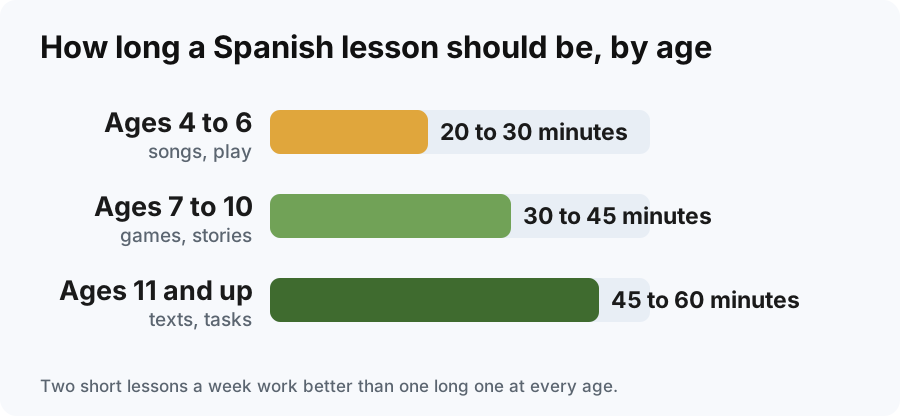
Between lessons, five or ten minutes a day of Spanish at home keeps the thread: a song in the car, a picture book at bedtime, a cartoon they already know, switched to Spanish. This matters as much as the lessons.
How fast will it go? It depends on how much Spanish the child hears in a week. A child with two lessons a week in an English-speaking country will, after a year, understand a good deal of simple Spanish, speak in short sentences on familiar topics and have a solid base for school Spanish later. That is real progress, and it is not fluency. A child living in Spain and attending a Spanish school hears the language thirty hours a week, and lessons work as a booster and a safe place to ask questions. Those children usually begin to chat with classmates within months.
Be wary of any school that promises a result by a date. Children do not develop on a schedule, and the ones pushed hardest often go quiet.
Starting school in Spain: the Spanish a child needs first
For English-speaking families who have moved to Spain, or are about to, this is the section that matters most.
Most foreign children in Spain attend a local state school (colegio público) or a state-funded semi-private one (concertado), where teaching is in Spanish and, in some regions, also in the regional language. Many regions run support for pupils who arrive without the language, under different names: aulas de enlace in Madrid, aulas de acogida in Catalonia, ATAL in Andalusia, among others. What exists varies by region, by school and by year, so ask the school directly what support your child will get and for how many hours a week.
Researchers who study children learning in a second language draw a distinction that is very useful for parents. Playground language, the Spanish needed to chat, play and get by, often comes within one or two years. Classroom language, the Spanish needed to follow a science lesson and write about it, takes much longer, commonly estimated at five years or more. The trap is in the gap between the two. A child who chatters happily with friends looks fluent, so the adults relax, and meanwhile the textbooks are getting harder.
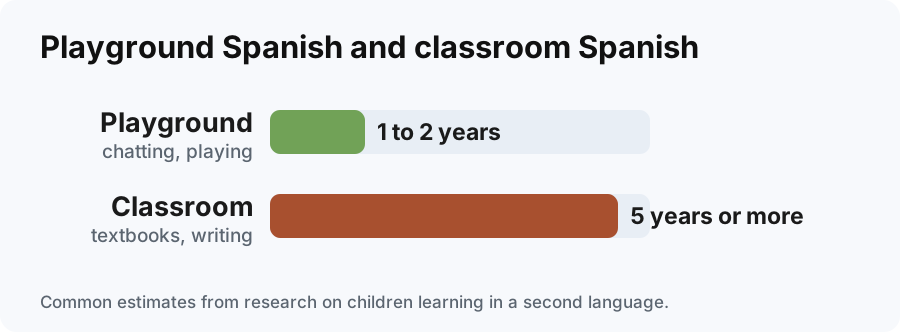
That gives preparation a clear order.
| Step | What to learn | Why it comes at this point |
|---|---|---|
| 1 | Survival and belonging | The child can ask for help and join in from day one |
| 2 | Classroom instructions | The child knows what to do even without understanding the lesson |
| 3 | Words of the school day | Timetable, homework diary and breaks stop being a mystery |
| 4 | Subject words and task verbs | Exercises get done because the instruction is understood |
First, survival and belonging. The language of the first week: asking for the toilet, saying you do not understand, asking for help, joining a game, saying something hurts. A child who can do these five things is not helpless, and that changes how they walk through the gate.
Second, classroom instructions. The same thirty phrases are said every day in every Spanish classroom:
- Sacad el libro. Take out your book.
- Abrid por la página veinte. Open at page twenty.
- En silencio, por favor. Quietly, please.
- Poned el nombre y la fecha. Write your name and the date.
- Copiad de la pizarra. Copy from the board.
- ¿Quién ha terminado? Who has finished?
- Para mañana. For tomorrow.
A child who recognises these knows what to do even when they understand nothing else, and looks around a great deal less.
Third, the school day. El patio (the playground), el comedor (the dining hall), el recreo (break), los deberes (homework), la agenda (the homework diary), la tutora (the class teacher), las extraescolares (after-school activities).
Fourth, subject words. Maths vocabulary (sumar, restar, multiplicar, dividir), then the words of Conocimiento del Medio or Ciencias, then the language of reading and writing tasks: subraya (underline), rodea (circle), completa (fill in), une con flechas (join with arrows). Children often understand the content and fail the exercise because they did not understand the instruction.
If you have a few months before the move, start now. Arriving with even a hundred words and the survival phrases makes the first term a different experience. If your child is already at school and struggling, lessons can follow the school: the teacher works with the actual textbook pages and the actual homework, so each lesson makes tomorrow easier.
One caution about regions. In Catalonia, the Valencian Community, the Balearic Islands, Galicia and the Basque Country, a second official language is used in school to varying degrees. Spanish is still needed everywhere, and it helps a great deal with Catalan and Valencian, which are close relatives. But ask the school how the languages are divided, so that nothing comes as a surprise.
How to choose a Spanish teacher for your child
A teacher who is excellent with adults can be lost with a six-year-old. Teaching young children is its own profession, and the questions to ask are different.
Is the teacher trained to work with children? A native speaker is a good start, not a qualification. Look for a teaching degree, ideally in early-years or primary education, and for specific training in teaching Spanish as a foreign language. Someone trained in Educación Infantil knows how a five-year-old's attention works, which is half the job.
Is the teacher a native speaker? For children it matters more than for adults, because children copy sounds exactly. A native teacher gives them the real rhythm and pronunciation at the age when they absorb it most easily.
Can the teacher talk to you? You need to hear how the lessons are going, what to do at home and what to say to the school. If you do not yet speak Spanish, a teacher who speaks English with parents saves a great deal of guessing. With the child, she should still use Spanish as much as possible.
Does the teacher have experience with your situation? Teaching a child in London for fun is different from preparing a child for a Spanish classroom in September. Ask directly.
Is there a trial lesson? Watch your child, not the teacher. Do they lean in? Do they laugh? Do they try a word? Do they ask when the next one is? A child's reaction after twenty minutes is the most reliable review you will get.
What do you hear afterwards? A short note after lessons or a monthly summary is a sign of a teacher who is following your child, not delivering a script.
A quick checklist to take to the trial lesson:
- Does the teacher speak Spanish most of the time, and does my child still follow?
- Is my child doing something, not only repeating?
- Do activities change before my child gets restless?
- Are mistakes repaired gently, without stopping the child?
- Did my child try a word, laugh, or ask about the next lesson?
- Did I hear afterwards what was done and what to do at home?
Things that should make you hesitate: lessons that are mostly worksheets, a teacher who corrects every error on the spot, a group of more than six young children, promises of fluency by a date, and any pressure to pay for a year in advance before your child has had a lesson.
How parents can help when they do not speak Spanish
You do not need Spanish to help your child learn it. You need ten minutes a day and a willingness to look slightly silly.
- Let them teach you. Ask what the word was for the thing in the song. Get it wrong. Children remember what they have taught.
- Switch familiar cartoons to Spanish. A programme they already know by heart in English is ideal, because they understand the story and can attend to the words.
- Play Spanish songs in the car. Children's songs repeat the same words many times, which is exactly what memory needs.
- Read picture books in Spanish. Badly, with a terrible accent, pointing at the pictures. Your accent will not damage theirs. They copy the teacher and their classmates, not you.
- Label ten things in the house and change the ten every fortnight.
- Learn alongside them. Twenty words a week is enough to follow what they are doing. A parent who is also a beginner is a very good ally.
- Never test them in front of other people. "Say something in Spanish for Grandma" is the fastest way to get silence.
- Keep your home language strong. Speak, read and tell stories in English as richly as you can. A child with a strong first language learns the second one better, and you do not want to trade one for the other.
If your child is in a Spanish school, add two things. Ask the teacher which topic is coming next week, so that the vocabulary can be met in advance. And find one after-school activity, football, dance, swimming, where the language is simple, physical and repeated. Friendships made there do more for speaking than any homework.
When your child will not speak: the silent period
Almost every parent of a child in a new language meets this, and it is frightening if nobody warned you. The child understands more every week, follows instructions, laughs at the right moments in the cartoon, and says nothing. At school in Spain this can last weeks or several months.
It is a recognised stage and it has a name, the silent period. The child is not refusing and is not failing. They are listening, sorting and building, and they will not risk a sentence until they are fairly sure of it. Quiet, careful and older children tend to stay in it longer than outgoing ones.
What helps:
- No pressure to perform. Do not ask them to speak, and ask relatives not to.
- Plenty of chances to answer without words. Pointing, choosing, nodding, drawing. A good teacher builds lessons this way.
- Low-risk speech first. Songs, counting games and repeated phrases in a story let a child speak without the danger of being wrong.
- One safe person. A one-to-one lesson, with nobody else listening, is often where the first sentences come out. Then they travel to the playground.
- Noticing understanding, not output. "You understood everything she said!" is true and encouraging.
When to look more closely: if a child who has been in a Spanish-speaking school for many months is also withdrawn at home, has stopped speaking in situations where they used to speak, or is distressed about school, talk to the class teacher and the school's guidance service (orientación). Most silence is ordinary. Some of it is a child who needs more support, and it is better to ask early.
Free Spanish resources for kids worth using
Lessons work best with a little Spanish around them, and much of the best material is free.
Cartoons. Many series your child already knows are available in Spanish. Pocoyó is Spanish-made, slow and nearly wordless at first, perfect for the very young. Spain's public children's channel, Clan, has a large free library of programmes online.
Songs. Traditional children's songs and modern ones are all over YouTube. Search for canciones infantiles. The classics (Un elefante se balanceaba, Debajo de un botón, Cinco lobitos) are what Spanish children actually sing.
Picture books. Public libraries in many countries have a Spanish shelf. In Spain, the municipal library card is free and the children's section is usually generous.
Apps. Vocabulary apps for children are fine for five minutes a day as a game. They do not replace a person who answers back, for the reasons given above.
Other children. By far the best free resource, and the hardest to arrange. A playground, a sports team, a birthday party. Twenty minutes of playing tag in Spanish does what no lesson can.
Use these as the daily background. Use lessons for what they add: a trained adult who notices what your child can and cannot do, builds the next step and tells you about it.
Where to start
| Your situation | First step this week |
|---|---|
| Spanish for the joy of it | Songs and one familiar cartoon in Spanish, then a trial lesson |
| Starting school in Spain | The survival phrases and classroom instructions, and a question to the school about language support |
| Already at school and gone quiet | One-to-one lessons built around the real homework, without waiting for the end of term |
If your child is starting Spanish for the joy of it, begin with songs and a cartoon this week, and book a trial lesson to see how they respond to a real teacher.
If your child is starting school in Spain, begin today with the five survival phrases and the classroom instructions above, find out what language support the school offers, and get lessons going before the first day if you can.
If your child is already in a Spanish school and has gone quiet, do not wait for the end of term to see whether it sorts itself out. A few weeks of one-to-one lessons built around their real homework often changes the picture.
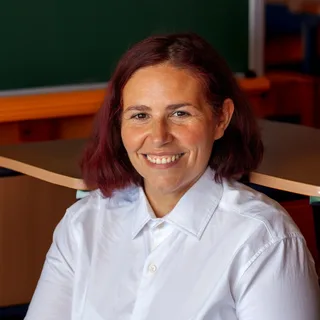
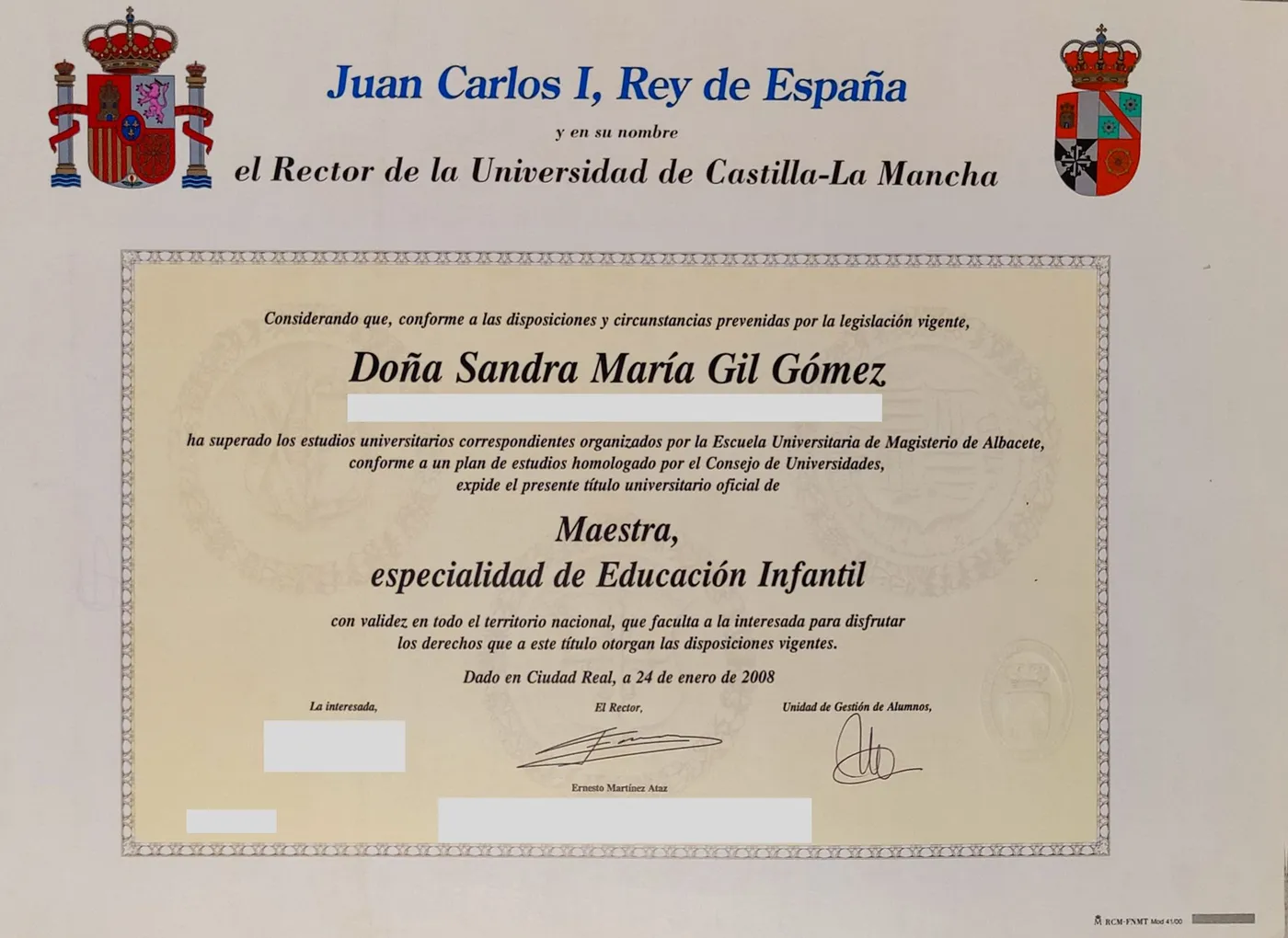
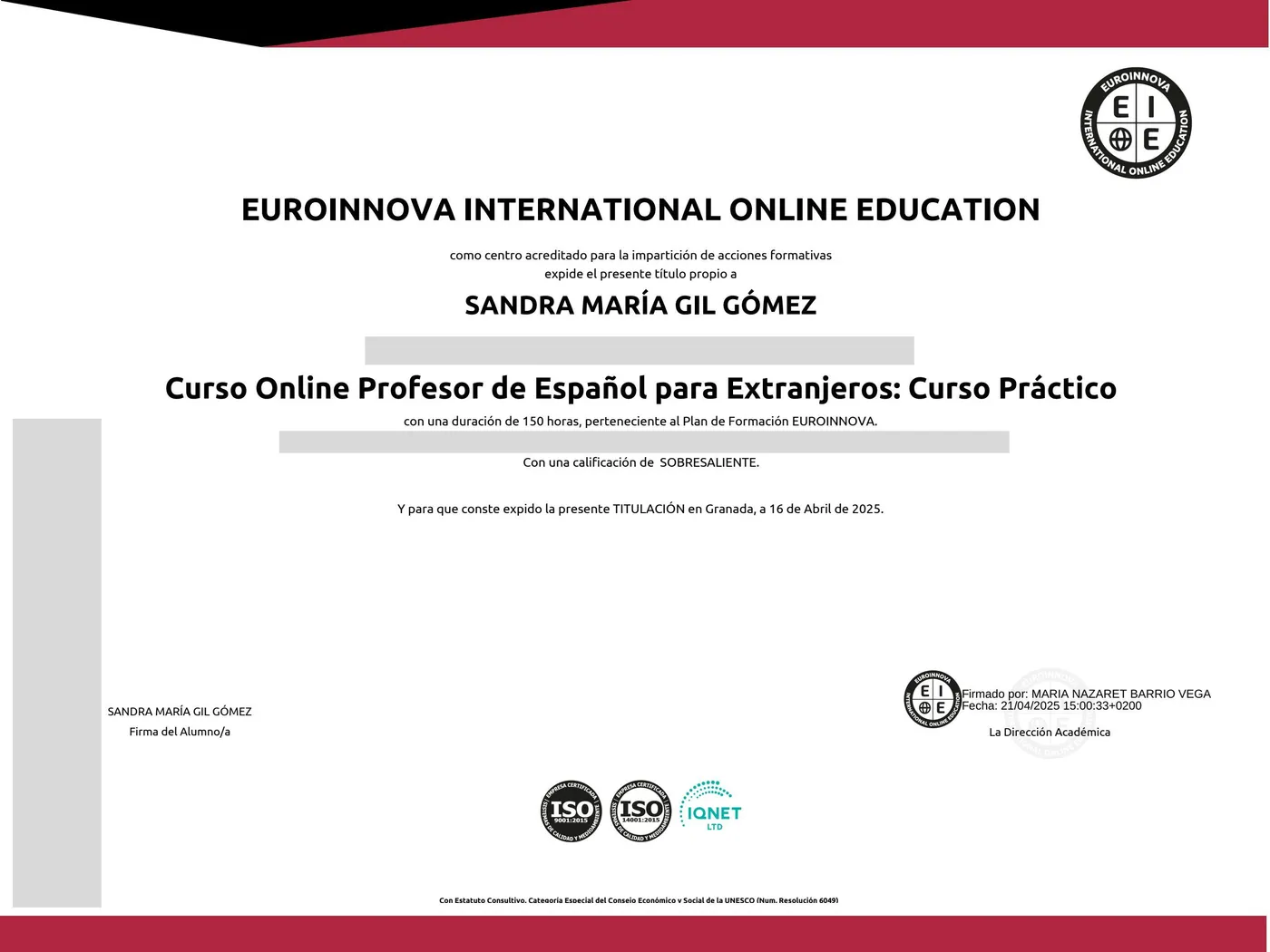
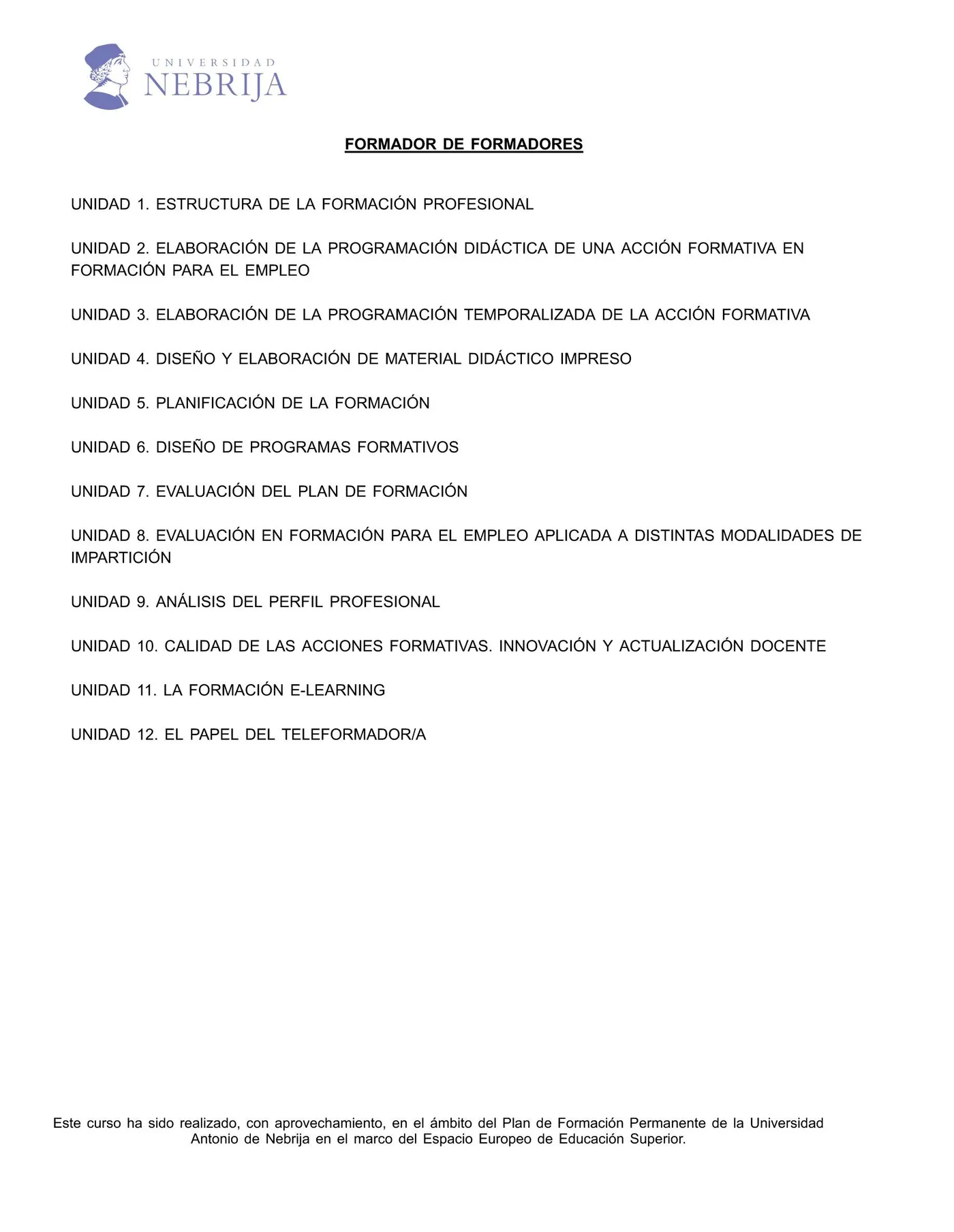
At ProLang, children are taught by a native Spanish teacher from Spain who holds a state teaching degree in Educación Infantil, the Spanish qualification for teaching young children, together with a separate qualification in teaching Spanish to foreigners. Lessons are one-to-one on Zoom, built around games, songs and stories for the little ones and around school texts and tasks for older children. She speaks English, so parents can discuss everything with her directly. The first lesson is free: she meets your child, sees what they already understand, and you agree a plan together.
Your child does not need to be gifted at languages. They need a person who is glad to see them, twice a week, speaking Spanish.
Frequently asked questions
What is the best age for kids to start Spanish lessons?
There is no deadline. From three to five children learn through songs, stories and play and gain an ear for the sounds. From six to eight they begin to read and speak more. Older beginners often catch up quickly because they can study on purpose.
Do online Spanish lessons work for children?
Live one-to-one lessons work well from about five, because the teacher sees the child, answers them and reacts to what they do. They need to be short, active and built on games and the child's own surroundings. Under four, a person in the room is usually better.
How many Spanish lessons a week does a child need?
Two short lessons a week do far more than one long one, because children forget quickly without repetition. Twenty to thirty minutes suits ages four to six, thirty to forty-five minutes ages seven to ten. Five to ten minutes of Spanish at home each day keeps the thread.
My child is starting school in Spain with no Spanish. What should they learn first?
First the survival phrases: asking for the toilet, saying they do not understand, asking for help and joining a game. Then the classroom instructions teachers repeat every day, then the words of the school day, then subject vocabulary.
My child understands Spanish but will not speak. Is that normal?
Yes. Many children go through a silent period of weeks or months in a new language while they listen and build understanding. Avoid pressure, give them ways to answer without words, and a one-to-one setting often brings out the first sentences. If the child is also withdrawn or distressed, talk to the school.
How long should a Spanish lesson be for a child?
Twenty to thirty minutes for ages four to six, thirty to forty-five minutes for ages seven to ten, and forty-five to sixty minutes from eleven. Young children need the lesson split into several short activities.
Will learning Spanish confuse my child or harm their English?
No. Research over several decades has not found that a second language delays speech or confuses children. They may mix languages for a while, which is normal. Keep speaking and reading with them in English: a strong first language supports the second.
Book your free trial lesson
One to one with a native teacher, on Zoom.
Times shown in your zone: Europe/Madrid
Loading the timetable…
3. Your email for the confirmation and the Zoom link
One-to-one lessons with a native teacher
On Zoom with a qualified teacher from Spain who also speaks English.