Languages on your CV: how to list CEFR levels (with examples)
"Spanish: good." "French: conversational." "English: fluent." Recruiters read lines like these every day, and none of them says what you can actually do. The fix is short and free: describe each language with a CEFR level from A1 to C2, back it with a certificate where you have one, and write it in plain text that an applicant tracking system (ATS) can read.
This guide gives you everything for that one section of the CV: what each level means to an employer, descriptors you can adapt level by level, complete example sections for six different profiles, how to list certificates, which keywords ATS and recruiters search for, how interviewers check the level you wrote, and the mistakes that cost interviews. The examples lean towards Spanish and jobs in Spain, but the method works for any language.
How do you put language levels on a CV?
Give each language its own line in a separate Languages section: the language, the CEFR level, and the proof. For example: Spanish - C1 (CEFR), DELE C1, 2025. That single line answers the three questions a recruiter has: which language, how well, and who says so.
A few rules make the section work:
- Native language first, written as Native (in Spanish CVs, lengua materna or nativo). Do not give it a letter.
- Other languages from strongest to weakest.
- One level per language, unless your skills are very uneven (more on that below).
- The certificate and the year in the same line, or in a Certifications section if you have several.
- Put the key language in your profile summary too when the job is built around it: Project manager with C1 Spanish and native English.
Where the section goes depends on the job. For most CVs it sits near the end, after experience, education and skills. When the language is the reason you are applying (a bilingual customer-service role, a translation job, a teaching post), move it up, directly under the profile summary, so the recruiter sees it in the first ten seconds.
If you are new to the scale itself, our overview of language proficiency levels from A1 to C2 explains it from the beginning.
What do the CEFR levels mean on a CV?
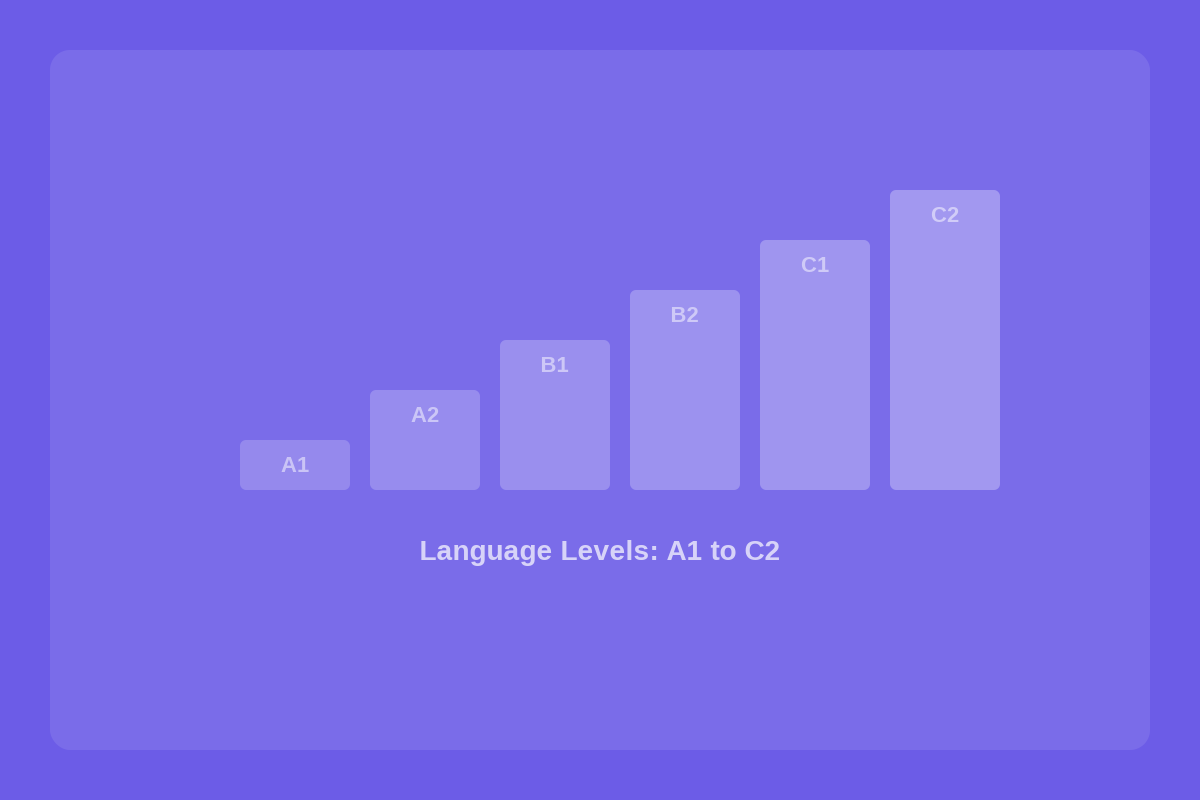
The Common European Framework of Reference for Languages (CEFR), published by the Council of Europe, has six levels in three bands: A1 and A2 (basic user), B1 and B2 (independent user), C1 and C2 (proficient user). European employers, universities and HR software use the same letters, so a level is the shortest honest description you can give. In Spain the framework is called MCER (Marco Común Europeo de Referencia para las Lenguas), so a Spanish CV may say B2 (MCER).
What a recruiter tends to read into each level:
| Level | What it signals at work |
|---|---|
| A1 | You know some words and phrases. Rarely worth listing. |
| A2 | Simple everyday exchanges: directions, small talk, short messages. |
| B1 | You handle familiar topics and routine tasks; you follow the main points of clear speech. |
| B2 | You work in the language: meetings, calls, emails, arguing a point with some precision. |
| C1 | You use it flexibly for complex professional texts and discussions, with little visible effort. |
| C2 | Near-effortless command, including nuance and implied meaning. |
B2 is the level many job ads in Spain mean when they ask for nivel alto or buen nivel, and imprescindible in front of a language means it will be tested on the first call. Our guide to job hunting in Spain in Spanish decodes the rest of that ad vocabulary. The difference between B1 and B2 is the one that changes interviews most; we compared them in detail in B1 vs B2: language levels explained.
The plus levels you sometimes see (B1+, B2+) are used by schools and in the Council of Europe's 2020 Companion Volume to mark the upper half of a level. They are fine on a CV, but do not invent intermediate labels like B1.5: a recruiter cannot check them.
CV language myths and facts
- Myth«Fluent» is the best word for a strong language.FactIt means different things to different readers. A CEFR level such as C1, plus what you do with the language at work, is clearer.
- MythWithout a certificate I cannot put a level on my CV.FactYou can, using the CEFR self-assessment grid. Mark it «self-assessed» and be ready to prove it in the interview.
- MythStars and bars look modern and ATS will read them.FactAn ATS reads text. Graphics usually carry no level a system or a recruiter can check.
- MythA native speaker should write C2.FactWrite «native». A letter next to your mother tongue looks odd; the CEFR levels are for languages you learned.
CEFR descriptors for your CV: what to write at each level
A good descriptor is one short phrase about tasks, not adjectives. The official CEFR wording is long and academic, so adapt it into what you do at work. Below, for each level, the core of the Council of Europe's global description in plain words and phrases you can borrow.
A1 – Breakthrough. You understand and use familiar everyday expressions and very basic phrases, introduce yourself and answer simple questions about where you live. On a CV: basic knowledge, studying. Only list it if the job mentions the language as a plus, or if you are applying in the country and want to show you have started.
A2 – Waystage. You manage short routine exchanges on familiar topics: shopping, directions, your job, simple messages. CV phrases: simple conversations with customers, short written messages, basic phone calls about schedules. A2 matters for jobs in tourism, retail and logistics where you meet the public briefly.
B1 – Threshold. You deal with most situations that arise at work and while travelling, follow the main points of clear standard speech on familiar matters, and write simple connected text. CV phrases: routine calls and emails, follows meetings on familiar topics, handles everyday customer requests. Be careful with B1: it is a working level for routine tasks, not for negotiations.
B2 – Vantage. You understand the main ideas of complex texts, including technical discussion in your field, and interact with a degree of fluency and spontaneity that makes regular contact with native speakers possible without strain for either side. CV phrases: daily work with Spanish-speaking clients, takes part in meetings and defends proposals, writes reports and formal emails. This is the line many employers draw between "useful" and "can work in it".
C1 – Effective operational proficiency. You express yourself fluently and spontaneously without much obvious searching for expressions, use the language flexibly for social, academic and professional purposes, and produce clear, well-structured text on complex subjects. CV phrases: negotiations and presentations, drafting contracts and proposals, leads meetings. Claim C1 only if you can talk about your work for twenty minutes with a stranger.
C2 – Mastery. You understand virtually everything heard or read, summarise from different sources and express yourself precisely, distinguishing finer shades of meaning even in complex situations. CV phrases: professional writing and editing, translation and proofreading, public speaking. Most non-native candidates who reach this level hold a C2 certificate or have studied or worked for years in the language.
The 2020 Companion Volume also added mediation: relaying information between people who do not share a language, summarising a Spanish document for an English-speaking team. If you do that at work, it is one of the most convincing things you can write: summarises Spanish-language supplier contracts for the UK team.
How to self-assess your level with the CEFR grid
The Council of Europe publishes a self-assessment grid with "I can" statements for five skills: listening, reading, spoken interaction, spoken production and writing. Read the row for each skill, pick the highest level where every statement is true for you, and note it.
Practical points:
- Be strict. "I can" means you do it reliably today, not on a good day after a week of practice.
- Expect an uneven profile. Many adults read at B2 but speak at B1. If the gap matters for the job, say so: Spanish - B2 (reading and writing B2, speaking B1).
- Use your weakest relevant skill for the headline level if the job depends on it. A call-centre role cares about speaking, not reading.
- Test it in real conditions. Can you follow a ten-minute podcast in the language without pausing? Write a complaint email without a translator? Explain your last project out loud for two minutes? Those three checks catch most overestimates.
- Get a second opinion. A placement test or a teacher's assessment gives you a level from outside. You can start with our free Spanish level test, then confirm the speaking part in conversation.
A self-assessed level is a claim, not a certificate. Write (self-assessed) if you have no proof; it reads as honest and protects you in the interview.
What happened to the Europass language passport?
The separate Europass Language Passport no longer exists as a standalone document. According to Europass, it is now part of the free Europass profile as a section called Language skills, where you rate your listening, reading, spoken interaction, spoken production and writing against the CEFR.
You can then share that self-assessment with employers or schools, or pull it into a CV made with the free Europass CV editor on europass.europa.eu. The Europass format is well known in public-sector and EU-funded jobs. In private companies in Spain it is accepted, but many recruiters prefer a shorter CV where the language section takes three or four lines, not a full grid.
A good compromise: build the grid in Europass for yourself, then copy only one line per language into your CV.
Which Spanish certificates to cite: DELE, SIELE and others
For Spanish, the two certificates most employers recognise are the DELE and the SIELE, both linked to the Instituto Cervantes. Name the exam, the level and the year; the recruiter needs nothing else.
- DELE (Diplomas de Español como Lengua Extranjera): official diplomas issued by the Instituto Cervantes on behalf of Spain's Ministry of Education, at levels A1 to C2. They are pass/fail per level and do not expire. Write: DELE B2 (Instituto Cervantes), 2026.
- SIELE: a computer-based exam promoted by the Instituto Cervantes, UNAM, the University of Salamanca and the University of Buenos Aires. It gives a score from 0 to 1000 linked to CEFR levels A1 to C1, and university and Cervantes centre pages state that the certificate is valid for five years. Write: SIELE Global, 780/1000 (B2), 2025.
- Escuela Oficial de Idiomas (EOI) certificates from Spain's public language schools are official and well known to Spanish HR teams. Under Royal Decree 1041/2017 their levels map directly onto the CEFR: Básico A1–A2, Intermedio B1–B2, Avanzado C1–C2. Write: Certificado de Nivel Intermedio B2, EOI Madrid, 2024.
| Certificate | Levels | Validity | How to write it |
|---|---|---|---|
| DELE | A1–C2, one level per exam | No expiry | DELE C1 (Instituto Cervantes), 2025 |
| SIELE Global | Score 0–1000, A1–C1 | Five years, as stated by issuing centres | SIELE Global 820/1000 (C1), 2026 |
| EOI certificate | A1–C2 by level | Official certificate | EOI, Certificado Avanzado C1, 2023 |
| University course | Varies | Depends on the course | Spanish course B2, University of X, 120 h |
If your certificate is older or you have improved since, write both: Spanish - C1 (DELE B2, 2021; currently C1 level, self-assessed). A recruiter will believe the certificate more than the self-assessment, so a recent exam at the level you claim is the strongest line you can write. If you are aiming for a certificate to put on your CV, our DELE B1/B2 preparation course works through all four parts of the exam one-to-one.
How many hours to B2 Spanish?
Five quick questions. You get an approximate range, not a promise.
How to list language certificates on a CV
Put the certificate in the same line as the language when you have one or two, and in a separate Certifications section when you have several or the job asks for them by name. Either way, the pattern is the same: exam, level or score, issuer if it is not obvious, year.
- One language, one certificate: Spanish - B2 (DELE B2, 2026).
- Several certificates: keep the Languages section short (Spanish - C1; German - B1) and list the exams under Certifications: DELE C1, Instituto Cervantes, 2025 · Goethe-Zertifikat B1, 2022.
- Scored exams: give the score and the level it corresponds to, because recruiters do not know every scale: IELTS Academic 7.0 (C1), 2024, TOEFL iBT 95, 2025, SIELE 780/1000 (B2).
- Exam booked but not yet taken: this is allowed if it is true and dated: DELE B2 - exam registered for May 2027. Do not write in progress for an exam you have not booked.
- Expired or dated results: scored tests such as IELTS and TOEFL are usually accepted by institutions for two years. On a CV you can still list an old result, but add the year so nobody thinks it is new.
- Certificate number or verification link: not necessary on the CV. Keep the PDF ready; the DELE and SIELE can be checked by the issuer, and some employers ask for a copy at the offer stage.
Never round a result up. DELE B1 with a note that you now work at B2 is credible; writing DELE B2 when you passed B1 is the kind of thing that is checked when HR asks for documents.
How to describe each language level on a CV: wording examples
The best wording is the CEFR letter plus a short note of what you do with the language at work. Keep the note concrete; adjectives like fluent mean different things to different readers.
- A2: Spanish - A2 (basic: simple conversations, short emails).
- B1: Spanish - B1 (independent: routine calls and emails, follows meetings on familiar topics).
- B2: Spanish - B2 (DELE B2, 2026): daily work with Spanish-speaking clients, meetings and written reports.
- C1: Spanish - C1 (DELE C1): negotiations, presentations and contract reading in Spanish.
- C2: Spanish - C2 (DELE C2): professional writing and editing.
- Native: English - native.
For a CV written in Spanish, the same pattern works: Español - B2 (MCER), DELE B2 (2026). Inglés - lengua materna. If the job ad uses words like fluido or bilingüe, mirror them in your profile summary but keep the letter in the language section.
| Instead of | Write |
|---|---|
| Spanish: good | Spanish - B1 (routine calls and emails) |
| Fluent Spanish | Spanish - C1 (DELE C1, 2025) |
| Conversational French | French - B1 (self-assessed) |
| Spanish: intermediate | Spanish - B2 (reading/writing), B1 (speaking) |
| Bilingual English/Spanish | English - native; Spanish - C2 (DELE C2) |
Example CV language sections for different profiles
The same rules produce quite different sections depending on who you are and what the job needs. Here are six realistic profiles. Copy the structure, not the levels: yours must be true.
1. Hospitality worker moving to the Costa del Sol (CV in Spanish)
Idiomas Inglés - lengua materna Español - B1 (MCER), atención al cliente en barra y sala, llamadas de reservas Alemán - A2, conversaciones sencillas con clientes
The B1 line names the two tasks that matter in a bar or restaurant. Tourist areas value extra languages, so even A2 German earns its place here.
2. Software developer applying to an international company in Barcelona (CV in English)
Languages English - C1 (IELTS Academic 7.5, 2024), working language for 6 years Spanish - B1 (self-assessed), daily stand-ups and team chat; studying towards B2 Ukrainian - native · Russian - native
When the working language is English, it goes first among the foreign languages. The honest B1 with "studying towards B2" is an asset: it signals you will integrate.
3. Recent graduate looking for a first job in Madrid (CV in Spanish)
Idiomas Francés - lengua materna Español - C1, DELE C1 (Instituto Cervantes, 2026); Erasmus en la Universidad de Granada (2024-2025) Inglés - B2, Cambridge B2 First (2022)
For graduates, a certificate plus a stay abroad does the work that years of experience do for others.
4. Customer-service agent for a multilingual hub (CV in English)
Languages (all used daily with customers by phone and chat) Italian - native Spanish - C1 (SIELE Global 850/1000, 2025) English - C1 Portuguese - B2 (self-assessed)
Here the languages are the job, so the section goes near the top and says how they are used.
5. Heritage speaker raised bilingual (CV in English)
Languages English - native Spanish - native-level speaking (family language); professional writing C1, DELE C1 2025
Heritage speakers often speak fluently but write less confidently. Splitting speaking and writing is more credible than a flat bilingual.
6. Career changer with basic Spanish, applying in Valencia (CV in Spanish)
Idiomas Inglés - lengua materna Español - A2, en clases semanales para alcanzar B1 en 2027
A2 with a dated plan is better than a vague nivel básico. Expect the interviewer to try a few questions in Spanish anyway.
Do ATS read language skills on a CV?
Yes, but only as text. An applicant tracking system pulls words out of your file and compares them with the job's requirements, so Spanish C1 is found while five stars, a progress bar or a flag icon usually are not. Write the language and the level as words and letters.
Habits that keep the language section machine-readable:
- Plain text in the body of the document, not in a header, footer, text box or image.
- A standard section title: Languages (or Idiomas in a Spanish CV).
- A simple file: a text-based PDF or a .docx, not a scanned image. Two-column templates sometimes scramble the reading order; a single column is safest.
- Both the letter and the word when in doubt: Spanish - C1 (advanced). Some screening is done by people searching the database, and they type either form.
Many online application forms also ask for languages in a dropdown with options like basic, intermediate, advanced, native. There is no official conversion; pick the closest honest option and repeat the CEFR level in any free-text field or in the CV you upload. Every ATS is configured differently, so treat these as safe habits, not guarantees.
ATS keyword tips for the languages section
Recruiters filter candidates by searching the ATS for words, so the safest strategy is to use the same words as the ad, where they are true for you. Read the ad, list every language term it uses, and make sure each one appears in your CV at least once.
| If the ad says | Make sure your CV contains |
|---|---|
| Spanish (C1) | Spanish - C1 |
| Español nativo o bilingüe | español + nativo or bilingüe, only if true; otherwise your real level |
| Castellano | castellano once (for example in the summary) as well as español |
| Inglés alto / nivel alto | inglés + the CEFR letter, plus nivel alto in the summary if it is true |
| DELE B2 required | DELE B2 written exactly, not just B2 |
| Catalan valued | catalán or català with a level, if you have any |
Further tips:
- Use both names of the language in a Spanish CV. In Spain castellano and español are used for the same language, and an ad may use either. A Catalan or Basque job ad may also mention the regional language.
- Repeat the key language in the profile summary. Some systems give weight to keywords near the top and to repetition; one mention in the summary plus one in Idiomas is natural, five is stuffing.
- Write certificates in full and abbreviated once: Diploma de Español como Lengua Extranjera (DELE) B2.
- Answer knock-out questions honestly. Forms often ask ¿Tienes nivel C1 de inglés? as a yes/no filter. A wrong "yes" gets you through the software and fails you at the first call.
- Mirror the language of the CV to the ad. An ad in Spanish usually expects a CV in Spanish; an ad in English at an international company usually accepts English. If unsure, send the CV in the ad's language.
- On LinkedIn, fill the Languages section too. It uses its own five-step scale (Elementary to Native or bilingual proficiency), which is not CEFR; put the CEFR letter in your headline or About section if the language is key.
How do interviewers test your language level?
Most often without warning: the recruiter simply switches language in the middle of the phone screen or interview. If your CV says Spanish - B2, expect at least part of the conversation in Spanish, and expect it to be about your work, not about the weather.
The usual methods:
- The switch. Bueno, si te parece seguimos un rato en español. Then the ordinary interview questions: Háblame de tu último puesto. ¿Por qué quieres trabajar con nosotros? They listen for whether you can keep going for a minute or two, not for perfect grammar.
- Questions about your own experience. At B2, you should be able to describe a project, a problem and what you did. At C1, they may push back: ¿Y si el cliente no estaba de acuerdo?
- A role play. Customer-facing roles may simulate a complaint or a sale: Soy un cliente y mi pedido no ha llegado.
- A written task. Write a short email to a client, or summarise a text, sometimes during the interview, sometimes as homework.
- An online test. Some large companies and agencies send a computer-based language test before or after the interview. The result usually comes as a CEFR level.
- The second interviewer. A native-speaking team member joins and talks naturally, at full speed.
What they actually check at each level:
| Level claimed | What the interviewer expects |
|---|---|
| B1 | Understands simple questions at normal speed, answers in short sentences, asks for repetition politely |
| B2 | Talks about work for several minutes, gives reasons, understands follow-up questions without repetition |
| C1 | Argues, nuances, handles interruption and humour, uses professional vocabulary naturally |
| C2 | Indistinguishable from an educated native speaker in professional topics |
If you get stuck, say so in the language: Perdona, ¿me lo puedes repetir? — Sorry, could you repeat that? No conozco la palabra exacta, pero te lo explico. — I do not know the exact word, but let me explain. Handling a gap calmly is a B2 skill in itself. For the interview phrases and the questions that usually come up, see our guide to the job interview in a foreign language.
Common mistakes when listing languages on a CV
The most damaging mistake is claiming a level you cannot hold in a conversation: in Spain the phone screen or interview is often partly in the language you listed. The others are smaller but common.
- Vague words without a level: good, fluent, working knowledge.
- Graphics instead of text: bars, dots, stars and percentages say nothing a recruiter can check and may be lost in an ATS.
- Mixing scales: a CEFR letter for one language and intermediate for another.
- Listing A1 languages in a CV where space is tight. Keep them for an "interests" line, if at all.
- Forgetting the date of a certificate. A 2015 DELE B1 next to a C1 claim raises questions; give both facts.
- Over-explaining: a full Europass grid in a two-page CV takes space you need for experience.
- Giving your native language a level: English - C2 for a native speaker looks odd. Write native.
- Translating level names literally in a Spanish CV: write nivel avanzado or C1, not proficiente; and lengua materna, not nativa lengua.
- Listing a language you have not used in ten years at the old level. Languages fade; reassess before you write.
- Inconsistency between documents: B2 on the CV, advanced on LinkedIn, C1 in the cover letter. Recruiters notice.
Before you send the CV, rehearse the two sentences you will be asked to say in that language: who you are and why this job. Then read your languages section aloud and ask yourself: if the recruiter called right now and switched language, would every line hold?
Is your languages section ready?
Under Spain's EOI system, which certificate corresponds to B2?
Frequently asked questions
How do I write my language level on a CV?
Give each language its own line: the language, the CEFR level and the proof, for example «Spanish - B2 (CEFR), DELE B2, 2026». Put your native language first and the others from strongest to weakest.
What does B2 mean on a CV?
B2 is an independent user who can work in the language: follow meetings, make calls, write emails and argue a point with some precision. In Spain, job ads asking for «nivel alto» usually mean B2 or above.
Can I put a language level on my CV without a certificate?
Yes. Assess yourself honestly with the Council of Europe's self-assessment grid and add «(self-assessed)». Expect the interviewer to check it, often by switching to that language.
Can I list a language exam I have not taken yet?
Only if it is booked, and with the date: «DELE B2 - exam registered for May 2027». Do not write «in progress» for an exam you have not registered for, and never write a level you have not passed as if it were a certificate.
Does the DELE expire?
No. DELE diplomas, issued by the Instituto Cervantes on behalf of Spain's Ministry of Education, have indefinite validity. SIELE certificates, by contrast, are described as valid for five years.
Do ATS systems read language skill bars or stars?
Usually not reliably. An ATS reads text, so write the language and level as words and letters, such as «Spanish C1», in the body of the document, not in graphics, headers or text boxes.
How will the interviewer check my Spanish level?
Usually by switching to Spanish during the phone screen or interview and asking about your work. Some employers add a role play, a short written task or an online test. At B2 they expect you to talk about your job for several minutes and understand follow-up questions.
Book your free trial lesson
One to one with a native teacher, on Zoom.
Times shown in your zone: Europe/Madrid
1. Pick a day
Loading the timetable…
3. Your email for the confirmation and the Zoom link
One-to-one lessons with a native teacher
On Zoom with a qualified teacher from Spain who also speaks English.