Difference Between B1 and B2: Language Levels Explained Practically

You can hold a conversation. You can get through a job interview without freezing. You can watch a movie in your target language and follow the plot, most of the time. But when someone asks you what level you are, you hesitate. Are you B1? B2? Somewhere in between? And does it even matter?
It matters more than you think. The difference between B1 and B2 is not just a letter on a certificate. It is the difference between surviving in a language and actually living in it. It is the difference between getting by at work and getting promoted. It is the gap between understanding what someone said and understanding what they meant. For immigration applications, university admissions, and career advancement, the distinction between these two levels can determine whether your application gets approved or rejected.
This guide breaks down exactly what separates B1 from B2, what each level looks and feels like in daily life, and how to move from one to the other without losing your mind in the process.
What CEFR Actually Means in Everyday Life
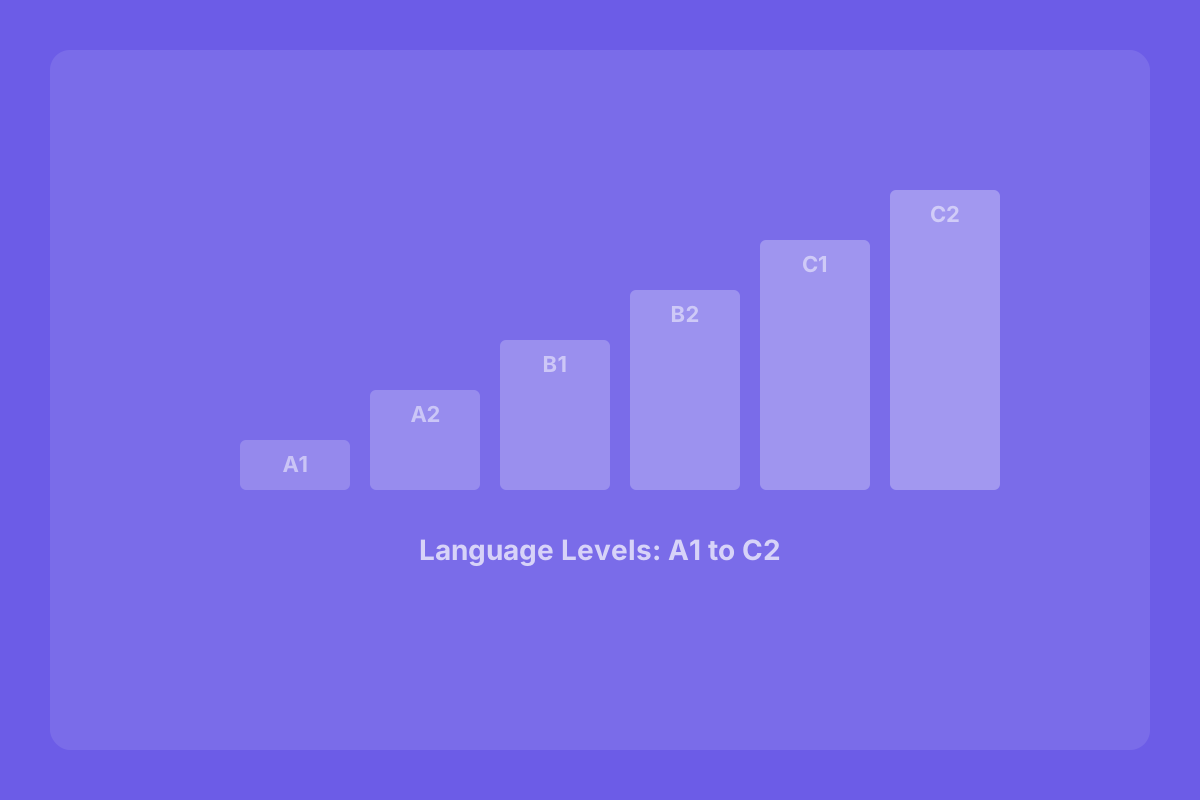
The Common European Framework of Reference for Languages, known as CEFR, is a standardized system that describes language ability on a six-point scale: A1, A2, B1, B2, C1, and C2. It was developed by the Council of Europe in the 1990s and published in 2001. Since then, it has become the global standard for measuring language proficiency, used by schools, employers, governments, and testing organizations around the world.
But here is what the official descriptions do not tell you: CEFR levels are not about memorizing grammar tables or passing written exams. They are about what you can do in real situations with real people under real pressure.
At A1, you can ask where the bathroom is. At A2, you can order dinner and make small talk with the waiter. At B1, you can explain to a doctor what hurts and understand the diagnosis. At B2, you can argue with your landlord about a broken heater and win. At C1, you can deliver a presentation to a boardroom full of executives and handle aggressive questions. At C2, you can do all of that while cracking jokes that actually land.
The framework was designed to be language-neutral. Whether you are learning English, Spanish, French, German, Italian, or Mandarin, the levels describe the same functional abilities. A B1 speaker of French and a B1 speaker of German should, in theory, be able to do roughly the same things in their respective languages.
In everyday life, CEFR levels translate directly into independence. A1 and A2 speakers need help constantly. They rely on translation apps, bilingual friends, and a lot of pointing. B1 speakers can handle routine situations on their own but still struggle when things go off script. B2 speakers can navigate most of life without assistance, including complex, unpredictable, and emotionally charged situations.
That jump from "I can handle routine situations" to "I can handle most situations" is exactly the B1-to-B2 transition. And it is one of the hardest jumps in the entire framework.
B1 in Practice: What You Can Really Do
B1 is often called the "threshold" level, and the name fits. You have crossed the threshold from beginner to intermediate. You can function independently in everyday situations, but only when those situations follow a predictable pattern.
Think of ordering food at a restaurant. At B1, you can read the menu, ask questions about dishes, order for yourself, and handle the payment. You can even tell the waiter you are allergic to shellfish. But if the waiter launches into a five-minute monologue about the chef's special tasting menu with wine pairings, you are going to lose the thread about 30 seconds in. You will nod, smile, and hope for the best.
Watching movies is another good test. At B1, you can follow the plot of a straightforward film, especially if you already know the genre conventions. A romantic comedy? You will get most of it. A courtroom drama with rapid-fire legal arguments? You will catch maybe half. A political satire full of cultural references and wordplay? You are going to need subtitles.
In a work context, a B1 speaker can participate in meetings where the topic is familiar and the pace is reasonable. You can write emails that get your point across, even if they sound a little stiff or formulaic. You can describe a problem to a colleague and understand their response. But presenting a quarterly report to senior management, debating strategy with a cross-functional team, or writing a persuasive proposal? Those tasks will push you past your limits.
Emergencies are revealing. At B1, you can call an ambulance and explain what happened. You can tell a police officer that your bag was stolen. You can describe symptoms to a pharmacist. But you will struggle with the follow-up questions. When the emergency dispatcher asks for your exact location and cross streets, when the police officer asks you to describe the thief in detail, when the pharmacist asks about your other medications and potential interactions, that is where B1 starts to crack.
Socially, B1 speakers can make friends and maintain relationships in their target language, but conversations tend to stay in comfortable territory. You can talk about your job, your family, your hobbies, recent travel, and plans for the weekend. You can exchange opinions on simple topics. But deeper conversations about politics, philosophy, ethics, or personal struggles often feel out of reach. You know what you want to say, but you cannot find the words to say it with the precision and nuance it deserves.
The official CEFR descriptor for B1 says the speaker "can deal with most situations likely to arise while travelling in an area where the language is spoken." That is accurate, but it undersells the limitations. B1 gets you through the day. It does not get you through every day comfortably.
B2 in Practice: The Comfort Zone Expands
B2 is where a language starts to feel less like a tool and more like a part of you. The official descriptor calls B2 the "vantage" level. You have climbed high enough to see the landscape clearly, even if there are still peaks above you.
At B2, the restaurant experience changes completely. You can handle the waiter's tasting menu monologue. You can ask detailed questions about ingredients, cooking methods, and portion sizes. You can make small talk with the sommelier about wine regions. If the kitchen makes a mistake with your order, you can politely but firmly send it back and explain exactly what went wrong.
Movies and TV become genuinely enjoyable rather than homework. You can follow complex plots, catch most of the humor, and understand character motivations even when they are implied rather than stated. You will still miss some slang, regional accents, and cultural references, but the overall experience is pleasure, not struggle.
At work, B2 is the level where you stop being "the person who speaks [language]" and start being "a professional who happens to work in [language]." You can write clear, detailed reports. You can lead meetings and respond to unexpected questions. You can negotiate with clients, handle complaints, and navigate office politics. Your emails sound natural rather than translated. You make mistakes, but they rarely cause confusion.
Emergencies become manageable rather than terrifying. You can give a detailed account of a car accident to an insurance agent over the phone. You can explain a complex medical history to a new doctor, including medications, allergies, past surgeries, and family history. You can follow legal instructions and understand your rights when dealing with authorities.
Socially, B2 is the level where real friendships become possible without constant linguistic accommodation from the other person. You can debate politics over dinner. You can comfort a friend going through a breakup. You can tell a joke and deliver the punchline with the right timing. You can express disagreement without sounding rude and agreement without sounding sycophantic. You can pick up on sarcasm, irony, and understatement most of the time, though not always.
The key difference between B1 and B2 is not just vocabulary or grammar. It is flexibility. A B1 speaker has a limited number of ways to express each idea. A B2 speaker can say the same thing five different ways, adjusting tone, register, and style depending on the audience and situation. That flexibility is what makes the difference between sounding competent and sounding natural.
Side by Side: B1 vs B2 in Real Scenarios
The abstract descriptions become much clearer when you put them side by side in specific situations.
Ordering at a restaurant. A B1 speaker says: "I would like the chicken, please. No onions. And water." A B2 speaker says: "Could I get the chicken, but would it be possible to swap the onions for extra peppers? And I will start with a sparkling water while I decide on wine."
Calling in sick to work. A B1 speaker says: "Hello, I am sick today. I cannot come to work. I am sorry." A B2 speaker says: "Hi, I woke up with a fever and I do not want to risk spreading anything around the office. I should be fine by tomorrow, but I will keep you posted. I have already emailed Sarah about covering the morning client call."
Explaining a problem to a mechanic. A B1 speaker says: "My car makes a strange noise. When I drive fast. I think it is the engine." A B2 speaker says: "There is a rattling sound coming from somewhere under the hood, and it gets worse above 80 kilometers per hour. It started about a week ago, and I noticed it is louder when the engine is cold."
Handling a disagreement with a colleague. A B1 speaker says: "I do not agree. I think we should do it the other way." A B2 speaker says: "I see where you are coming from, but I have some concerns about that approach. The last time we tried something similar, we ran into problems with the timeline. What if we combined your idea with the approach we used in the Q2 project?"
Writing a complaint email to a hotel. A B1 speaker writes: "Dear Hotel, my room was not clean. The shower did not work. I am not happy. I want my money back." A B2 speaker writes: "I am writing regarding my stay on June 12-14, room 307. Unfortunately, the room was not up to the standard I expected. The bathroom had not been properly cleaned upon arrival, and the shower had intermittent hot water throughout my stay. I reported both issues to the front desk, but they were not resolved. I would appreciate a partial refund or credit toward a future stay."
In every scenario, the B1 speaker gets the message across. The B2 speaker gets the message across with context, nuance, and social awareness. That is not a small difference. In professional and high-stakes situations, it is often the difference between being taken seriously and being overlooked.
Grammar Differences Between B1 and B2
Grammar is where the B1-to-B2 transition gets technically demanding. At B1, you have a solid grasp of the fundamental structures. At B2, you need to master the structures that add precision, subtlety, and flexibility to your speech and writing.
At B1, a typical learner has command of the following: present, past, and future tenses in their basic forms; common modal verbs (can, must, should, would); basic conditional sentences ("If it rains, I will stay home"); comparative and superlative forms; basic passive voice; and common conjunctions for joining ideas (and, but, because, so, when, if).
At B2, the grammar toolkit expands significantly. You need to handle mixed conditionals ("If I had studied harder, I would be in a better position now"); reported speech with appropriate tense shifts; a full range of passive constructions, including impersonal passives; relative clauses with both defining and non-defining functions; subjunctive or hypothetical structures (these vary greatly by language); advanced time expressions and aspect distinctions; cleft sentences and other emphasis structures; and a wider range of discourse markers for organizing complex arguments.
The challenge is not just learning these structures. It is learning to use them naturally, in real time, without pausing to think about the rule. A B1 speaker might know that the third conditional exists but still needs ten seconds to construct a sentence with it. A B2 speaker uses it without thinking, the same way a native speaker does.
In languages other than English, the grammar gap between B1 and B2 can be even wider. In German, B2 requires comfortable use of the Konjunktiv II, extended adjective constructions, and complex sentence frames with multiple subordinate clauses. In French, the subjunctive moves from a curiosity at B1 to a necessity at B2. In Spanish, the distinction between the preterite and imperfect must become automatic, and the subjunctive must be used correctly in a wider range of contexts.
One of the biggest grammar shifts at B2 is the move from "correct but simple" to "appropriate and varied." A B1 speaker tends to use the same structures repeatedly because they are safe. A B2 speaker varies sentence length, uses inversion for emphasis, employs different clause types, and adjusts formality level depending on context. This variety is what makes B2 speech and writing sound mature rather than mechanical.
Vocabulary Size and Range at Each Level
Research on vocabulary size at different CEFR levels gives us some useful benchmarks, though the numbers vary depending on the language and the study.
For English, a B1 speaker typically has an active vocabulary of around 2,500 to 3,000 word families and a passive vocabulary (words you can recognize and understand but might not use) of roughly 4,000 to 5,000. A B2 speaker's active vocabulary jumps to approximately 4,000 to 5,000 word families, with a passive vocabulary reaching 6,000 to 8,000.
But raw numbers do not tell the whole story. The type of vocabulary changes as much as the quantity.
At B1, your vocabulary covers everyday life reliably. You know words for food, clothing, transportation, housing, family, work, health, weather, and leisure activities. You can describe people, places, and events. You know the most common collocations and set phrases. But your vocabulary is largely concrete and literal. Abstract concepts, technical terminology, idiomatic expressions, and figurative language are weak spots.
At B2, vocabulary becomes more layered. You start to acquire words that express degree and nuance: not just "good" and "bad" but "adequate," "mediocre," "outstanding," "dismal." You learn the vocabulary of argumentation: "nevertheless," "consequently," "on the other hand," "granted." You pick up domain-specific vocabulary for your work, your interests, and current events. You start to understand and use idioms, phrasal verbs, collocations, and fixed expressions that do not translate literally.
Perhaps most importantly, a B2 speaker develops a sense of register. You learn which words are formal, which are casual, which are technical, and which are slang. You learn that "commence" and "start" mean the same thing but belong in different contexts. You learn that "pass away" and "die" carry different emotional weights. This register awareness is invisible in a vocabulary count, but it is one of the clearest markers of B2 ability.
At ProLang, we often tell students that B1 vocabulary lets you say what you mean. B2 vocabulary lets you say what you mean the way you mean it.
How Long Does It Take to Go from B1 to B2
This is the question every B1 student asks, and every honest teacher hates answering. The truth is that it varies enormously depending on the learner, the language, the intensity of study, and the quality of practice.
That said, there are some general benchmarks. The Common European Framework suggests approximately 150 to 200 guided learning hours to move from B1 to B2. The Alliance Francaise estimates 200 hours for French. The Goethe-Institut suggests a similar range for German. Cambridge Assessment puts it at 200 hours for English. The Cervantes Institute suggests 200 hours for Spanish as well.
These numbers refer to structured, guided learning hours, meaning time spent in class or working with a teacher. They do not include self-study, homework, or incidental exposure like watching TV or reading for pleasure. If you add those in, the total time investment is usually two to three times higher.
For a student taking two 90-minute classes per week at ProLang, with regular homework and some independent practice, the B1-to-B2 journey typically takes nine to twelve months. Students in intensive courses (four to five classes per week) can compress that to four to six months. Students who combine classes with immersion (living or working in a country where the language is spoken) can sometimes make the jump in as little as three months.
Several factors speed up or slow down the process. Your native language matters. If your native language is closely related to the target language, certain aspects of B2 will come more quickly. Motivation and consistency matter more than intensity. Studying three hours a week every week for a year beats studying twenty hours a week for two months and then stopping. Active use of the language matters enormously. Students who speak, write, read, and listen in their target language outside of class progress significantly faster than those who treat the language as a classroom-only activity.
Age is a factor, but not in the way most people assume. Adult learners are often faster at reaching B2 than teenagers because they have stronger analytical skills, larger conceptual frameworks, and clearer motivation. The advantage that young learners have is in pronunciation and eventual ceiling level, not in speed of intermediate progress.
The B1 to B2 Plateau and How to Break Through
The transition from B1 to B2 is where the infamous intermediate plateau lives. This is the period where progress slows to a crawl, motivation drops, and many learners either get stuck or give up entirely. Understanding why it happens is the first step to beating it.
At B1, you have already learned the grammar and vocabulary that gives you the biggest return on investment. The remaining grammar is more subtle and situation-specific. The remaining vocabulary is more specialized and less frequently encountered. Each hour of study produces less visible improvement than it did at A2 or early B1.
There is also a psychological component. At B1, you know enough to understand how much you do not know. You can hear the gap between your speech and a native speaker's. Every conversation reminds you of your limitations. This awareness is actually a sign of progress, but it does not feel like one.
Here are proven strategies for breaking through the plateau.
Change your input sources. If you have been using textbooks and language learning apps, switch to authentic materials: news articles, podcasts made for native speakers, novels, YouTube channels about topics you genuinely care about. The difficulty jump will be uncomfortable at first, but it forces your brain to process language at a higher level.
Focus on output, not just input. Many B1 learners spend 90 percent of their study time reading and listening and only 10 percent speaking and writing. Flip that ratio, or at least balance it. Writing forces you to notice grammar gaps you can gloss over when speaking. Speaking forces you to retrieve vocabulary actively rather than passively recognizing it.
Embrace error correction. At B1, many learners develop a comfort zone of "good enough" language. They can communicate, so there is less pressure to improve. Ask teachers and conversation partners to correct you, even when your meaning is clear. The errors you tolerate at B1 become the fossilized habits that define your permanent level.
Learn vocabulary in context, not in isolation. Stop memorizing word lists. Start collecting phrases, collocations, and sentences from authentic sources. Instead of learning that "severe" means "very bad," learn that "severe weather" and "severe consequences" are common combinations while "severe happiness" is not.
Set specific, measurable goals. "Get better at French" is not a goal. "Be able to summarize a newspaper article orally in under two minutes" is a goal. "Write a formal complaint letter without using a dictionary" is a goal. Specific goals give you something concrete to work toward and a clear way to measure progress.
Get professional guidance. The B1-to-B2 transition is where self-study most often fails. A skilled teacher can identify your specific weaknesses, provide targeted practice, correct fossilized errors, and keep you accountable. This is not a sales pitch. It is the pattern teachers see again and again at this level.
Test Score Equivalents for B1 and B2
If you need to prove your level for work, study, or immigration, you will need a recognized test score. Different exams use different scoring systems, but they all map to the CEFR framework.
IELTS (International English Language Testing System). B1 corresponds to an IELTS band score of approximately 4.0 to 5.0. B2 corresponds to approximately 5.5 to 6.5. Most universities require a minimum of 6.0 to 6.5 (solidly B2) for admission. Immigration programs in countries like Canada and Australia typically require 6.0 to 7.0 depending on the visa category.
TOEFL iBT (Test of English as a Foreign Language). B1 maps to approximately 42 to 71 on the internet-based test. B2 maps to approximately 72 to 94. Most North American universities require scores in the 80 to 100 range for undergraduate admission and higher for graduate programs.
Cambridge English Exams. The B1 level is assessed by the Cambridge B1 Preliminary (PET) exam, with a passing score of 140 to 159 on the Cambridge English Scale. The B2 level is assessed by the Cambridge B2 First (FCE) exam, with a passing score of 160 to 179. These exams are widely recognized in Europe and increasingly accepted worldwide.
DELE (Diplomas de Espanol como Lengua Extranjera). For Spanish, the DELE B1 and DELE B2 are separate exams, each with its own passing threshold. The DELE B2 is typically required for university admission in Spain and for many professional registrations in Spanish-speaking countries.
DELF/DALF (Diplome d'Etudes en Langue Francaise). For French, the DELF B1 and DELF B2 are separate diploma exams. A score of 50 out of 100 is required to pass each level. The DELF B2 exempts holders from French language requirements at most French universities.
Goethe-Zertifikat. For German, the Goethe-Zertifikat B1 and Goethe-Zertifikat B2 are separate exams administered by the Goethe-Institut. The B2 certificate is required for admission to many German universities and for certain professional licenses, particularly in healthcare.
TestDaF and DSH. For academic study in Germany specifically, the TestDaF (Test Deutsch als Fremdsprache) requires a TDN 4 in all sections (roughly B2 to C1), while the DSH requires a DSH-2 result, also corresponding to high B2 or above.
When choosing which test to take, consider where you will use the results. IELTS and TOEFL are strongest for English in academic and immigration contexts. Cambridge exams are popular in Europe and for employment purposes. DELE, DELF, and Goethe certificates are the gold standards for their respective languages.
It is worth noting that test preparation is a skill in itself. A student who is solidly B2 in everyday life might score poorly on a specific test without preparation, simply because they are unfamiliar with the format, timing, and task types. At ProLang, we recommend at least four to six weeks of test-specific preparation after reaching the target level through general courses.
Career and Immigration Requirements by Level
The practical stakes of the B1 vs B2 distinction are highest in career advancement and immigration.
Immigration. Many countries have specific language requirements for visas and residency permits. Canada's Express Entry system awards points for language ability, with significantly more points for B2 (CLB 7-8) than B1 (CLB 5-6). Australia's General Skilled Migration program requires "competent English" (IELTS 6.0, roughly B2) as a minimum, with extra points for higher scores. Germany's skilled worker visa typically requires B1 for general employment and B2 for regulated professions. France requires B1 for naturalization and long-term residency. The Netherlands requires B1 for integration, with some professions demanding B2. The UK's points-based immigration system requires B1 for settlement and citizenship.
For citizenship applications, many European countries set the bar at B1, but this is a minimum, not a recommendation. Applicants at B1 often struggle with the interview component, where questions can be unpredictable and conversational. Arriving at the interview with B2 ability gives you a significant safety margin.
Healthcare. Doctors, nurses, and other healthcare professionals face some of the strictest language requirements. In Germany, foreign doctors typically need to pass both the Fachsprachprufung (a B2/C1 medical language exam) and demonstrate general B2 proficiency. In the UK, the General Medical Council requires an IELTS score of 7.0 to 7.5 across all bands, corresponding to high B2 or C1. In France, the Ordre des Medecins requires demonstration of sufficient French ability, generally interpreted as B2 or above.
Engineering and technology. Language requirements in tech vary widely. Many multinational companies operate in English regardless of location, and B2 English is usually sufficient for technical roles. However, customer-facing positions, management roles, and positions in smaller companies typically require the local language at B2 or higher.
Education. Teaching positions almost universally require B2 or higher in the language of instruction. University lecturers are often expected to operate at C1 or C2. For students, B2 is the most common minimum for admission to degree programs taught in a foreign language. Some programs accept B1 with the condition that the student reaches B2 within the first year.
Legal and financial services. Lawyers, accountants, and financial advisors typically need C1 or above due to the precision required in their work. However, support roles in these fields often list B2 as the minimum requirement.
Customer service and hospitality. B1 is often listed as the minimum for front-line roles, but employers increasingly prefer B2, especially in international hotels, airlines, and tourism companies where customers expect smooth communication.
The general pattern is clear. B1 opens doors. B2 opens more doors and keeps them open. In competitive job markets and immigration systems, the difference between B1 and B2 can be the difference between getting hired and getting passed over, between having your visa approved and receiving a rejection letter.
At ProLang, we work with students at every level, but we pay special attention to the B1-to-B2 transition because we know what is at stake. Whether your goal is a career move, a university degree, a new country, or simply the satisfaction of speaking another language with confidence and ease, reaching B2 is the milestone that changes everything. And with the right approach, the right guidance, and enough persistence, it is a milestone that every motivated learner can reach.
Frequently asked questions
What is the main difference between B1 and B2 language levels?
B1 speakers can handle everyday situations and express opinions on familiar topics, while B2 speakers can engage in complex discussions, understand abstract ideas, and communicate fluently with native speakers without strain on either side.
How long does it take to go from B1 to B2?
Most learners need between 200 and 400 hours of focused study and practice to move from B1 to B2, depending on the target language, learning intensity, and exposure to native speakers. This typically translates to 6 to 12 months of consistent effort.
Is B2 enough for working abroad?
B2 is the most commonly required level for professional work in a foreign language. Many employers, universities, and immigration programs accept B2 certification as proof of sufficient language competence for daily professional communication.
Book your free trial lesson
One to one with a native teacher, on Zoom.
Times shown in your zone: Europe/Madrid
Loading the timetable…
3. Your email for the confirmation and the Zoom link
One-to-one lessons with a native teacher
On Zoom with a qualified teacher from Spain who also speaks English.