How to order tapas in Spain: caña, ración, menú del día
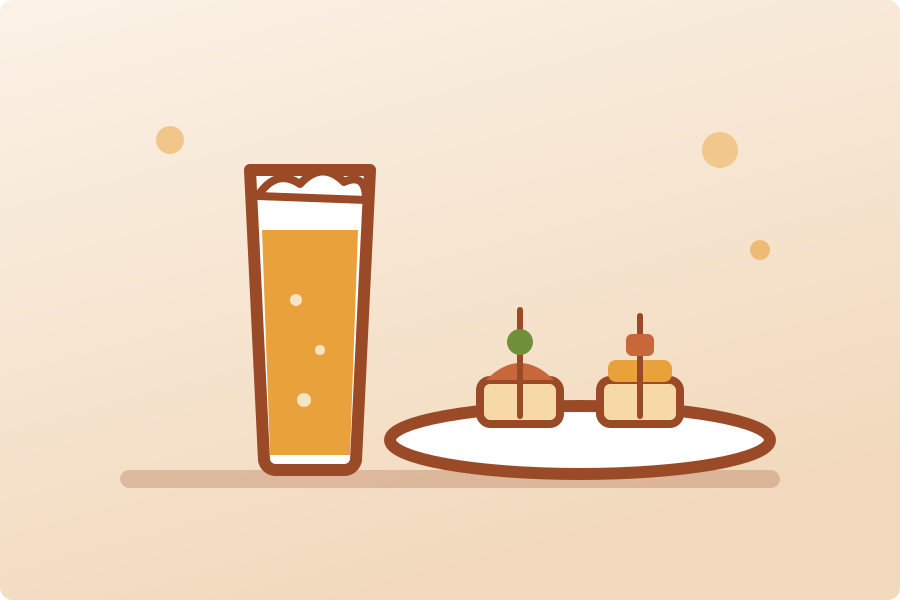
The first evening in a Spanish bar usually goes like this: you say una cerveza, you get a glass you did not expect, a small plate arrives that you did not order, and at the end nobody brings a bill until you ask. None of it is random. Spanish bars run on a short list of words and a few unwritten rules, and once you know them, ordering stops being a gamble.
This guide goes deeper than our overview of everyday Spanish in shops, bars and with neighbours: beer sizes, portion sizes, pintxos, free tapas, the menú del día and, finally, how to pay without an awkward scene at the counter.
What is the difference between a caña, a tercio and a doble?
A caña is a small glass of draught beer, a doble is a bigger glass of draught, and a tercio is a 33 cl bottle. If you just say una cerveza, most bars will pour you a caña.
There is no national standard for glass sizes, so a caña is "small" rather than an exact measure, and a doble is larger but not always twice as big. The rest of the beer vocabulary you will hear:
- Un quinto or un botellín: a small 20 cl bottle, common in Madrid.
- Una mediana: in Catalonia, the usual word for the 33 cl bottle that elsewhere is a tercio.
- Una jarra: a beer mug, usually the biggest draught option.
- Un zurito: a very small glass of beer in the Basque Country, made for moving from bar to bar.
- Una clara: beer mixed with lemonade. Say con limón (lemon soda) or con gaseosa (plain fizzy lemonade).
- Una sin or una cero: an alcohol-free beer.
The safe order anywhere is una caña, por favor. If you want more, ask: ¿Qué tamaños tenéis?
Tapa, media ración or ración: how much should you order?
A tapa is a small portion for one person, a ración is a full plate meant for sharing, and a media ración is half of that. For two people trying several dishes, medias raciones are usually the sweet spot.
The board behind the counter often lists the same dish in two or three sizes: Croquetas: tapa / media / ración. As a rough guide:
- Tapa: a few bites. One person, one drink.
- Media ración: a small plate that two people can share.
- Ración: a full plate for three or four people, or a light dinner for two.
Sizes vary a lot between bars and regions, so look at what arrives at the next table before you order four raciones for two people. Two more words you will see: un pincho (a small portion, often on bread, sold by the piece) and una tosta (a slice of toasted bread with a topping). When you are not sure, ask the waiter directly: ¿Es mucha cantidad? ¿Para dos personas está bien una ración?
What does a Spanish tapas menu say? Words for dishes and cooking
A Spanish menu (la carta) describes most dishes with the main ingredient plus a cooking method: calamares a la romana, gambas al ajillo, pulpo a la gallega. Learn the dozen cooking words below and you can decode most boards in any bar.
| On the menu | What it means | Example |
|---|---|---|
| a la plancha | grilled on a hot flat plate, little oil | sepia a la plancha |
| frito / fritura | deep- or pan-fried | fritura de pescado |
| a la romana | in a light batter, fried | calamares a la romana |
| rebozado / empanado | battered / breadcrumbed | pollo empanado |
| al ajillo | sizzled in oil with garlic (and often chilli) | gambas al ajillo |
| a la brasa | grilled over charcoal or embers | chuletillas a la brasa |
| al horno / asado | baked / roasted | pollo asado |
| guisado / estofado | stewed | ternera guisada |
| en salsa / en su tinta | in sauce / in its own ink | chipirones en su tinta |
| casero / de la casa | homemade / house speciality | flan casero |
| de temporada | seasonal | setas de temporada |
| S/M or según mercado | price depends on the day's market | percebes S/M |
Then the classics you will see on almost every board, at least somewhere in Spain:
| Dish | What you get |
|---|---|
| patatas bravas | fried potato chunks with a spicy sauce (and sometimes alioli) |
| croquetas | creamy béchamel croquettes, often ham (de jamón) or chicken |
| tortilla de patatas | thick potato omelette, with or without onion — a debate of its own |
| pimientos de Padrón | small fried green peppers; most are mild, the odd one is hot |
| ensaladilla rusa | potato salad with tuna, mayonnaise and vegetables |
| boquerones en vinagre | anchovies marinated in vinegar, garlic and parsley |
| pulpo a la gallega | boiled octopus with paprika, olive oil and salt, often on potatoes |
| oreja / callos | pig's ear / tripe stew — eaten, but not for everyone |
| jamón / chorizo / morcilla | cured ham / paprika sausage / blood sausage |
| salmorejo | thick cold tomato and bread cream, mainly from Córdoba |
Two quick tests before you order something unfamiliar: ¿Qué lleva? (What's in it?) and ¿Pica? (Is it spicy?). For buying the same ingredients yourself, see our guide to shopping at the market and the supermarket in Spanish.
Pintxos: how do they work in the Basque Country?
In the Basque Country, and in many bars in Navarre, the counter is covered with pintxos: small portions, usually on bread, held together with a toothpick. You choose with your eyes, have one or two with a drink, and move on to the next bar.
The routine in a busy bar in San Sebastián or Bilbao is roughly this:
- Catch the bartender's eye and order a drink: un zurito or un txakoli.
- Ask for a plate (¿Me das un plato?) and take what you want from the counter, or point and let the bartender serve you. Customs vary by bar, so watch the locals for a minute first.
- Hot pintxos (pintxos calientes or de cocina) are listed on a board and made to order: Uno de carrillera, por favor.
- Pay at the end and say what you had: Dos pintxos y un zurito. ¿Qué te debo?
You may hear that bars count the toothpicks on your plate to make the bill. Some do, but many simply trust what you tell them. Be honest: the system only works because people are.
Where in Spain do you get a free tapa with your drink?
In some cities a small tapa comes with every drink at no extra cost. Granada is the best-known example, and the custom is also strong in León, Jaén and Almería, among others. In Madrid you may get a few olives or crisps; in Barcelona, as a rule, you order and pay for food separately.
This is a custom of individual bars, not a rule, so even in Granada it depends on the place. Some bars let you choose the tapa, others bring whatever the kitchen has made, and the tapa often gets bigger with each round. If you are not sure, ask politely: ¿La tapa va con la bebida? The answer tells you whether to order food separately.
One more thing to check: some bars charge more for a table on the terrace (la terraza) than at the counter (la barra). The price list usually shows both.
Spanish bar myths and facts
- MythTapas are free everywhere in Spain.FactA free tapa with each drink is a local custom in Granada and some other cities, and it depends on the bar. In most of Spain you order and pay for food.
- MythYou should leave a 10% tip.FactTipping is optional. Many people leave small change or round up; there is no expected percentage.
- MythThe waiter will bring the bill when you finish.FactIn most bars you have to ask: «¿Me cobras?» at the counter or «La cuenta, por favor» at a table.
- Myth«Ponme una caña» sounds rude.FactIt is the normal, polite way to order at a Spanish counter. Politeness is in the tone, not in long conditionals.
Which tapas are typical in each region of Spain?
Every region has its own bar food, and the same word can mean different things a few hundred kilometres apart. The overview below is a starting point, not a rulebook: many dishes are now found everywhere, and each city has its own favourites.
- Madrid: bocadillo de calamares (fried squid roll), callos a la madrileña, patatas bravas and often a free dish of olives or crisps with the drink.
- Andalusia: fried fish (pescaíto frito), salmorejo, gazpacho in summer, jamón and, in cities like Granada and Almería, the free tapa with each round. In Seville people often order tapas standing at the counter and medias raciones at a table.
- Galicia: pulpo á feira (called pulpo a la gallega elsewhere), pimientos de Padrón, empanada and seafood by weight.
- Basque Country and Navarre: pintxos on the counter, the gilda (olive, guindilla pepper and anchovy on a stick) and hot pintxos from the kitchen.
- Catalonia: pa amb tomàquet (bread rubbed with tomato and oil), bombas in Barcelona (meat-filled potato balls) and a habit of ordering several small plates to share; free tapas are rare.
- Castile and León: in León, a tapa with each drink is a well-known custom; morcilla and cecina (cured beef) are common.
If you are not sure what the local speciality is, ask the bartender: ¿Cuál es la tapa típica de aquí? or ¿Qué me recomiendas? People like to answer that question.
How does the menú del día work?
The menú del día is a fixed-price weekday lunch: a first course, a second course, bread, a drink and dessert or coffee, for one price. It is the cheapest proper meal in most Spanish towns, and many workers eat it every day.
Its roots go back to the 1960s "menú turístico". A ministerial order of 17 March 1965 on restaurants included rules for a fixed-price menu that restaurants had to offer; that order was repealed in 2010 by Real Decreto 39/2010. Today no national law forces a bar to offer one: it is simply a custom that survives because it works.
How it goes in practice:
- It is served at lunchtime on weekdays, usually from about 13:30 to 16:00. Weekends and holidays may have a different, more expensive menu or none at all.
- The waiter often recites the dishes instead of handing you a list: De primero tenemos lentejas, ensalada mixta o macarrones. De segundo, pollo asado, merluza o lomo.
- You choose one from each: De primero, lentejas. De segundo, la merluza.
- Then: ¿Y para beber? Wine, beer, water or a soft drink is usually included. In many places wine comes with a bottle of gaseosa to mix.
- At the end: ¿Postre o café? Usually one or the other is included, not both.
Some places also offer medio menú (one course plus drink and dessert) at a lower price. If you have a food allergy, say so clearly: Soy alérgico a los frutos secos. ¿Lleva algo de esto?
How do you order in a Spanish bar?
Ordering starts when the bartender looks at you and says ¿Qué te pongo? (What can I get you?) or, to a group, ¿Qué os pongo? You answer with the same verb: Ponme una caña or ¿Me pones un tinto de verano? This is normal and polite.
The pattern is short and direct, and it uses tú with the staff. If you wonder why it sounds so blunt in English, our article on greetings, two kisses and tú or usted explains when the familiar form is expected. The phrases that carry a whole evening:
- Perdona or Oye, perdona — to get attention. Not ¡Camarero! and never snapping your fingers.
- ¿Qué tenéis de tapas? — What tapas do you have?
- Para mí, una media de croquetas. — For me, a half portion of croquetas.
- Lo mismo, por favor. — The same again.
- Otra ronda. — Another round.
- ¿Me pones otra? — Another one, please.
- Nada más, gracias. — Nothing else, thanks.
At a crowded counter nobody forms a queue. You get served by being visible and catching an eye, not by waiting quietly at the back.
A full dialogue: ordering tapas at the bar and at a table
Below are two complete, realistic exchanges you can practise word for word. The first is at the counter (la barra), quick and informal; the second is at a table, a little slower, with the menú del día.
At the counter, two friends, evening
Camarero: ¡Buenas! ¿Qué os pongo? Tú: Hola, buenas. Una caña y un tinto de verano, por favor. Camarero: ¿El tinto con limón o con gaseosa? Tú: Con limón. ¿Y qué tenéis de tapas hoy? Camarero: Croquetas de jamón, ensaladilla, bravas, boquerones… y de cocina, oreja y chipirones. Tú: Vale. Ponnos una media de bravas y una de croquetas. ¿Las croquetas cuántas vienen? Camarero: Seis en la media. Tú: Perfecto. Y si puede ser, la salsa aparte. (later) Tú: Perdona, ¿nos pones otra ronda? Lo mismo. (at the end) Tú: ¿Me cobras, por favor? Camarero: Son catorce con cincuenta. Tú: ¿Con tarjeta puede ser? Camarero: Claro, acerca la tarjeta.
At a table, weekday lunch
Tú: Hola, ¿tenéis menú del día? Camarera: Sí. De primero hay lentejas, ensalada mixta o espaguetis. De segundo, pollo asado, merluza a la plancha o albóndigas. Tú: ¿Las lentejas llevan chorizo? Camarera: Sí, llevan chorizo. Tú: Entonces, de primero, la ensalada. Y de segundo, la merluza. Camarera: ¿Y para beber? Tú: Agua, por favor. Del grifo está bien. (after the main course) Camarera: ¿Postre o café? Tú: ¿Qué postres hay? Camarera: Flan casero, natillas, fruta o arroz con leche. Tú: Un flan. Y la cuenta cuando puedas, por favor.
Notice the pattern: greet, order the drinks first, ask a question about the food, order with sizes, and ask for the bill yourself. Del grifo means tap water; many places serve it if you ask, although in some regions it is less common to request it. Acerca la tarjeta means "bring your card close" for contactless payment.
How do you say you have an allergy in a Spanish restaurant?
Say it before you order, in one clear sentence: Soy alérgico a los frutos secos (a woman says alérgica), then ask ¿Qué platos no llevan frutos secos? Spanish law requires bars and restaurants to be able to tell you which regulated allergens each dish contains.
The rule comes from EU Regulation (EU) No 1169/2011 on food information, which lists 14 allergens that must be declared, and Spain applies it to non-packaged food (including food served in bars and restaurants) through Real Decreto 126/2015. In practice the information may be written on the menu, in a separate allergen sheet, or given orally by the staff, provided it is backed by written records the customer can ask for. So ¿Tenéis la carta de alérgenos? is a perfectly normal question.
The 14 allergens, as they appear on Spanish allergen sheets:
| Spanish | English |
|---|---|
| cereales con gluten (trigo, centeno, cebada, avena) | cereals containing gluten |
| crustáceos | crustaceans (prawns, crab, lobster) |
| huevos | eggs |
| pescado | fish |
| cacahuetes | peanuts |
| soja | soy |
| leche (incluida la lactosa) | milk, including lactose |
| frutos de cáscara | tree nuts (almonds, walnuts, hazelnuts…) |
| apio | celery |
| mostaza | mustard |
| granos de sésamo | sesame seeds |
| dióxido de azufre y sulfitos | sulphur dioxide and sulphites (often in wine) |
| altramuces | lupin |
| moluscos | molluscs (mussels, squid, octopus, clams) |
Useful sentences:
- Soy celíaco / celíaca. ¿Tenéis opciones sin gluten? — I'm coeliac. Do you have gluten-free options?
- Tengo intolerancia a la lactosa. — I'm lactose intolerant.
- ¿Se fríe en el mismo aceite que el pescado? — Is it fried in the same oil as the fish? (cross-contamination, contaminación cruzada, is the real risk with fried tapas)
- Sin cebolla / sin ajo, por favor. — Without onion / garlic, please.
- No como carne. ¿Esto lleva caldo de carne? — I don't eat meat. Does this have meat stock?
Two cautions. First, the legal duty covers the 14 listed allergens, not every ingredient you might react to, so for anything else ask directly. Second, small bars vary in how well staff know the recipes; if the answer is vague (creo que no), ask them to check: ¿Lo puedes comprobar con cocina, por favor? For a severe allergy, the written sheet is more reliable than a quick answer at a busy counter. This is general information, not medical advice.
How do you pay in a Spanish bar?
In most bars you pay at the end, all at once: ask ¿Me cobras? or ¿Qué te debo? at the counter, or La cuenta, por favor at a table. The bill rarely comes on its own, because bringing it unasked would feel like hurrying you out.
Things that surprise newcomers:
- The bill is shared. Spanish groups usually split it equally, a medias (between two) or a escote (everyone the same), rather than item by item. Colloquially you also hear pagar a pachas.
- Rounds rotate. Among friends, one person pays each round. Esta la pago yo or Me toca a mí means it is your turn.
- Invito yo means you pay. If someone says te invito, they are paying for you. The polite answer is ¡Gracias! La próxima, yo. Insisting is part of the ritual, but do not fight over the bill for long.
- Tipping is optional. Menu prices include VAT and there is no expected percentage. Many people leave the small change or round up; a few euros after a good meal is generous. Quédate con el cambio means keep the change.
- Cards are almost everywhere. Ask ¿Puedo pagar con tarjeta? Some small bars still prefer cash for small amounts.
If the bill looks wrong, ask without accusing: Perdona, creo que hay un error: solo tomamos dos cañas.
How do you split the bill in Spain?
The simplest way is to ask for one bill and divide it equally: ¿Lo pagamos a escote? or, for two people, ¿A medias? Paying item by item is possible but less common, and in a busy bar it is easier to settle it among yourselves than to ask the waiter to split it.
Ways to settle the bill with a group:
- Equal split (a escote): total divided by the number of people. Most common among friends and colleagues.
- One card, then transfers: one person pays, the others send their share by phone. Among Spanish friends this is usually done with Bizum, the instant mobile payment linked to Spanish bank accounts: Te hago un Bizum.
- Separate payment: ¿Podemos pagar por separado? Many restaurants accept it, but at a crowded lunch hour some will ask you to pay together. Ask before you order, not at the end.
- Rounds: with drinks only, people take turns paying a whole round, so nobody splits anything.
- "Invito yo": one person pays for everyone, usually for a birthday, a celebration or to return a favour.
A typical end of the meal:
Tú: ¿Nos traes la cuenta, por favor? Camarero: Aquí tenéis. Son cuarenta y ocho euros. Amiga: Somos cuatro, a doce cada uno. Tú: Pago yo con tarjeta y me hacéis un Bizum, ¿vale? Todos: Vale.
Who pays when someone has invited you, and how rounds work among friends, is covered in more detail in our guide to the vermouth hour, terraces and who pays.
Common mistakes English speakers make in Spanish bars
Most mistakes are not grammar but habits brought from home. These are the ones Spanish bar staff see most often from English speakers, with what to do instead.
- Waiting to be seated or waiting in a queue at the counter. In a bar you walk in, find a space and catch an eye. In a restaurant with table service, a quick ¿Hay mesa para dos? is enough.
- Translating "Can I get…?" literally. ¿Puedo conseguir una cerveza? sounds odd. Say ¿Me pones una caña? or Una caña, por favor.
- Saying Estoy caliente when the terrace is hot. For the weather or the room say Tengo calor; estoy caliente has a sexual meaning. Estoy lleno (I'm full) is fine.
- Ordering "a pint". There is no pint in a Spanish bar. Ask for una caña, un doble or una jarra.
- Ordering too much. Four raciones for two people is a feast. Start with medias and order more.
- Expecting the bill to arrive. Ask for it: ¿Me cobras? or La cuenta, por favor.
- Tipping 15–20%. Not expected. Round up or leave small change if you were happy.
- Using embarazada for "embarrassed". Estoy embarazada means "I'm pregnant". Embarrassed is me da vergüenza, and ¡Qué vergüenza! covers a spilled glass.
- Eating dinner at 18:30 and finding the kitchen closed. Many kitchens serve lunch from about 13:30 and dinner from about 20:30 or later; bars may serve tapas in between, but not always.
Spanish bar phrases: quick reference table
| You hear or say | Meaning |
|---|---|
| ¿Qué te pongo? / ¿Qué os pongo? | What can I get you? |
| Ponme una caña. / ¿Me pones un tercio? | A small draught beer, please. / A 33 cl bottle, please. |
| Un doble, por favor. | A bigger glass of draught beer. |
| ¿Qué tenéis de tapas? | What tapas do you have? |
| Una media de patatas bravas. | A half portion of patatas bravas. |
| Una ración para compartir. | A full portion to share. |
| ¿La tapa va con la bebida? | Does the tapa come with the drink? |
| ¿Tenéis menú del día? | Do you have a set lunch menu? |
| De primero… De segundo… | For the first course… For the second… |
| ¿Postre o café? | Dessert or coffee? |
| Otra ronda. / Lo mismo. | Another round. / The same again. |
| ¿Me cobras? / ¿Qué te debo? | Can I pay? / What do I owe you? |
| La cuenta, por favor. | The bill, please. |
| Invito yo. / Me toca a mí. | It's on me. / It's my turn. |
| A medias. / A escote. | Split in two. / Split equally. |
| Quédate con el cambio. | Keep the change. |
Knowing the words is half the job. The other half is hearing them at full speed, over a coffee machine and three conversations, and answering without rehearsing first. If that is where your Spanish stops, our Spanish for moving to Spain course practises real situations like these in one-to-one lessons with a native teacher. To see how ready you are for everyday life more broadly, try our survival Spanish test with 8 real situations.
Are you ready for a Spanish bar?
You just ask for «una cerveza». What do you usually get?
Frequently asked questions
How big is a caña in Spain?
There is no national standard. A caña is a small glass of draught beer, smaller than a British pint; the exact size depends on the bar's glasses. A doble is a larger glass of draught, and a tercio is a 33 cl bottle.
What is the difference between a tapa and a ración?
A tapa is a small portion for one person, a ración is a full plate for sharing, and a media ración is half a ración. Sizes vary from bar to bar, so look at other tables before ordering.
Are tapas free in Spain?
Only in some places. In Granada, and in many bars in León, Jaén or Almería, a small tapa usually comes with each drink. In most of Spain, including Barcelona, you order and pay for food separately. If unsure, ask: ¿La tapa va con la bebida?
What is included in a menú del día?
Usually a first course, a second course, bread, a drink and dessert or coffee for one fixed price, served at weekday lunchtime. Each restaurant decides the details; no national law requires it any more.
Do you tip in Spanish bars?
Tipping is optional. Prices include VAT and there is no expected percentage. Many people leave the small change or round up, and a few euros after a good meal is generous.
What does «invito yo» mean?
It means «it's on me»: the person who says it pays. If someone tells you te invito, they are paying for you. A polite reply is ¡Gracias! La próxima, yo.
How do I tell a Spanish waiter about a food allergy?
Say it before you order: «Soy alérgico (alérgica) a…» and ask «¿Qué platos no llevan…?». Under EU Regulation 1169/2011 and Spain's Real Decreto 126/2015, bars and restaurants must be able to tell you which of the 14 regulated allergens a dish contains, in writing or orally backed by written records.
Book your free trial lesson
One to one with a native teacher, on Zoom.
Times shown in your zone: Europe/Madrid
1. Pick a day
Loading the timetable…
3. Your email for the confirmation and the Zoom link
One-to-one lessons with a native teacher
On Zoom with a qualified teacher from Spain who also speaks English.