Grocery shopping in Spain: market and supermarket Spanish
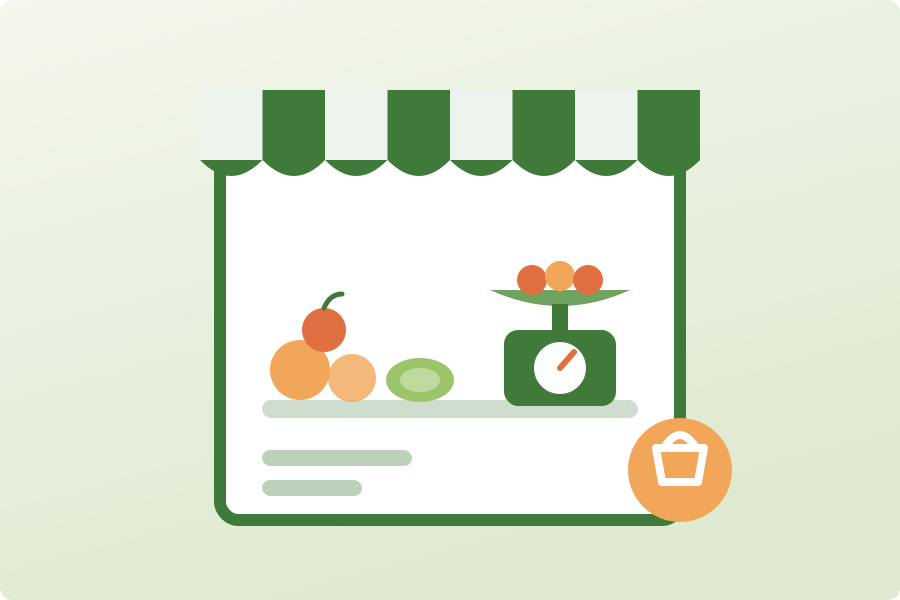
The first time you shop at a Spanish market, the hard part is not the vocabulary. It is the moment a stallholder looks at you and says ¿Qué te pongo? while five people who arrived before you are standing in no visible order. This guide covers the Spanish you need for the mercado de abastos and the supermarket: joining the queue, ordering by weight, the butcher's and fish counters, what is in season, and the small supermarket rules about bags, scales and cards.
If you want the wider picture first, the bar, the lift and the neighbours, start with our guide to everyday Spanish in Spain. For eating out, see how to order tapas and the menú del día. This one stays at the shop counter.
How do you buy at a Spanish market?
You walk in, pick a stall, ask who is last, wait your turn and order out loud: the stallholder serves you, weighs everything and you pay at that stall. There is no basket and no central checkout; each puesto is its own small shop.
The mercado de abastos, also called mercado municipal or plaza, is a covered hall with dozens of stalls: frutería, carnicería, pollería, pescadería, charcutería, quesería, sometimes a bakery and a bar. Most are busiest in the morning, and many stalls close by mid-afternoon, so check the opening hours of your own market before you plan an evening shop. Saturday morning is the social peak.
A few habits that save you embarrassment:
- Greet the stall. Buenos días or simply Buenas when it is your turn.
- Don't touch the fruit at a market stall unless the vendor invites you. You point, they pick. This is the opposite of the supermarket.
- Prices are per kilo and written on small boards. Food stalls do not haggle; bargaining belongs to flea markets such as a rastro.
- Say what it is for. Es para hoy (for today) or para el fin de semana gets you fruit at the right ripeness.
Vendors may call you cariño, reina, guapo or jefe. It is ordinary market warmth, not flirting. Whether to answer with tú or usted is the same question as anywhere in Spain; our guide to greetings, tú and usted in Spain explains the current norm.
What does "¿quién es el último?" mean?
¿Quién es el último? means "who is last?": you ask it when you arrive at a stall, someone says yo, and you are served after that person. You do not have to remember the whole crowd, only the one person ahead of you.
Variants you will hear: ¿Quién da la vez?, ¿El último?, or ¿Quién va ahora? from the vendor. When the next customer arrives and asks, you answer Yo. If someone tries to go ahead of you, a calm Perdona, creo que voy yo (sorry, I think I'm next) is enough.
Number tickets. At busy counters, in supermarket deli and fish sections and in many markets, you take a number from a red dispenser instead: coger número or coger turno. A screen shows Su turno and the number being served.
- ¿Hay que coger número? — Do I need to take a number?
- ¿Por qué número va? — What number are you on?
- Perdona, se me ha pasado el turno. — Sorry, I missed my number.
Being called after your number has passed is usually fine if you say so straight away.
Market myths and facts
- MythNo visible queue means it's every man for himself.FactThe queue exists in people's memory. Ask «¿Quién es el último?» and wait for the person who answers «yo».
- Myth«Cuarto y mitad» is a quarter and a half of a kilo, so 750 g.FactIt is a quarter plus half a quarter: 375 g. 750 g is «tres cuartos».
- MythYou can haggle at a Spanish food market.FactAt food stalls the price per kilo is marked and you pay it. Bargaining belongs to flea markets.
- Myth«Quería» is past tense, so it sounds like you no longer want it.FactIn a shop «quería» is the ordinary polite way to ask: «Quería medio kilo de fresas».
- MythYou can pick up painkillers with your groceries.FactMedicines, even paracetamol, are sold only in Spanish pharmacies. The supermarket parafarmacia has creams and plasters, not medicines.
How to order by weight in Spanish
Order with póngame, ¿me pone…? or quería, then the quantity, then the product: Póngame medio kilo de tomates. The vendor will ask ¿Algo más? after each item until you say Nada más, gracias.
Quería (literally "I wanted") is the polite standard in shops; it is not past tense here. With a vendor who uses tú, ponme and ¿me pones…? are just as normal.
| You say | It means |
|---|---|
| un kilo | 1 kg |
| medio kilo | 500 g |
| un cuarto (de kilo) | 250 g |
| cuarto y mitad | 375 g: a quarter plus half a quarter |
| tres cuartos | 750 g |
| cien gramos | 100 g |
| un kilo y medio | 1.5 kg |
Cuarto y mitad is the famous one, and the dictionary of the Real Academia Española defines it exactly as a portion of 375 grams. You will hear it most at the butcher's and the charcutería.
Not everything goes by weight:
- una docena / media docena de huevos — a dozen / half a dozen eggs
- un manojo de perejil — a bunch of parsley
- una pieza / un par de pechugas — one piece / a couple of chicken breasts
- una malla de naranjas — a net of oranges
- una bandeja — a tray (supermarket packs)
When the scale goes over, the vendor asks Se ha pasado un poco, ¿se lo dejo? (it's a bit over, shall I leave it?). Sí, déjelo or Quítele un poco settles it. To pay: ¿Cuánto es? or ¿Qué le debo?
Spanish phrases for the butcher's and the deli counter
At the carnicería you say the cut and then how you want it prepared: Medio kilo de ternera para guisar, en tacos. The butcher does the work; your job is to name the dish.
- Carne picada, mitad cerdo, mitad ternera. — Mince, half pork, half beef.
- ¿Me la pica, por favor? — Could you mince it for me?
- Filetes finos, para empanar. — Thin steaks, for breading.
- Un pollo troceado. — A chicken cut into pieces.
- Sin hueso. / Deshuesado. — Boneless.
- Quíteme la grasa, por favor. — Take the fat off, please.
Ternera is beef from a young animal and the default word for beef at the counter; cerdo is pork, cordero lamb.
At the charcutería everything is sliced to order:
- Cien gramos de jamón, en lonchas finas. — 100 g of ham, thinly sliced.
- Un cuarto de queso manchego, en cuña. — 250 g of manchego, as a wedge.
- ¿Me lo pone en taquitos? — Can you dice it?
- ¿Puedo probarlo? — Can I taste it?
Asking to taste cheese or olives is normal at a market stall.
At the fish counter: how to ask for it cleaned
Choose the fish, then say how you will cook it: the fishmonger cleans, scales and cuts it for free. ¿Me lo limpia para la plancha? is often all you need.
- ¿Me lo limpia? — Could you clean it?
- En rodajas. / En lomos. — In steaks. / In loins.
- Abierto, para la plancha. — Butterflied, for the griddle.
- Sin cabeza, pero guárdeme la cabeza y la raspa para caldo. — Without the head, but keep the head and backbone for stock.
- Para freír. / Para el horno. — For frying. / For the oven.
- ¿Es de aquí? / ¿Es de piscifactoría? — Is it local? / Is it farmed?
- ¿Cómo lo hago? — How should I cook it?
The last question is the best one you can ask. Fishmongers like it, and you get a recipe in Spanish for free. Expect thin choice on Mondays in many places, because fishing boats often do not go out at weekends.
Counters are where the conversation speeds up: the butcher answers your question with three of his own. If you want to rehearse these situations before the real thing, our Spanish for moving to Spain course practises the market, the bank and the doctor's one-to-one with a teacher.
What fruit and vegetables are in season in Spain?
In winter it is citrus; in spring strawberries, artichokes and asparagus; in summer stone fruit, melon and watermelon; in autumn grapes, figs, persimmons, pomegranates and chestnuts. At a market, the in-season produce is the cheapest and the most prominent on the stall.
| Season | Typical produce | Words to know |
|---|---|---|
| Winter | naranjas, mandarinas, alcachofas, coliflor | de temporada, de la tierra |
| Spring | fresas, espárragos, habas, guisantes | ¿Ya hay fresas? |
| Summer | melocotones, nectarinas, melón, sandía, tomates | ¿Está maduro? |
| Autumn | uvas, higos, caquis, granadas, castañas | ¿Son de aquí? |
Spain's Ministry of Agriculture publishes an official fruit and vegetable season calendar; dates vary by region, so treat the table as a rough guide. Two words trip newcomers up: in Spain a peach is melocotón and a potato is patata. The Latin American durazno and papa will be understood but sound foreign. Our comparison of Spanish from Spain and Latin America has more of these pairs.
Spanish supermarket basics: bags, scales and loyalty cards
At the supermarket you serve yourself, but three things catch newcomers out: carrier bags cost money, loose fruit often has to be weighed by you, and the cashier will ask whether you have a store card.
Bags. Plastic carrier bags generally cost a few cents: Real Decreto 293/2018 ended free plastic bags in July 2018, and thin non-compostable carrier bags have been banned since 2021. The cashier asks ¿Quiere bolsa? Answer No, gracias, traigo (I've brought one) or Sí, una, por favor. The thin bags in the fruit section are there for loose produce.
Scales. In many supermarkets you put loose fruit in a bag, weigh it on the scale, press the product's number and stick the label on. Plastic gloves (guantes) next to the fruit are expected. If there is no scale, the cashier weighs it.
- ¿Esto se pesa aquí o en caja? — Do I weigh this here or at the till?
Loyalty cards. At the till you will hear ¿Tiene la tarjeta? or ¿Eres socio?. Several chains run programmes: Club Carrefour, Lidl Plus (an app), Club Dia. Mercadona does not run a points scheme. No, no tengo is a full answer.
At the till.
- ¿Me da el ticket, por favor? — Could I have the receipt?
- ¿Se puede pagar con tarjeta? — Can I pay by card?
- Caja de autocobro — self-checkout.
- Oferta, 2x1, segunda unidad al 50% — offer, two for one, second item half price.
Ready for the mercado?
How much is «cuarto y mitad»?
What does a real conversation at a Spanish market counter sound like?
Short, fast and built from the same five moves: greeting, order, preparation, ¿algo más?, payment. Below are four full exchanges as they really run, so you can hear where each phrase from this guide fits.
At the fishmonger's (pescadería)
— Buenas. ¿Quién es el último? — Yo. — Vale, gracias. (…a few minutes later…) — ¿Qué te pongo, guapa? — Quería dos doradas. ¿Son de aquí? — Son de piscifactoría, pero muy buenas. Las salvajes están ahí, a veintidós. — Pues las de piscifactoría. ¿Me las limpia para el horno? — ¿Con cabeza o sin cabeza? — Con cabeza. Y sin escamas, por favor. — Hecho. ¿Algo más? — Sí, medio kilo de gambas. ¿Cómo las hago? — A la plancha, con sal gorda y ya está. ¿Nada más? — Nada más. ¿Qué le debo?
Note that the vendor quoted the wild fish a veintidós: "at twenty-two (euros a kilo)". The unit is never said; you are expected to know it is per kilo.
At the butcher's (carnicería)
— Buenos días. Póngame un kilo de carne picada, mitad y mitad. — ¿Cerdo y ternera? — Sí. Y cuatro filetes de pechuga, finitos. — ¿Para empanar? — Eso es. — Se ha pasado un poco, un kilo cien. ¿Se lo dejo? — Sí, déjelo. — ¿Algo más? Hoy tengo costillas muy buenas. — No, nada más, gracias.
The butcher's suggestion (hoy tengo…) is normal selling, not pressure. No, gracias is fine.
At the bakery (panadería)
Spanish bread has its own vocabulary: una barra is the standard long loaf, una pistola or media barra a smaller one, una chapata a ciabatta, pan integral wholemeal, una hogaza a big round country loaf. Names vary by region; when in doubt, point and say esa de ahí.
— Hola, una barra, por favor. Bien hecha, si puede ser. — ¿Te la corto? — No, entera. Y dos cruasanes. — ¿Algo más? — ¿El pan de centeno es de hoy? — Sí, todo es de hoy. — Pues medio, cortado en rebanadas.
Bien hecha means well baked (crusty); poco hecha is paler and softer. En rebanadas means sliced.
At the deli (charcutería), with a number ticket
— ¡El cuarenta y tres! — Yo. Cien gramos de jamón serrano, muy fino. — ¿Se lo pongo en papel o en bandeja? — En papel. Y un cuarto de queso de cabra, en cuña. — ¿Quiere probarlo? — Sí, gracias… Muy rico. Ese mismo.
If you miss what was said, ¿Perdón? or ¿Cómo dice? is better than nodding. Vendors repeat without irritation; they are used to it.
How do you read food labels in Spain: fecha de caducidad vs consumo preferente?
Spanish packaging uses two different dates. Fecha de caducidad (use-by) is a safety date for perishable food such as fresh meat, fish and some dairy; consumir preferentemente antes del… (best before) is a quality date for things like pasta, biscuits or tins, which are usually still safe after it.
Both come from the EU food information rules (Regulation (EU) No 1169/2011), so the wording is the same in every Spanish supermarket. The regulation treats food past its use-by date as unsafe; past best before it may simply lose flavour or texture.
| On the label | Meaning | What to do |
|---|---|---|
| Fecha de caducidad: 28/11 | use by 28 November | do not eat after that date |
| Consumir preferentemente antes del 03/2027 | best before March 2027 | quality date, check smell and look |
| Consumir antes de… | use by (short form) | treat as a safety date |
| Una vez abierto, consumir en 3 días | once opened, use within 3 days | count from opening |
| Conservar en frío / en lugar fresco y seco | keep refrigerated / in a cool, dry place | storage instruction |
| Ingredientes | ingredients | allergens are highlighted in bold or capitals |
| Puede contener trazas de… | may contain traces of… | voluntary allergen warning |
| Sin gluten / sin lactosa | gluten-free / lactose-free | dietary claims |
| Peso neto / peso escurrido | net weight / drained weight | tins: escurrido is without the liquid |
| Origen: España / Producto de… | origin | often on fruit, meat, fish and honey |
Dates are written day/month/year: 05/12 is 5 December, not 12 May. That alone catches out many American shoppers.
Useful phrases at the counter: ¿Hasta cuándo aguanta? (how long will it keep?), ¿Tiene fecha más larga? (do you have one with a later date?), ¿Esto lleva frutos secos? (does this contain nuts?). For allergies, Soy alérgico/alérgica a… is the phrase to learn by heart.
Can you buy medicines in a Spanish supermarket?
No. In Spain medicines, including paracetamol and ibuprofen, are sold only in pharmacies (farmacias, marked with a green cross): the Ley de garantías y uso racional de los medicamentos (article 3.6) reserves their dispensing to oficinas de farmacia. Supermarkets may have a parafarmacia or droguería-perfumería aisle, but it sells cosmetics, sun cream, nappies, baby food and supplements, not medicines.
What you find in each place:
| Section | Spanish | What it sells |
|---|---|---|
| Household / cleaning | droguería, limpieza | detergent (detergente), bleach (lejía), washing-up liquid (lavavajillas) |
| Toiletries | perfumería, higiene | shampoo (champú), toothpaste (pasta de dientes), deodorant (desodorante) |
| Baby | bebé | nappies (pañales), wipes (toallitas), baby food (potitos) |
| Parafarmacia | parafarmacia | creams, plasters (tiritas), some supplements |
| Pharmacy | farmacia | all medicines, prescription or not |
So when you need something for a headache, walk out of the supermarket to the nearest green cross:
— Buenas tardes. ¿Tiene algo para el dolor de cabeza? — ¿Paracetamol o ibuprofeno? — Ibuprofeno. ¿Necesito receta? — El de cuatrocientos, no. El de seiscientos, sí. — Pues el de cuatrocientos. Y unas tiritas. — ¿Algo más? — No, eso es todo.
Pharmacists in Spain give real advice; ¿Qué me recomienda para…? (what do you recommend for…?) is a normal question. For prescriptions, the tarjeta sanitaria and the duty pharmacy, see our guide to Spanish at the doctor in Spain.
How do you order groceries online in Spain?
Most large Spanish chains deliver: you fill a basket on the website or app, choose a delivery slot (franja horaria), and a driver (repartidor) brings the order. The Spanish you need is on the screen and at the door, and it is shorter than at the market.
Words you will see on the website:
| Spanish | Meaning |
|---|---|
| añadir a la cesta / al carrito | add to basket |
| pedido mínimo | minimum order |
| gastos de envío | delivery charge |
| franja horaria | delivery slot |
| dirección de entrega | delivery address |
| piso, puerta, escalera | floor, door, staircase (important in Spanish flats) |
| sustituir / no sustituir | replace / do not replace a missing item |
| producto agotado | out of stock |
| recoger en tienda | click and collect |
| devolución / reembolso | return / refund |
Always fill in the floor and door: an address like Calle Mayor 12, 3.º B means third floor, door B. Without it, the driver will phone you, and the call will be in fast Spanish.
At the door:
— ¡Hola! Pedido para Ana López. — Sí, soy yo. Pase, es aquí. — Le dejo las bolsas en la entrada. Le falta el pan, que estaba agotado, y el yogur natural se lo hemos cambiado por otro de la misma marca. — Vale. ¿Tengo que firmar? — No, ya está. Que vaya bien.
If something arrives broken or missing, the shops expect you to report it through the app or the customer service line (atención al cliente): Me ha llegado un producto roto (an item arrived broken), Me falta un producto del pedido (an item is missing), Quería reclamar (I'd like to make a complaint).
Common mistakes English speakers make at the Spanish market
Most errors come from translating English shopping habits word for word. Here are the ones teachers hear most often, with the form a Spaniard would use.
| Mistake | Why it's wrong | Say instead |
|---|---|---|
| ¿Puedo tener medio kilo? | literal "Can I have", sounds odd | ¿Me pone medio kilo? |
| Estoy esperando por el último | "wait for" doesn't take por here | Estoy esperando. ¿Quién es el último? |
| Una libra de tomates | Spain uses kilos and grams | Medio kilo de tomates |
| Quiero el recibo | recibo is a bill or utility receipt | ¿Me da el ticket? |
| Rodajas de jamón | ham is sliced in lonchas | Lonchas de jamón |
| Papas y duraznos | Latin American words | Patatas y melocotones |
| Es caducado | state, not identity | Está caducado (it's out of date) |
| Estoy embarazada for "embarrassed" | it means pregnant | Qué vergüenza |
| Groserías for groceries | means rude words | la compra (hacer la compra) |
The last two are classic false friends. "To do the grocery shopping" is simply hacer la compra, and the shopping itself, bags and all, is la compra.
Practice dialogue at the fishmonger's
The fish counter is where many learners freeze, because the fishmonger asks follow-up questions. Read this aloud a few times.
Pescadero: ¡Buenos días! ¿Quién es el último? Tú: Soy yo. ¿Me pone un kilo de mejillones, por favor? Pescadero: Aquí tiene. ¿Algo más? Tú: Sí, quería dos doradas. ¿Me las puede limpiar? Pescadero: Claro. ¿Se las preparo para hacer a la plancha o al horno? Tú: Al horno, por favor. Y quíteles la cabeza, si no le importa. Pescadero: Muy bien. ¿Le pongo también un poco de perejil? Tú: Sí, gracias. Eso es todo. ¿Cuánto es?
Notice the key structures. ¿Quién es el último? is how you find your place in the queue, and you answer soy yo when you are the last one. ¿Me pone...? literally means will you put me, and it is the standard polite way to order at any counter in Spain. Quería, in the imperfect, sounds softer than quiero. Limpiar el pescado means cleaning and gutting it, and at most counters the fishmonger will happily do it if you ask. Si no le importa, if you don't mind, makes any request sound friendlier.
Market and supermarket vocabulary
| Spanish | English |
|---|---|
| el puesto | stall |
| el turno | turn, number |
| el precio por kilo | price per kilo |
| a granel | loose, unpackaged |
| maduro / verde | ripe / unripe |
| la loncha | slice (ham, cheese) |
| la rodaja | round slice, fish steak |
| la raspa | fish backbone |
| la carne picada | mince |
| la caja | till, checkout |
| el ticket | receipt |
| la bolsa | bag |
Learn the order phrases first, the quantities second, the product names last: a vendor can point to a fish you cannot name, but not to a quantity you cannot say.
Product words by aisle
| Aisle | Spanish | English |
|---|---|---|
| Dairy | leche entera / semidesnatada / desnatada | whole / semi-skimmed / skimmed milk |
| Dairy | nata para montar / nata para cocinar | whipping cream / cooking cream |
| Dairy | queso fresco, queso curado | fresh cheese, aged cheese |
| Bakery | barra, pan de molde, bollería | baguette, sliced bread, pastries |
| Meat | pechuga, muslo, costillas, lomo | breast, thigh, ribs, loin |
| Fish | merluza, bacalao, dorada, lubina, gambas | hake, cod, sea bream, sea bass, prawns |
| Fruit & veg | pimiento, calabacín, berenjena, judías verdes | pepper, courgette, aubergine, green beans |
| Pantry | aceite de oliva virgen extra, harina, garbanzos | extra virgin olive oil, flour, chickpeas |
| Frozen | congelados, ultracongelados | frozen food |
| Drinks | agua con gas / sin gas, zumo | sparkling / still water, juice |
| Household | lejía, suavizante, papel higiénico | bleach, fabric softener, toilet paper |
Frequently asked questions
What does "cuarto y mitad" mean in Spanish?
It is 375 grams: a quarter kilo (250 g) plus half of a quarter (125 g). The Real Academia Española defines it exactly that way. You hear it mostly at the butcher's and the deli counter: «Cuarto y mitad de carne picada, por favor».
What do you say when you arrive at a market stall in Spain?
Greet and ask who is last: «Buenas, ¿quién es el último?». Someone answers «yo», and you are served after that person. When the next customer asks, you answer «yo».
How do you ask for food by weight in Spanish?
Use «póngame», «¿me pone…?» or «quería», then the quantity and the product: «Póngame medio kilo de tomates». Medio kilo is 500 g, un cuarto 250 g, cuarto y mitad 375 g, tres cuartos 750 g.
Are plastic bags free in Spanish supermarkets?
Generally not. Real Decreto 293/2018 ended free plastic carrier bags in 2018, and thin non-compostable carrier bags have been banned since 2021. The cashier will ask «¿Quiere bolsa?»; most people bring their own.
Do you weigh fruit yourself in Spanish supermarkets?
Often, yes. In many supermarkets you bag loose fruit, weigh it on a scale, press the product number and stick on the label, using the plastic gloves provided. If you see no scale, ask «¿Esto se pesa aquí o en caja?».
What is the difference between fecha de caducidad and consumo preferente?
«Fecha de caducidad» is a use-by date for perishable food such as fresh meat or fish: do not eat it after that date. «Consumir preferentemente antes del…» is a best-before date for quality; pasta, biscuits or tins are usually still safe afterwards. Both come from EU Regulation 1169/2011.
Can you buy paracetamol or ibuprofen in a Spanish supermarket?
No. In Spain medicines are sold only in pharmacies (farmacias, with a green cross). The supermarket parafarmacia aisle sells creams, plasters and baby products, not medicines. Ibuprofen 400 mg comes in non-prescription packs; 600 mg needs a prescription.
Book your free trial lesson
One to one with a native teacher, on Zoom.
Times shown in your zone: Europe/Madrid
1. Pick a day
Loading the timetable…
3. Your email for the confirmation and the Zoom link
One-to-one lessons with a native teacher
On Zoom with a qualified teacher from Spain who also speaks English.