Summer in Spain: Spanish for the beach, heat and holidays
Your first Spanish summer comes with its own vocabulary. At the beach a lifeguard blows a whistle and shouts something you do not catch, a yellow flag flaps over the tower, the town hall posts an aviso naranja por calor, your office suddenly closes at three, and half the shops on your street put up a sign that says cerrado por vacaciones. None of this is hard once you know the words, but most phrasebooks stop at una cerveza, por favor.
This guide covers summer in Spain the way you actually live it: what the beach flags mean, what a chiringuito and a socorrista are, the rules that local councils really enforce, how to read an AEMET heat warning, summer office hours, public holidays and puentes, the municipal pool, summer festivals, ready-to-use dialogues, a vocabulary list and the mistakes English speakers make most often. One point of caution runs through all of it: beach and pool rules are set locally, by each town hall (ayuntamiento) and region, so always check the sign at the entrance of the beach you are on.
What do the beach flag colours mean in Spain?
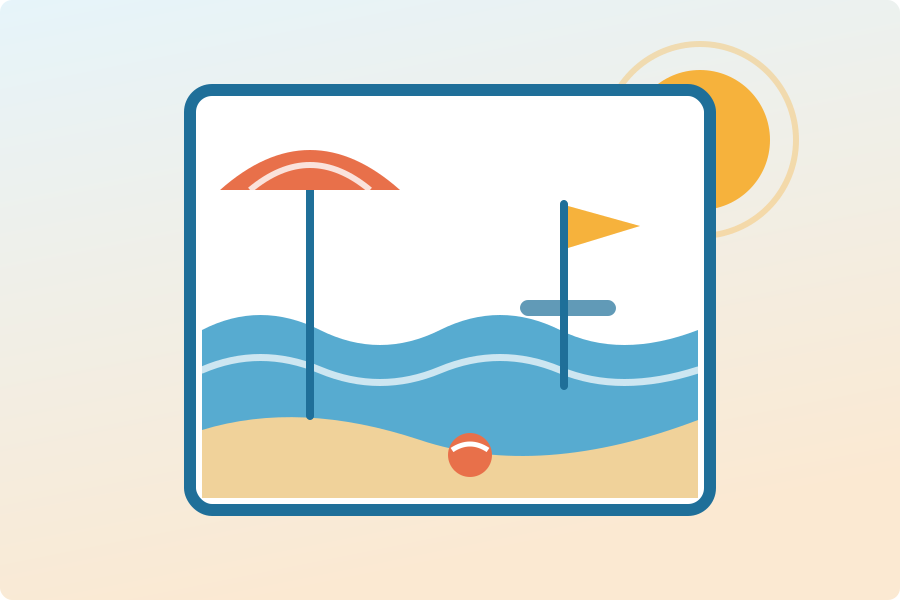
On a supervised beach in Spain, a green flag means bathing is allowed and the sea is calm, a yellow flag means you can swim but with caution, and a red flag means bathing is prohibited. The flags describe the state of the sea right now, not the water quality, and they can change several times in one day.
The flags are hoisted by the lifeguard service, usually on the lifeguard tower (torre de vigilancia) or a pole near the access point. Here is what you are likely to see:
- Bandera verde - calm sea, bathing allowed. It does not mean "no risk": currents and sudden drops can still exist.
- Bandera amarilla - baño con precaución. Waves, wind or currents are stronger than usual. Stay where you can stand, do not swim far out, and keep children close.
- Bandera roja - prohibido el baño. Going into the water with a red flag is not a matter of personal choice; many municipal bylaws treat it as an offence, and the lifeguard or the local police (Policía Local) can call you out of the water.
- Jellyfish flag - a white flag with a jellyfish drawn on it (bandera de medusas) is used on many beaches to warn that jellyfish have been seen. It usually flies together with a yellow or red flag.
- Other flags - depending on the region you may see a flag that signals the lifeguard is not on duty, or a different colour for contaminated water. These extras are not used the same way everywhere, so read the information panel at the beach entrance; it normally explains the local code.
The Blue Flag (Bandera Azul) is a different thing altogether. It is an environmental award given to beaches and marinas that meet criteria on water quality, services and safety. It is a quality label for the season, not a daily safety signal, so a Blue Flag beach can still have a red flag on a rough day.
Outside the lifeguard season, or outside the lifeguard's hours (often roughly from late morning to early evening, but every town sets its own), there may be no flag at all. No flag means no supervision, not "safe".
Chiringuito, socorrista and other beach words you will hear
A chiringuito is a beach bar, usually a simple structure on the sand or the promenade that sells drinks, snacks, grilled sardines or paella. A socorrista is a lifeguard. These two words, together with sombrilla, toalla and hamaca, cover most beach conversations.
The chiringuito is a summer institution. Some are basic kiosks, others are full restaurants with tables on the sand. You can order a caña (small draught beer), a tinto de verano (red wine with lemonade or soda), a clara (beer with lemonade), espetos of sardines on the Málaga coast, or simply un agua fría. If you already know how the vermouth hour works, our article on the vermouth hour, terraces and who pays explains the same bar etiquette that applies at the chiringuito.
The socorrista sits in the tower or patrols the shore. Lifeguards whistle (pitar) when someone swims too far or ignores the flag, and they often give instructions by hand signals. If you hear ¡Fuera del agua! or ¡Salgan del agua!, it means "Get out of the water". ¡No pases de las boyas! means "Do not go past the buoys". The lifeguard post usually has a first aid point (puesto de socorro or puesto de primeros auxilios) where you can go if a jellyfish stings you or a child gets lost.
Other words you will hear on the sand:
- la sombrilla - beach umbrella (el parasol is used too, but sombrilla is the everyday word).
- la hamaca or la tumbona - sun lounger, often rented by the day or half day.
- la toalla - towel.
- la crema solar or el protector solar - sunscreen.
- las chanclas - flip-flops.
- el bañador - swimsuit (in some regions el traje de baño or el biquini for a bikini).
- la orilla - the shoreline, where the water meets the sand.
- el paseo marítimo - the seafront promenade.
- las duchas and los lavapiés - showers and foot washes at the beach exit.
- la marea - tide, important on the Atlantic coast and in the north.
A small detail that surprises newcomers: Spaniards say ir a la playa for going to the beach, but bañarse for going into the water. Nadar means actually swimming, with strokes. You can bañarse without nadar, which is what most people at the beach do.
Beach rules in Spain: what is allowed and what can get you fined?
There is no single national list of beach rules for bathers. The State owns and protects the coast through the Coastal Law, but everyday use of each beach is regulated by municipal bylaws (ordenanzas municipales) and, for safety and lifeguards, by regional rules. That is why the same thing can be allowed in one town and fined in the next.
Rules that appear in many Spanish municipal ordinances include:
- No swimming with a red flag. This is the rule most commonly enforced. Fines are set locally and, according to press reports on several regional rules, can reach hundreds of euros.
- Dogs only on designated beaches. During the bathing season most beaches do not allow dogs, but many towns have a playa canina where they are welcome. Look for the sign.
- Smoke-free beaches. A growing number of towns have declared playas sin humo, where smoking is banned or discouraged. Some impose fines; others only ask.
- No camping or sleeping on the beach. Tents and overnight stays are usually not allowed.
- No reserving spots in advance. Some councils remove umbrellas and towels left early in the morning to "reserve" a place, and some fine it.
- Soap and shampoo. Using gel or shampoo in the beach showers is often prohibited.
- Ball games and loud music. Many ordinances restrict ball games near other people and loud music. Speakers are a common source of complaints.
- Fishing and boats. Fishing is restricted in bathing areas during the season, and boats and jet skis must stay outside the marked bathing zone (zona de baño balizada).
- Glass and rubbish. Glass containers are banned on many beaches, and leaving rubbish is always a fine-worthy offence.
Nudism is not banned by Spanish national law, and there are many traditional nudist beaches (playas nudistas). Some municipalities regulate it locally, so again, the sign at the beach entrance is your guide.
The practical rule: before you lay down your towel, read the panel at the access point. It is usually in Spanish and, in tourist areas, also in English. Phrases to look for: prohibido, no se permite, queda prohibido, sanción or multa (fine), animales de compañía (pets) and temporada de baño (bathing season).
Summer in Spain: myths and facts
- MythA Blue Flag means the beach is safe for swimming today.FactThe Blue Flag is a seasonal environmental award. Daily safety is shown by the green, yellow and red flags, and a Blue Flag beach can still fly a red flag.
- MythBeach rules are the same all over Spain.FactDay-to-day beach rules come from municipal bylaws and regional rules, so dogs, smoking or reserving spots can be allowed in one town and fined in the next.
- MythNo flag on the tower means the sea is fine.FactNo flag usually means no lifeguard on duty. It is not a green light.
- MythEveryone in Spain has a jornada intensiva in summer.FactThe continuous summer day depends on the collective agreement or company policy. It is common, but not a general legal right.
What does an AEMET heat warning mean?
AEMET, the State Meteorological Agency, issues weather warnings in three levels: yellow (amarillo), meaning a risk for specific activities; orange (naranja), meaning a significant risk; and red (rojo), meaning an extraordinary risk. For heat, the threshold for each level depends on the area, because 38 degrees is normal in parts of Andalusia but exceptional on the Cantabrian coast.
The warnings are part of AEMET's Plan Meteoalerta, and they are published on aemet.es by zone, not just by province. Warnings are usually issued a few days in advance, so check the map before a trip. Typical wording you will see in the news and on official accounts:
- aviso amarillo por temperaturas máximas - yellow warning for high maximum temperatures.
- aviso naranja por calor - orange heat warning.
- ola de calor - heatwave. AEMET uses this term only when high temperatures affect a wide area for several days in a row, not for a single hot afternoon.
- noche tropical - a night when the temperature does not drop below 20 degrees; noche tórrida is used when it stays above 25.
- golpe de calor - heatstroke.
What to do with a warning? The health authorities repeat the same advice every summer: drink water without waiting to feel thirsty, avoid physical effort in the hottest hours (roughly midday to late afternoon), stay in the shade or in air-conditioned places, never leave anyone in a parked car, and keep an eye on older neighbours, babies and people with chronic illnesses. In an emergency, call 112.
Heat warnings also matter at work. Since 2023, Spanish law requires employers to adapt outdoor work when AEMET issues an orange or red warning, for example by changing schedules or stopping certain tasks in the hottest hours. How this applies to your job depends on your sector and your company's risk prevention plan, so ask your employer or your servicio de prevención.
Summer hours in Spain: jornada intensiva and shops in August
Many Spanish offices switch to the jornada intensiva in summer: a continuous working day, typically from about 8:00 to 15:00, with no long lunch break. It usually runs in July and August, sometimes from mid-June to mid-September, depending on the company and the collective agreement.
The jornada intensiva is not a legal right for everyone; it depends on the convenio colectivo or on company policy. Public administration offices have their own summer hours, and many of them only attend the public in the morning. If you need an appointment at a town hall or a regional office in August, check the hours and expect fewer available slots.
Shops and services also change rhythm:
- Big stores and supermarkets usually keep normal hours, and in tourist areas they may even open longer.
- Small businesses - the hairdresser, the dry cleaner, the family-run bakery, the local bar - often close for two to four weeks in August. The sign on the door says cerrado por vacaciones and usually gives the return date: volvemos el 1 de septiembre.
- Health centres run on reduced staff, and your usual family doctor may be on holiday.
- Cities empty out. Madrid in mid-August is noticeably quieter, while the coast fills up.
Meal times shift later too. Dinner at 22:00 is ordinary in summer, and children are out in the squares until late. If you want the full picture of Spanish timetables, our article on the siesta and Spanish schedules explains when Spaniards actually eat, work and rest.
Vocabulary for timetables: horario de verano (summer timetable), abierto de lunes a viernes (open Monday to Friday), por la mañana (in the morning), por la tarde (in the afternoon or early evening), cerramos a mediodía (we close at midday), de 9 a 14 h (from 9 to 2).
Public holidays and puentes in summer in Spain
The only national public holiday in the core of the summer is 15 August, the Assumption (la Asunción or la Virgen de agosto). The other summer holidays are regional or local, and they change from one region and town to another.
Examples of summer holidays you may meet, depending on where you live:
- 24 June, San Juan - a holiday in Catalonia and, in some years, in other regions such as the Valencian Community. The night before, la noche de San Juan, is celebrated with bonfires and fireworks, often on the beach.
- 25 July, Santiago Apóstol - the National Day of Galicia and a holiday in Galicia; some other regions include it in certain years.
- Local holidays - every municipality has two local holidays a year, and many towns put one of them in the middle of the summer fiestas.
Each region publishes its official holiday calendar in its official bulletin, and the national list appears in the Boletín Oficial del Estado (BOE). Check your region's calendar for the current year rather than relying on last year's.
A puente (literally "bridge") is the habit of taking an extra day off between a holiday and the weekend. If 15 August falls on a Thursday, many people take Friday off too, and you will hear hacemos puente. A long weekend created by a holiday on a Monday or Friday is simply a fin de semana largo or, in the news, an operación salida when traffic authorities expect heavy departures. The operación salida of summer usually refers to the start of July and the start of August, when millions of cars leave the cities.
School holidays matter as much as public holidays for family life: in most regions the school year ends around the third week of June and begins again in the first half of September. Summer camps are called campamentos de verano or campus de verano, and town halls often run escuelas de verano for children.
Going to the public swimming pool: rules and vocabulary
A public outdoor pool in Spain is usually called a piscina municipal or piscina de verano, and it typically opens from around mid-June to early September. You buy a ticket at the entrance (entrada) or a season pass (abono de temporada), and residents often pay less than visitors.
Each pool has its own rules, posted at the entrance as normas de uso. Common ones include:
- Shower before swimming - es obligatorio ducharse antes del baño.
- Swimming cap - in many indoor pools and some outdoor ones a cap (gorro de baño) is compulsory. Many summer pools do not require it, so check.
- Children - children under a certain age must be accompanied by an adult; the age varies.
- Food and glass - eating is often allowed only in the lawn area (zona de césped) or not at all, and glass is banned.
- Swimwear - street clothes in the water are not allowed, and some pools ask for proper swimwear rather than shorts.
- Lifeguard instructions - the socorrista can ask you to stop running, jumping or playing rough.
Many residential buildings and gated communities have a piscina comunitaria, a shared pool for residents. The comunidad de propietarios sets the rules: opening dates, hours, guests, wristbands or keys, and whether there is a lifeguard. If you rent, ask the landlord or the building administrator for the pool rules and who to talk to.
Useful sentences at the pool:
- ¿Cuánto cuesta la entrada? - How much is the ticket?
- ¿Hay abono para el verano? - Is there a summer pass?
- ¿Es obligatorio el gorro? - Is a cap compulsory?
- ¿A qué hora cierra la piscina? - What time does the pool close?
- ¿Dónde están los vestuarios? - Where are the changing rooms?
- ¿Hay taquillas? - Are there lockers?
- Mi hijo ha perdido la pulsera. - My son has lost his wristband.
Summer festivals in Spain: what to say at the verbena
Summer is the high season of Spanish fiestas. Almost every town and city neighbourhood holds its fiestas patronales between June and September, with a verbena (open-air dance at night), fireworks (fuegos artificiales), a fair with rides (la feria), processions and food stalls.
Some summer festivals are famous abroad:
- La noche de San Juan (23 June) - bonfires on beaches and in squares across many regions, with the Hogueras de San Juan in Alicante as one of the best-known versions.
- San Fermín (6-14 July) - Pamplona's festival, known for the bull runs (encierros), with white clothes and a red scarf (pañuelo rojo).
- La Tomatina (late August) - the tomato fight in Buñol, Valencia. Access is limited and has required a ticket for years, so check the official information before you plan.
- Semana Grande - the big August week in several northern cities, such as San Sebastián and Bilbao (where it is called Aste Nagusia).
Local fiestas often have peñas, groups of friends with their own premises and matching shirts, and casetas, temporary bars or tents. Our guide to local fiestas, casetas, peñas and verbenas explains how to join in without feeling like an outsider.
Phrases for the fiesta:
- ¿A qué hora empiezan los fuegos? - What time do the fireworks start?
- ¿Dónde es la verbena esta noche? - Where is the dance tonight?
- ¿Hay que pagar para entrar? - Do you have to pay to get in?
- ¿Dónde está el programa de fiestas? - Where is the festival programme?
- ¡Felices fiestas! - Happy fiestas!
Dialogues: Spanish at the beach, the pool and in the heat
Short dialogues are the fastest way to fix the vocabulary in your head. Read them aloud: you will hear these exact exchanges in real life.
At the beach, with the lifeguard
- Tú: Perdone, ¿se puede bañar hoy? Veo la bandera amarilla.
- Socorrista: Sí, pero con precaución. Hay corriente cerca de las rocas, así que quédate en esta zona y no pases de las boyas.
- Tú: Vale. ¿Y hay medusas?
- Socorrista: Esta mañana hemos visto algunas. Si te pica una, ven al puesto de socorro y te lo lavamos con agua salada.
- Tú: Muchas gracias.
At the chiringuito
- Camarero: ¡Hola! ¿Qué os pongo?
- Tú: Para mí un tinto de verano y para ella una clara. ¿Tenéis algo para picar?
- Camarero: Tenemos espetos, calamares y patatas bravas.
- Tú: Pues una ración de calamares, por favor. ¿Podemos pagar con tarjeta?
- Camarero: Claro, sin problema.
Renting a sun lounger
- Tú: Buenos días, ¿cuánto cuestan dos hamacas y una sombrilla?
- Empleado: ¿El día entero o media jornada?
- Tú: Solo la mañana, hasta las dos.
- Empleado: Pues media jornada. Elige la fila que quieras, la primera está libre.
At the municipal pool
- Tú: Hola, dos entradas de adulto y una infantil, por favor.
- Taquillera: ¿Estáis empadronados en el pueblo? Los empadronados pagan menos.
- Tú: Sí, aquí tengo el volante de empadronamiento.
- Taquillera: Perfecto. Recordad que es obligatorio ducharse antes de entrar al agua y que no se puede comer en la zona de la piscina, solo en el césped.
At work, during a heat warning
- Compañera: ¿Has visto que hay aviso naranja mañana?
- Tú: Sí, dicen que vamos a llegar a cuarenta y uno. ¿Cambiamos el horario de las visitas?
- Compañera: El jefe dice que las visitas a obra se hacen solo por la mañana, hasta las doce.
- Tú: Mejor. Con este calor no se puede trabajar fuera por la tarde.
With a neighbour in August
- Vecina: ¿Te quedas en Madrid en agosto?
- Tú: La primera quincena sí, luego me voy a la costa. ¿Y tú?
- Vecina: Nosotros hacemos puente el 15 y nos vamos al pueblo. Oye, la panadería cierra todo el mes, ¿lo has visto?
- Tú: Sí, pone que vuelven el uno de septiembre.
Notice two things. First, Spaniards use vosotros forms a lot in shops and bars (¿Qué os pongo?, ¿Estáis empadronados?): it is the normal plural "you" in Spain. Second, a quincena is a fortnight, and Spaniards plan August holidays in quincenas: la primera quincena de agosto, la segunda quincena.
If you want to practise these situations out loud with a teacher, a one-to-one course lets you rehearse exactly the conversations you need: one-to-one Spanish lessons with Sandra, in Spanish and adapted to your level.
Summer in Spain vocabulary list
This list gathers the words from the whole article, grouped by situation, so you can review it before a trip or print it for the fridge.
Beach and sea
| Spanish | English |
|---|---|
| la playa | beach |
| la arena | sand |
| la orilla | shoreline |
| la ola | wave |
| la corriente | current |
| la marea alta / baja | high / low tide |
| la bandera roja / amarilla / verde | red / yellow / green flag |
| el socorrista | lifeguard |
| el puesto de socorro | first aid post |
| la medusa | jellyfish |
| la picadura | sting, bite |
| la sombrilla | beach umbrella |
| la hamaca, la tumbona | sun lounger |
| el chiringuito | beach bar |
| el paseo marítimo | seafront promenade |
| bañarse | to go in the water |
| tomar el sol | to sunbathe |
| quemarse | to get sunburnt |
Heat and weather
| Spanish | English |
|---|---|
| hace calor | it is hot |
| tengo calor | I am hot |
| la ola de calor | heatwave |
| el aviso amarillo / naranja / rojo | yellow / orange / red warning |
| la noche tropical | tropical night |
| el golpe de calor | heatstroke |
| la sombra | shade |
| el aire acondicionado | air conditioning |
| el ventilador | fan |
| hidratarse | to stay hydrated |
Time, holidays and festivals
| Spanish | English |
|---|---|
| la jornada intensiva | continuous summer working day |
| el horario de verano | summer timetable |
| cerrado por vacaciones | closed for holidays |
| la quincena | fortnight |
| el festivo | public holiday |
| el puente | long weekend with an extra day off |
| la operación salida | mass holiday departure |
| las fiestas patronales | patron saint festivities |
| la verbena | open-air night dance |
| los fuegos artificiales | fireworks |
Pool
| Spanish | English |
|---|---|
| la piscina municipal | public pool |
| la piscina comunitaria | residents' pool |
| el abono de temporada | season pass |
| el gorro de baño | swimming cap |
| el vestuario | changing room |
| la taquilla | locker; also ticket office |
| el césped | lawn |
| las normas de uso | rules of use |
Common mistakes English speakers make about summer in Spanish
Most summer mistakes are not grammar problems: they come from translating English word by word. Here are the ones teachers hear most often from English speakers, with the natural Spanish version.
- "Estoy caliente" for "I am hot". In Spanish, estar caliente about a person has a sexual meaning. For the weather or your body temperature, say tengo calor. For the weather in general, hace calor.
- "Hace caliente". Weather uses hace plus a noun: hace calor, hace sol, hace viento. Not hace caliente.
- "Nadar" for any time in the water. If you just go in and splash about, say bañarse: ¿Nos bañamos? Nadar is for real swimming.
- "Estoy embarazada" for "I am embarrassed". Embarazada means pregnant. If you are embarrassed by your sunburn, say me da vergüenza.
- "Constipado" for "constipated". Estar constipado means having a cold, which you may catch from the air conditioning. Constipation is estreñimiento.
- "Sunburn" as "quemadura de sol" in every context. It exists, but people usually say me he quemado (I got burnt) or estoy rojo como un tomate.
- "Tomar el sol" vs "tomar sol". In Spain you tomas el sol, with the article. Without it the phrase sounds unusual.
- "Vacación" in the singular. Holidays are las vacaciones, plural: me voy de vacaciones. A single day off is un día libre or un festivo.
- "Toalla de playa" vs "manta". A beach towel is toalla; a manta is a blanket, which you will not need in August, except perhaps in Galicia.
- "Actualmente" for "actually". Actualmente means "currently". If you mean "actually", say en realidad.
One more cultural mistake: assuming that "summer" means the same everywhere in Spain. The north (Galicia, Asturias, Cantabria, the Basque Country) can be cool and rainy even in July, the Atlantic has strong tides, and the Mediterranean is warm and calm on most days. Ask locals: ¿Qué tal está el agua? (How is the water?) is a perfect conversation starter at any beach.
Quick quiz: summer in Spain
What does a yellow flag mean on a Spanish beach?
Before your first Spanish summer: a quick checklist
Before the season starts, a few minutes of preparation make the whole summer easier, and every item practises the Spanish you will need.
- Save the AEMET website or app and learn the three warning colours.
- Find the nearest supervised beach and note the lifeguard hours posted by your town hall.
- Check whether your town has a playa canina if you have a dog.
- Ask your employer whether your company has jornada intensiva and from what date.
- Look up your region's holiday calendar for the year and mark the possible puentes.
- Check the opening date and price of the piscina municipal and whether you need the empadronamiento for the resident price.
- Find the programme of your town's fiestas patronales.
- Read the dialogues above aloud twice, and learn ten words from the list.
Spanish summer is long, social and outdoors. The more of these small conversations you can handle yourself, from the lifeguard to the pool ticket office, the more the season feels like yours rather than like a holiday you are watching from the outside.
Frequently asked questions
What do the beach flags mean in Spain?
Green means calm sea and bathing allowed, yellow means bathe with caution, and red means bathing is prohibited. Many beaches also use a white flag with a jellyfish when jellyfish have been seen. The flags describe the sea right now and can change several times a day.
Can you be fined for swimming with a red flag in Spain?
In many municipalities, yes. Beach rules are set by municipal bylaws and regional rules, so the amount and procedure vary; press reports on several local rules mention fines of hundreds of euros. The lifeguard or the local police can order you out of the water.
What is a chiringuito?
A chiringuito is a beach bar, usually a simple structure on the sand or the promenade that serves drinks, snacks, grilled sardines or paella. Some are kiosks, others full restaurants.
What do AEMET yellow, orange and red heat warnings mean?
They are the three levels of AEMET's Meteoalerta plan: yellow is a risk for specific activities, orange a significant risk and red an extraordinary risk. The temperature thresholds depend on the warning zone.
Is 15 August a public holiday in Spain?
Yes. The Assumption on 15 August is a national public holiday. Other summer holidays, such as San Juan on 24 June or Santiago on 25 July, are regional and depend on your region's calendar for that year.
Do I need a swimming cap in Spanish pools?
It depends on the pool. Many indoor pools and some summer pools require a gorro de baño, while many outdoor municipal pools do not. Check the normas de uso at the entrance or ask at the ticket office.
Book your free trial lesson
One to one with a native teacher, on Zoom.
Times shown in your zone: Europe/Madrid
1. Pick a day
Loading the timetable…
3. Your email for the confirmation and the Zoom link
One-to-one lessons with a native teacher
On Zoom with a qualified teacher from Spain who also speaks English.