Spanish Conversation Club at B2–C1: Why It Beats a Course
You can follow a Spanish film, read the news and get through a meeting. And yet every time a conversation speeds up, you hear yourself reaching for the same twenty safe phrases. Another grammar course rarely fixes that. At B2–C1 what usually moves you forward is regular, structured speaking: the job a good conversation club is built for.
This guide explains why clubs work better than courses once you can already speak, how a session runs from the first minute to the last, which topics and starter questions suit each level, the phrases you need to give an opinion, disagree, interrupt politely and ask someone to repeat, how to prepare in 15 minutes, how to actually get corrected, and where to practise in Spain, online or in person.
Is a Spanish conversation club worth it at B2–C1?
Yes, if the club is small, has a topic and someone who corrects you. At B2 you already have the grammar for most situations; what you lack is speed, precision and practice defending an idea in real time, and those only grow when you speak.
The Council of Europe's CEFR global scale describes the gap well. A B2 speaker can interact "with a degree of fluency and spontaneity" with native speakers. A C1 speaker expresses ideas "fluently and spontaneously without much obvious searching for expressions" and uses language "flexibly and effectively" for social, academic and professional purposes. The difference is not new tenses. It is how quickly and how precisely you find the words.
A club is worth it when you:
- understand far more than you can say;
- have finished B2 coursebooks but feel you speak "like a textbook";
- live in Spain and want to hold your own in a discussion at work or with neighbours, not just get by;
- need to keep Spanish active alongside other languages.
It is not worth it yet if you still freeze on basic past tenses or regularly lose the thread of everyday speech. Then a course or private lessons will give you more. Clubs for lower levels do exist, and the topic lists below include A2 and B1, but there the moderator has to teach much more and the format looks closer to a lesson.
How does a Spanish conversation club work?
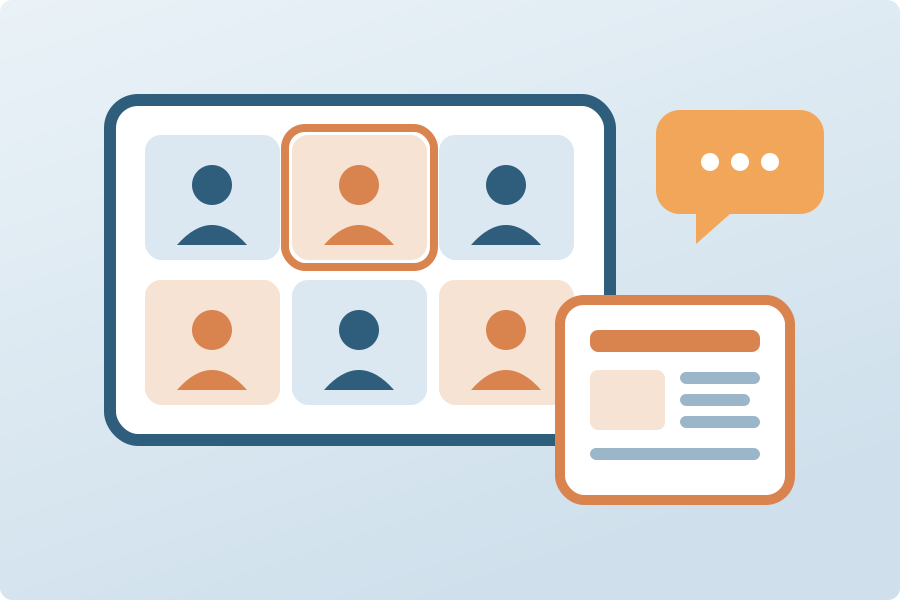
A typical session lasts about an hour and follows the same arc each week: a short warm-up, a check that everyone understood the material, a moderated discussion, feedback on mistakes and a vocabulary list afterwards. The predictable structure is what lets you focus on speaking instead of wondering what comes next.
Here is what a well-run 60-minute session usually looks like:
| Minutes | What happens | What you should do |
|---|---|---|
| 0–5 | Warm-up round: how was your week, one sentence on the topic | Say something, even short |
| 5–15 | Summary of the article or video, key vocabulary checked | Retell one fact in your own words |
| 15–45 | Discussion or debate: positions, follow-up questions, sometimes switching sides | React to others, not only to the moderator |
| 45–55 | Feedback: recurring mistakes, better ways to say what people said | Write down the ones that are yours |
| 55–60 | Wrap-up and next topic | Note the topic and when the material arrives |
| After | Vocabulary list and corrections in writing | Review within 24 hours |
Across a month, a good moderator also varies the type of speaking, not just the topic. One week may be about describing and narrating (what happened, how it affects people), the next about comparing and arguing, another about hypotheses (si fuera alcalde...), and another a more formal debate where you defend a side you were given. That variety matters because each type pulls different grammar out of you: narration needs past tenses, argument needs connectors, hypotheses need the subjunctive.
What a discussion sounds like in practice, on the topic of remote work:
Moderator: Bueno, ¿qué os ha parecido el artículo? ¿El teletrabajo ha llegado para quedarse? Anna: A mi modo de ver, sí. Desde la pandemia muchas empresas se han dado cuenta de que funciona. Marc: Perdona que te interrumpa, pero ¿no crees que depende mucho del sector? Anna: Hombre, claro, en un restaurante no se puede teletrabajar. Lo que yo digo es que en una oficina... Moderator: Marc, ¿y tú? ¿Volverías a la oficina cinco días a la semana? Marc: Ni de broma. Por mucho que me guste mi equipo, pierdo dos horas al día en el tren. Li: Perdón, no te he pillado. ¿Puedes repetir lo último, lo del tren?
Notice what each person does: Anna gives an opinion, Marc interrupts politely and disagrees with a question, Anna concedes a point and comes back to hers, the moderator brings in a quieter speaker, and Li asks for a repetition without stopping the flow. Those moves, not exotic vocabulary, are what a club trains.
Why do courses stop working at the intermediate plateau?
Courses are built to add new material, and after B2 there is less new grammar to add. Progress shifts from knowing more to using what you know faster and more accurately, and a class where you speak five minutes per hour cannot train that.
This is the classic intermediate plateau, which we cover in detail in our guide on how to break through the intermediate plateau. The arithmetic of a typical class shows the problem. In a 90-minute lesson with twelve students, a large share of the time goes to the teacher's explanations and to exercises. Divide what remains by twelve and each learner gets only a few minutes of real speaking.
Linguist Merrill Swain argued in her output hypothesis that producing language pushes learners to notice what they cannot yet say, which listening alone does not do. At B2 that noticing is exactly what you need: the moment you try to argue that rent controls are a bad idea and realise you have no word for "loophole".
Courses also tend to recycle the same comfortable topics: travel, hobbies, food. A conversation club built around current affairs forces you into areas where your vocabulary is thin, which is where growth happens.
Conversation club myths and facts
- MythI should finish all the grammar before I join a conversation club.FactAt B2 you already have the grammar for most situations. What is missing is speed and precision, and those grow by speaking.
- MythAn intercambio and a conversation club are the same thing.FactAn intercambio gives you natives and social contact but rarely corrections; a club with a moderator gives you a topic, feedback and a vocabulary list.
- MythA bigger group means more people to learn from.FactWith more than six people each person speaks less. Four to six is a good size for one hour.
- MythPreparing in advance makes the conversation less natural.FactFifteen minutes of reading and a few notes give you something to say. Only a written script kills spontaneity.
What makes a good Spanish conversation club?
A good club has four things: a small group, a topic with material to prepare, a moderator who corrects, and vocabulary that follows you after the session. Without them a club easily becomes a pleasant hour in which everyone repeats what they already know.
A small group. With four to six people everyone speaks several times per session, and nobody can hide. In a group of fifteen, the confident speakers dominate and the quiet ones listen.
A topic and something to read first. A short press article sent in advance gives everyone the same facts and the key vocabulary. You arrive with opinions instead of spending the first ten minutes looking for something to say.
A moderator who corrects. This is the main difference from a free meetup. Research on classroom feedback, such as the 1997 study by Roy Lyster and Leila Ranta, found that teachers most often correct by simply rephrasing a student's sentence correctly, and that learners notice and repair errors more when they are prompted to fix them themselves. In a club this means a moderator who notes your recurring mistakes and points them out, not one who corrects every word mid-sentence.
Vocabulary that follows you. A written list of the words and phrases that came up turns one hour of talking into material you can review. Without it, most new words are gone by the next week.
Add a regular rhythm. Weekly sessions work better than an occasional marathon, because vocabulary needs to come back several times to stick.
Spanish conversation topics by level, with starter questions
Choose topics one step above your comfort zone: at A2 talk about your own life, at B1 about experiences and habits, at B2 about social questions with two sides, at C1 about abstract ideas and nuance. Each topic below comes with starter questions you can use in a club, an intercambio or with a friend.
A2: your life and surroundings
| Topic | Starter questions |
|---|---|
| Your neighbourhood | ¿Qué hay cerca de tu casa? ¿Qué es lo que más te gusta de tu barrio? |
| Food | ¿Qué desayunas normalmente? ¿Qué plato español te gusta más? |
| The weekend | ¿Qué hiciste el sábado pasado? ¿Qué vas a hacer este fin de semana? |
| Shopping | ¿Prefieres el mercado o el supermercado? ¿Por qué? |
| Free time | ¿Qué haces cuando tienes una tarde libre? ¿Practicas algún deporte? |
B1: experiences, habits and plans
| Topic | Starter questions |
|---|---|
| Life in Spain | ¿Qué te sorprendió cuando llegaste? ¿Te has acostumbrado a cenar tarde? |
| Work | ¿Cómo es un día normal en tu trabajo? ¿Qué cambiarías si pudieras? |
| Travel | ¿Cuál ha sido tu mejor viaje? ¿Qué es lo peor que te ha pasado viajando? |
| Childhood | ¿Cómo era tu colegio? ¿Qué hacías en verano cuando eras pequeño? |
| Social media | ¿Cuánto tiempo pasas en el móvil? ¿Te gustaría desconectarte una semana? |
B2: social questions with two sides
| Topic | Starter questions |
|---|---|
| Housing | ¿Debería el Estado limitar el precio del alquiler? ¿Qué pasaría si lo hiciera? |
| Remote work | ¿El teletrabajo mejora la vida o aísla a la gente? |
| Tourism | ¿Habría que limitar los pisos turísticos en el centro de las ciudades? |
| Schools | ¿Deberían prohibirse los móviles en los colegios? |
| Artificial intelligence | ¿Qué trabajos crees que desaparecerán? ¿Te preocupa o te da igual? |
C1: abstract ideas and nuance
| Topic | Starter questions |
|---|---|
| Language and identity | ¿Una lengua es solo una herramienta o forma parte de quién eres? |
| Merit | ¿Hasta qué punto el éxito depende del esfuerzo y no de la suerte? |
| Media | ¿Se puede informar con total neutralidad? ¿Debería intentarse? |
| Ageing | ¿Cómo debería adaptarse una sociedad en la que cada vez hay más mayores? |
| Consumption | ¿Somos responsables de cómo se fabrica lo que compramos? |
A tip for any level: a good starter question is open (it cannot be answered with sí or no), personal enough that everyone has something to say, and concrete. "¿Qué opinas de la educación?" kills a conversation; "¿Deberían prohibirse los móviles en clase?" starts one.
How to give your opinion, agree and disagree in Spanish
Start opinions with creo que, a mi modo de ver or desde mi punto de vista, agree with estoy de acuerdo contigo or tienes razón, and disagree softly with entiendo lo que dices, pero... or yo no lo veo así. Having three or four ready-made openers frees your attention for the content.
Giving your opinion
| Spanish | Meaning | When to use |
|---|---|---|
| Creo que... / Pienso que... | I think that... | Neutral, everywhere |
| A mi modo de ver... | The way I see it... | Before a personal view |
| Desde mi punto de vista... | From my point of view... | Slightly more formal |
| Me da la impresión de que... | I get the impression that... | When you are not sure |
| Lo que pasa es que... | The thing is... | To explain a cause or problem |
| No lo tengo claro, pero... | I'm not sure, but... | To give a cautious view |
Watch the grammar: creo que takes the indicative (creo que es caro), but no creo que takes the subjunctive (no creo que sea caro).
Agreeing
| Spanish | Meaning | When to use |
|---|---|---|
| Estoy de acuerdo contigo. | I agree with you. | Neutral |
| Tienes toda la razón. | You're absolutely right. | Strong agreement |
| Eso es. / Exacto. | That's it. / Exactly. | Short reaction while someone speaks |
| Yo pienso igual. | I think the same. | Informal |
| Hasta cierto punto, sí. | Up to a point, yes. | Partial agreement before a "but" |
Disagreeing
| Spanish | Meaning | When to use |
|---|---|---|
| Entiendo lo que dices, pero... | I see what you mean, but... | Soft, always safe |
| Yo no lo veo así. | I don't see it that way. | Clear but polite |
| No estoy de acuerdo del todo. | I don't fully agree. | Softened |
| Sí, pero por otro lado... | Yes, but on the other hand... | Concession plus counter-argument |
| Hombre, depende. | Well, it depends. | Colloquial, very common in Spain |
| ¡Qué va! | No way! / Not at all! | Informal, among people you know |
Spanish discussions are often more direct than English-speaking learners expect. No estoy de acuerdo is not rude in a debate; what matters is the tone and what you say next.
How to interrupt politely and ask someone to repeat in Spanish
Interrupt with perdona que te interrumpa or una cosa..., and ask for a repetition with ¿perdona?, ¿puedes repetirlo? or, in colloquial Spain, no te he pillado. In Spanish conversation, short overlaps and quick reactions are normal, so a polite interruption is part of the game rather than a breach of manners.
Our article on greetings and politeness in Spain explains why overlapping talk is often read as interest, not rudeness. In a club it means you should not wait for a perfect silence that may never come.
Interrupting and taking the floor
| Spanish | Meaning | When to use |
|---|---|---|
| Perdona que te interrumpa, pero... | Sorry to interrupt, but... | The safe all-purpose option |
| Una cosa... | One thing... | Quick, informal |
| Si me permites... | If I may... | More formal, meetings |
| ¿Puedo añadir algo? | Can I add something? | When the moderator leads |
| Antes de que sigas... | Before you go on... | To react to a specific point |
| Perdona, sigue tú. | Sorry, go ahead. | When you both started at once |
Asking to repeat or clarify
| Spanish | Meaning | When to use |
|---|---|---|
| ¿Perdona? / ¿Cómo? | Sorry? / Pardon? | You missed a word |
| ¿Puedes repetirlo, por favor? | Can you repeat that, please? | You missed a sentence |
| ¿Puedes hablar un poco más despacio? | Can you speak a bit more slowly? | Fast speakers, online lag |
| No te he pillado. | I didn't catch that. | Colloquial, Spain |
| ¿Qué quieres decir con...? | What do you mean by...? | To clarify an idea, not a word |
| ¿Cómo se dice... en español? | How do you say... in Spanish? | You lack a word |
Gaining time without going silent
A ver..., Pues..., Bueno..., ¿Cómo te lo diría? and Es que... are the fillers Spaniards use while thinking. Using them keeps your turn and sounds natural; a long silence hands the floor to someone else.
How to prepare for a Spanish conversation club in 15 minutes
Fifteen minutes is enough if you use them well: read for the gist, mark a few set phrases, write your position in two or three sentences, choose one structure and one phrase to try, and say your opening line aloud. If you have 20–30 minutes, read the article twice in full and look up the words you need.
The 15-minute routine:
- Minutes 0–5, gist. Read the headline, the first paragraphs and the last one. What happened, who is involved, why it matters in Spain.
- Minutes 5–9, phrases. Skim again with a pen. Underline five set phrases, not single words: poner en marcha, a raíz de, dar marcha atrás.
- Minutes 9–12, position. Write one sentence for, one against, and which side you take.
- Minutes 12–14, one structure and one move. Pick a structure to test, for example si hubiera..., por mucho que... or lo que pasa es que..., plus one phrase from the bank above, such as perdona que te interrumpa.
- Minutes 14–15, say it. Read your opening sentence aloud twice. The first time you say a sentence should not be in front of the group.
Don't write a speech. Notes in front of you are fine; a script kills spontaneity, and spontaneity is what you came to train.
How to get corrections in a Spanish conversation club
Ask for them explicitly and narrowly: tell the moderator which kind of mistake you want flagged, keep an error log, and correct yourself out loud when you notice a slip. Most people around you will not correct you unless invited, because it feels rude.
Practical ways to get useful feedback:
- Say what you want at the start. ¿Me puedes corregir los errores de subjuntivo? or Me interesa sobre todo el vocabulario, avísame si algo no suena natural. One focus is more useful than "correct everything".
- Ask whether you want corrections now or later. Mid-sentence corrections break your flow; corrections at the end are easier to digest. Many advanced learners prefer notes at the end plus an instant correction only for mistakes that block understanding.
- Check yourself: ¿Se dice así?, ¿Suena natural?, ¿Está bien dicho? and Perdón, quería decir... signal that you want accuracy, which makes others more willing to help.
- Notice recasts. When someone repeats your idea in slightly different words, it is often a correction in disguise. Lyster and Ranta found recasts are the most common form of feedback, and also the easiest to miss.
- Keep an error log with three columns: what I said, the correct form, a new sentence of my own. Reread it before each session.
- Record yourself for a few minutes, with the group's permission, and listen back once. You will hear mistakes you never notice while speaking.
How to get the most out of each session
Speak early, ask follow-up questions and use your prepared words even when it feels clumsy. The session is the one hour where mistakes cost nothing, so take risks there rather than in a meeting at work.
During the session:
- Speak in the first five minutes. The longer you wait, the harder it gets.
- React to others, not just to the moderator: Entiendo lo que dices, pero..., ¿Y no crees que...? A discussion is about answering objections, not taking turns at monologues.
- Ask for the word you lack: ¿Cómo se dice...? Asking is part of speaking.
- Write down every correction that concerns you.
After the session, within 24 hours:
- Review the vocabulary list and mark the words you actually want to use.
- Write three sentences with them about your own life.
- Repeat your most frequent correction aloud five times.
If speaking in a group still makes your heart race, that is common and it fades with practice. Our article on language anxiety and how to overcome it has concrete techniques.
Online conversation club or intercambio in Spain?
Both are useful, but they do different jobs. An online club with a teacher gives you structure and correction; a local intercambio gives you native speakers, accents and real social life, but rarely corrects you.
| Online club with a teacher | Local intercambio | |
|---|---|---|
| Who you talk to | Advanced learners and a teacher | Natives and learners of all levels |
| Corrections | Yes, the moderator's job | Rarely, it feels rude |
| Topic | Prepared, with material | Whatever comes up |
| Cost | Paid | Usually free |
| Time spent in Spanish | Full session | Often half, the other half in your language |
If you live in Spain, these are the main kinds of options. What exists varies a lot from town to town, so check locally.
- Intercambio evenings. In most large cities some bars and cafés host weekly language exchange nights, often organised through Meetup groups or social media. They are lively and free or cheap, but noisy and unstructured.
- Apps. Tandem and HelloTalk connect you with Spanish speakers who want to learn your language; you can then meet in person or call.
- Universities. Many Spanish universities run tándem programmes, usually for their own students and exchange students. If you study or work at one, ask the language centre.
- Escuelas Oficiales de Idiomas. These public language schools offer courses rather than clubs, and some include Spanish for foreigners. Places are limited and enrolment has fixed periods.
- Town halls and NGOs. Municipal services and organisations such as Cruz Roja or Accem run Spanish classes for migrants in many places, mostly at beginner levels.
- Libraries and cultural centres. Public libraries often run reading clubs (clubes de lectura), which at C1 are excellent conversation practice with natives.
- Everyday life. Volunteering, sports clubs and neighbourhood associations give you hours of real Spanish that no class can.
In Catalonia, the Valencian Community, the Basque Country, Galicia and the Balearic Islands, check which language an exchange is for: many local pairing schemes, such as Catalonia's Voluntariat per la llengua, are for the co-official language, not Spanish.
Our guide to language exchange and tandem learning explains how to run an exchange well. Its limit at B2–C1 is that the conversation usually stays at small-talk level, and your partner is there to practise their language, not to fix your subjunctive. The best combination for many advanced learners is one structured session a week plus informal contact with Spanish speakers.
Common mistakes English speakers make in Spanish conversation
The most frequent slips are false friends (actualmente, realizar, eventualmente), English verbs carried over with the wrong preposition, and the indicative after no creo que. They rarely block understanding, which is exactly why nobody corrects them and they become fossilised.
| What English speakers often say | Correct form | Why |
|---|---|---|
| Actualmente, no estoy de acuerdo. (meaning "actually") | En realidad, no estoy de acuerdo. | Actualmente means "currently" |
| No realicé que era tarde. | No me di cuenta de que era tarde. | Realizar means "carry out" |
| Eventualmente lo aceptaron. (meaning "in the end") | Al final lo aceptaron. | Eventualmente means "possibly, occasionally" |
| Depende en el precio. | Depende del precio. | Depender takes de |
| Estoy pensando sobre cambiar de trabajo. | Estoy pensando en cambiar de trabajo. | "Think about" is pensar en |
| No creo que es buena idea. | No creo que sea buena idea. | No creer que takes the subjunctive |
| Esto hace sentido. | Esto tiene sentido. | Calque of "makes sense" |
| Estoy de acuerdo con tú. | Estoy de acuerdo contigo. | Con + tú becomes contigo |
| Yo pienso que... yo creo que... yo... | Pienso que... | Spanish drops the subject pronoun; repeated yo sounds insistent |
Pick the two that sound most like you and listen for them in the next session. Correcting two fossilised mistakes does more for how you sound than learning twenty new words.
How to choose a conversation club at your level
Ask four questions before signing up: who is it for, how big is the group, who leads it and what happens before and after a session. Clear answers mean a real format; vague ones usually mean a chat room.
- Level: a club "for all levels" rarely works at B2–C1. You need people who can discuss, not only describe.
- Group size: six people is a good maximum for an hour.
- Moderator: a teacher or at least a trained native speaker, not just the most fluent participant.
- Material: an article or video before, a vocabulary list after.
- Feedback: does someone note recurring mistakes, and do you get them in writing?
- Trial: can you join once before committing?
As an example, our B2–C1 conversation club runs four 60-minute sessions a month on Zoom in a group of up to six. Each week there is a current-affairs topic from a short Spanish press article sent before the session, a structured debate, feedback on recurring mistakes at the end, and a vocabulary list afterwards. It is led by a qualified native teacher and is designed for learners who already speak and want to sound more precise.
Are you ready for a conversation club?
According to the CEFR global scale, what mainly separates C1 from B2 speaking?
Frequently asked questions
What level do I need for a Spanish conversation club?
For an advanced club, a solid B2: you can follow everyday speech and the news and handle past tenses without freezing. Below that, a course or private lessons usually give you more than a discussion group.
How many people should a conversation group have?
Four to six is a good size for a one-hour session. Everyone speaks several times and the moderator can follow each person's mistakes. In large groups the confident speakers dominate and the quiet ones mostly listen.
Can a conversation club replace a Spanish course?
At B2–C1, for many learners, yes: they already have the grammar and need speed and precision. If you still struggle with basic tenses or lose the thread of everyday conversations, a course should come first.
Is a language exchange as good as a conversation club?
It does a different job. An intercambio gives you native speakers and real social contact, usually for free, but rarely corrections or a prepared topic, and half the time is spent in the other person's language. Many advanced learners combine both.
How should I prepare for a conversation club?
Fifteen minutes is enough: read the headline and first paragraphs for the gist, underline five set phrases, write one sentence for and one against, pick one structure and one phrase to try, and say your opening line aloud twice. Keep notes, not a script.
How often should I attend to make progress?
A weekly rhythm works better than occasional long sessions, because new vocabulary needs to come back several times before it sticks. Review the vocabulary list within 24 hours after each session.
How do you politely interrupt someone in Spanish?
Say «Perdona que te interrumpa, pero...» or, more informally, «Una cosa...». In a meeting, «Si me permites...» is more formal. Short overlaps are normal in Spanish conversation, so a polite interruption is not rude.
Book your free trial lesson
One to one with a native teacher, on Zoom.
Times shown in your zone: Europe/Madrid
1. Pick a day
Loading the timetable…
3. Your email for the confirmation and the Zoom link
One-to-one lessons with a native teacher
On Zoom with a qualified teacher from Spain who also speaks English.