The Intermediate Plateau: How to Break Through the B1 Stall
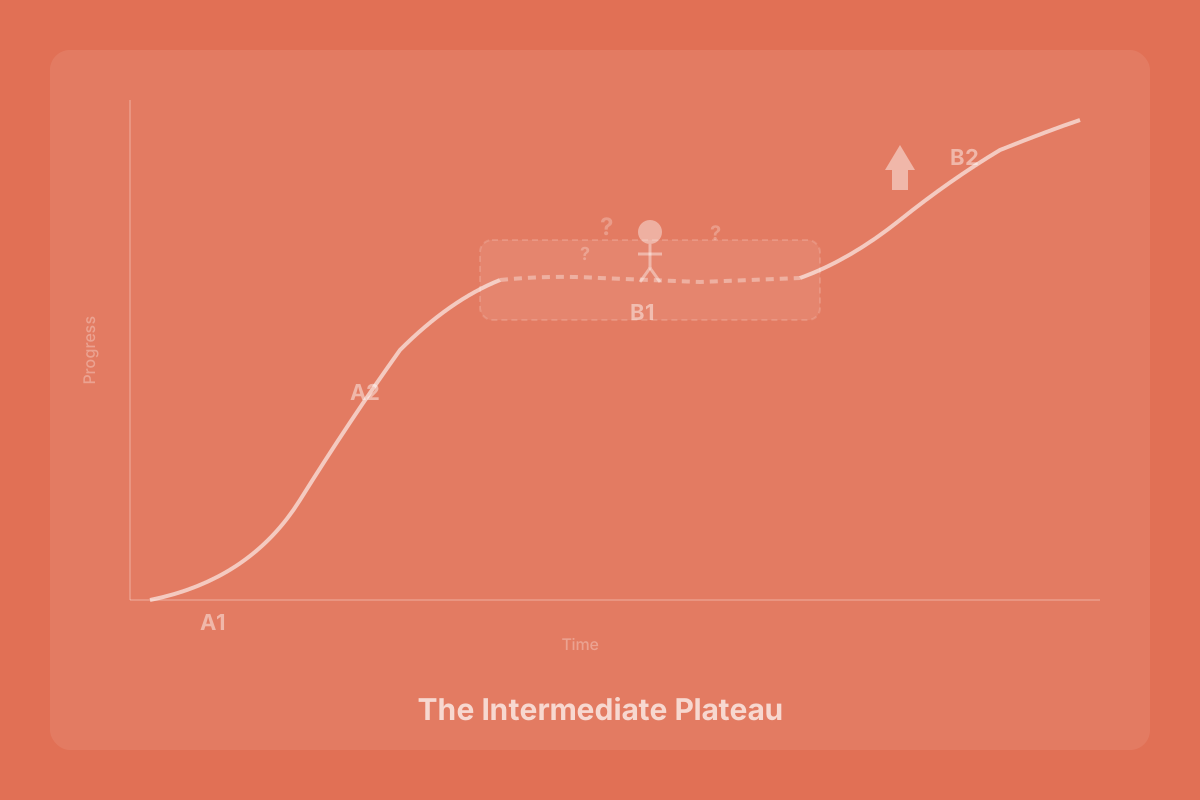
You remember the early days. Every lesson delivered a dopamine hit. New words stuck effortlessly. After a few weeks you could order food, introduce yourself, hold a basic conversation. After a few months you were watching TV shows with subtitles and actually following along. Progress felt automatic, almost inevitable.
Then it stopped.
Not dramatically. Not overnight. It crept in like a slow fog. You kept studying, kept showing up, kept using the same apps and textbooks that had worked so well before. But the needle stopped moving. Weeks went by and you could not point to a single new thing you had learned. Months went by and your speaking felt exactly the same. You started wondering if you had hit some kind of ceiling, if maybe this was just as far as your brain could go.
You have not hit a ceiling. You have hit the intermediate plateau. And you are far from alone.
What Is the Intermediate Plateau?
The intermediate plateau is the period, typically somewhere in the B1 range, where measurable progress in a foreign language slows dramatically or appears to stop entirely. Language teachers and researchers have documented it for decades. It is one of the most predictable phenomena in second language acquisition, and yet it catches nearly every learner off guard.
At beginner levels, progress is binary and visible. Yesterday you did not know the word for "train station." Today you do. Yesterday you could not conjugate a verb. Today you can. Each lesson adds concrete, countable knowledge. You can literally feel yourself getting better.
At B1, the game changes. The low-hanging fruit has been picked. The grammar you still need to learn is subtle and situational. The vocabulary you need is specialized, abstract, or idiomatic. The gap between what you understand passively and what you can produce actively widens. You can read a newspaper article and get the general idea, but if someone asked you to summarize it out loud, you would stumble. You understand a podcast at 80 percent, but the missing 20 percent is exactly the part that carries the nuance, the humour, the point.
This is not failure. This is the natural shape of language acquisition. But it does not feel natural. It feels like a wall.
Why the Plateau Happens: The Science Behind the Stall
The learning curve for any complex skill is not a straight line. It follows a pattern that researchers call a "power law of practice." Early gains come fast because everything is new. Each piece of information represents a massive percentage increase in your total knowledge. Going from zero words to 500 words is a 500-word gain. Going from 3,000 words to 3,500 words is the same absolute gain, but it barely registers as a change in your day-to-day ability.
There are several specific mechanisms that drive the plateau.
Diminishing returns on input. At A1 and A2, almost everything you encounter in the language is new and therefore useful. At B1, most of what you hear and read consists of words and structures you already know. The ratio of new material to familiar material drops sharply. You have to consume ten times as much content to get the same number of new learning moments. This is frustrating because it feels like you are putting in the same effort but getting a fraction of the reward. A beginner who reads one short article might learn fifteen new words. An intermediate learner who reads the same article might encounter one or two, and even those might be words they have already seen but not fully internalized.
The grammar ceiling effect. Basic grammar gives you enormous communicative power. Present tense, past tense, a handful of modal verbs, and some connecting words let you express a surprising range of ideas. But the grammar that separates B1 from B2 is more nuanced: subjunctive moods, complex clause structures, register shifts, collocations that do not follow logical patterns. These structures take longer to acquire and their individual impact on your overall fluency is smaller. You might spend three weeks mastering the subjunctive in French, only to realize that it barely changes how you are understood in conversation. The payoff is real but diffuse, spread across dozens of small improvements rather than one big leap.
Automaticity vs. accuracy. Your brain has started to automatize the language it already knows. This is good, because it means you can speak without consciously thinking about every word. But it is also dangerous, because the errors you have been making are getting automatized too. Your brain is building highways for both your correct and incorrect patterns. At the beginner stage, you were building everything consciously, one brick at a time. Now your brain has shifted into a mode where it takes shortcuts, and some of those shortcuts are wrong.
The measurement problem. At beginner levels, progress is obvious to everyone. At intermediate levels, progress is real but invisible. You might improve your listening comprehension by 5 percent over a month, but you cannot feel 5 percent. You can only feel the gap between where you are and where you want to be, and that gap looks just as wide as it did last month. This creates a dangerous feedback loop: because you cannot see progress, you start to doubt whether progress is happening at all, which undermines your motivation, which slows your progress further.
The Dunning-Kruger Curve in Language Learning
There is a psychological dimension to the plateau that makes it even worse. Researchers David Dunning and Justin Kruger described a cognitive bias where people with limited knowledge in a subject tend to overestimate their ability, while people with moderate knowledge tend to underestimate it.
In language learning, this plays out with almost comical precision.
At A1, many learners feel surprisingly confident. You have learned a few phrases, you can get by in basic situations, and you think fluency is just around the corner. You do not know what you do not know. This is the "peak of Mount Stupid" in the Dunning-Kruger model, though that phrase oversimplifies a more nuanced finding.
At B1, reality hits. You now know enough to understand just how much you do not know. You can hear the gap between your speech and a native speaker's. You notice your mistakes, even when you cannot fix them in real time. You sit in conversations feeling like a fraud, convinced that everyone can tell you are faking it.
This is the "valley of despair," and it happens to coincide almost exactly with the intermediate plateau. You are dealing with two problems at once: your actual progress has slowed down, and your perception of your own ability has also dropped. The combination is devastating for motivation.
The good news is that this valley has an exit. The bad news is that the exit is through, not around. You cannot skip the uncomfortable middle. You cannot hack your way past it with a new app or a language-learning trick. The only way out is sustained, focused practice that targets your specific weaknesses. And the first step is understanding exactly what those weaknesses are.
The Comfort Zone Trap
Here is where things get uncomfortable. A major cause of the plateau is not a limitation of the brain. It is a choice, usually an unconscious one.
At B1, you can function in the language. You can hold conversations, read articles, watch videos, navigate daily life in a country where the language is spoken. It is not perfect, but it works. And because it works, your brain starts to optimize for efficiency rather than growth.
You start gravitating toward content you can understand easily. Podcasts for intermediate learners. Graded readers. Conversations with patient friends who are used to your level and subconsciously simplify their speech for you. You avoid the news broadcast you can only follow at 60 percent. You dodge the novel that would require a dictionary every other page. You steer conversations away from topics where your vocabulary runs thin.
None of this is laziness. It is perfectly rational behaviour. Your brain is doing what brains do: minimizing effort and maximizing reward. The problem is that language acquisition requires the opposite. Growth happens at the edge of your ability, not in the comfortable middle.
Linguist Stephen Krashen famously described effective language input as "i+1," meaning input that is just one step above your current level. Not ten steps above, which would be incomprehensible and frustrating. Not at your level, which is comfortable but teaches you nothing. One step above. That is the sweet spot, and the plateau is what happens when you stop seeking it.
The comfort zone trap is particularly insidious because it disguises itself as productive study. You finish an intermediate podcast and feel like you accomplished something. You read a graded reader and check it off your list. But if you understood 95 percent of it without trying, you were not learning. You were reviewing. There is a place for review, but it should not be the majority of your study time at this stage.
Error Fossilization: When Mistakes Become Permanent
There is a technical term that every intermediate learner needs to know: fossilization. In linguistics, fossilization refers to the process by which incorrect language forms become permanently embedded in a learner's speech, resistant to correction even when the learner knows the correct form.
Think of it like a hiking trail. The first few times you walk through a forest, you can choose any path. But after you have walked the same route a hundred times, there is a groove in the ground. Even if someone shows you a better path, your feet keep following the old one.
This is exactly what happens with language errors at the intermediate level. You have been saying "I am agree" instead of "I agree" for two years. You know it is wrong. Your teacher has corrected you. You have written the correct form in your notebook. But in conversation, under pressure, your mouth goes on autopilot and produces the fossilized form.
Fossilization is particularly dangerous because it is invisible in the short term. A fossilized error does not prevent communication. People understand you just fine. But it places a hard ceiling on your perceived proficiency. Native speakers will always hear the error, even if they are too polite to correct it, and it marks you permanently as "someone who speaks the language okay but not really well."
The process of fossilization accelerates when learners spend most of their time communicating with other non-native speakers. In a group of intermediate learners, everyone makes errors, nobody corrects them, and the errors reinforce each other. This is one reason why conversation practice groups, while socially enjoyable, are not a substitute for time with a qualified teacher.
The only reliable cure for fossilization is conscious attention combined with immediate feedback. You need to catch the error in real time, produce the correct form, and repeat that correction often enough to build a new neural pathway that overrides the old one. This is almost impossible to do alone. It is one of the strongest arguments for working with a teacher at this stage.
Strategy 1: Narrow Reading and Narrow Listening
Most intermediate learners make the mistake of consuming language input that is too broad. They jump from a news article about politics to a cooking video to a crime novel to a business podcast. Every new topic brings a completely new set of vocabulary, and none of it gets reinforced before the next topic replaces it.
Narrow reading, a concept developed by linguist Stephen Krashen, flips this approach. Instead of reading widely across many topics, you read deeply within a single topic or by a single author. You pick one subject that genuinely interests you, maybe astrophysics, maybe football tactics, maybe the history of jazz, and you read everything you can find about it.
The magic is in the repetition. When you read five articles about climate change, the same specialized vocabulary keeps appearing: emissions, carbon footprint, renewable, sustainability, greenhouse effect. By the third article, those words are no longer new. By the fifth, they are yours.
Narrow listening works the same way. Instead of sampling ten different podcasts, find one that covers a topic you care about and listen to every episode. The host's voice becomes familiar. The recurring vocabulary becomes automatic. Your comprehension deepens with each episode because you are building on what you already know rather than starting from scratch every time.
The science behind narrow reading and listening is solid. Research consistently shows that vocabulary acquisition depends heavily on the number of times a word is encountered in context. Most learners need to see or hear a word seven to twelve times before it moves from recognition to active use. Broad consumption spreads those encounters across hundreds of different words, so none of them reach the threshold. Narrow consumption concentrates them, pushing key vocabulary past the tipping point much faster.
How to apply it: Pick one topic. Commit to it for at least two weeks. Find three to five sources (articles, podcasts, YouTube channels) that cover it in your target language. Consume all of them. Write down new vocabulary as you encounter it, but do not worry about memorizing it deliberately. The repetition across sources will do the heavy lifting.
Strategy 2: Shadowing
Shadowing is one of the most underrated techniques in language learning, and it is particularly effective at the intermediate plateau. The concept is simple: you listen to a native speaker and repeat what they say in real time, matching their speed, rhythm, and intonation as closely as you can.
It sounds easy. It is not.
The first time you try shadowing, you will probably manage about three words before falling behind. That is normal. Your brain is being forced to process the input and produce output simultaneously, which is an entirely different cognitive task from either listening or speaking on its own.
The benefits compound quickly. Shadowing trains your ear to segment continuous speech into individual words. It forces your mouth to practice sound combinations that do not exist in your native language. It improves your rhythm, your stress patterns, and your intonation, which are exactly the features that make the difference between someone who "speaks the language" and someone who "speaks the language well."
There is also a less obvious benefit: shadowing exposes you to natural connected speech patterns that textbooks rarely cover. When native speakers talk at normal speed, they blend words together, drop sounds, and shift stress in ways that are completely invisible in written language. By shadowing, you internalize these patterns without having to study them explicitly. Your ear learns to expect them, and your mouth learns to produce them.
How to apply it: Find audio with a transcript. Podcasts with show notes work well, as do TED talks and audiobooks where you also have the text. Start with short segments of 30 to 60 seconds. Play the audio and speak along, staying as close to the original as possible. Repeat the same segment three to five times. Once you can keep up comfortably, move to a new segment. Do this for 10 to 15 minutes a day. The improvement in your spoken fluency after two weeks will surprise you.
Strategy 3: Output Forcing
Input is necessary but insufficient. You can listen to a thousand hours of French and still freeze when someone asks you a question. The plateau is partly a symptom of the gap between passive knowledge and active ability, and the only way to close that gap is to force output.
Output forcing means putting yourself in situations where you have to produce language under pressure, without time to rehearse, translate in your head, or look things up. It is uncomfortable by design.
The simplest form is timed free writing. Set a timer for ten minutes. Pick a topic, any topic. Write without stopping. Do not correct yourself. Do not look up words. If you cannot think of a word, describe the concept using words you do know. The goal is not accuracy. The goal is fluency: the ability to produce language continuously without freezing.
Spoken output forcing follows the same principle. Record yourself speaking about a topic for three minutes without pausing. Then listen back. Then do it again on the same topic, trying to be clearer, more precise, more natural. The first recording will make you cringe. The fifth will make you proud.
Another powerful technique is retelling. Read an article or watch a video, then immediately try to retell the content from memory, in the target language. This forces your brain to take passively consumed input and actively reconstruct it, which is exactly the cognitive bridge that the plateau blocks.
A variation that many learners find helpful is the "explain it to a child" exercise. Take a complex article you have just read in the target language and try to explain its main idea in the simplest possible words, as if talking to a ten-year-old. This forces you to paraphrase, to use circumlocution, to find alternative ways to express ideas when your first choice of words fails you. It builds the kind of flexible, adaptive language use that separates B2 speakers from B1 speakers.
How to apply it: Commit to one output exercise per day. Alternate between writing and speaking. Keep your output sessions short but consistent. Ten minutes of daily output practice is worth more than an hour once a week. Save your recordings and writings so you can track your progress over time. When you compare your output from week one to week eight, the improvement will be undeniable.
Strategy 4: The Error Journal
Most learners have a vocabulary notebook. Very few have an error journal. This is a mistake, because at the intermediate level, fixing errors matters more than learning new words.
An error journal is exactly what it sounds like: a dedicated notebook (physical or digital) where you record your recurring mistakes. Not every mistake. Just the ones that keep coming back. The verb tense you always get wrong. The preposition that trips you up every time. The pronunciation that native speakers keep correcting.
For each error, you write down three things: the incorrect form you keep producing, the correct form, and an example sentence using the correct form. Then, and this is the critical part, you review the journal regularly and test yourself.
The error journal works because it transforms a vague feeling of "I keep making mistakes" into a concrete, finite list of specific problems. And a list of specific problems can be solved. Vague frustration cannot.
Over time, your error journal becomes a map of your personal learning edge. Patterns emerge. You might notice that most of your errors cluster around a particular grammar point, or that you consistently struggle with the same type of preposition. These patterns give you and your teacher actionable information about where to focus your study time for maximum impact.
How to apply it: Start your error journal today. For the first week, just collect errors. Ask your teacher, your language partner, or your own careful attention to identify the mistakes you repeat. By the end of the week, you will probably have ten to fifteen entries. Pick the three most frequent ones. Focus on those three, and only those three, for the next two weeks. Once they are fixed, move to the next three. This is systematic, measurable progress, and it is the antidote to the plateau's vague sense of stagnation.
Strategy 5: Language Exchange with Structure
Many intermediate learners engage in language exchange partnerships where they spend half the time speaking their target language and half the time helping their partner practice. These exchanges can be valuable, but most of them are unstructured and therefore far less effective than they could be.
An unstructured language exchange typically involves casual conversation about whatever topic comes to mind. The problem is that casual conversation tends to stay in comfortable territory. You talk about your day, your weekend plans, the weather. You use the same vocabulary and structures every time. You rarely push into areas where you struggle, because struggling feels awkward when you are also trying to be a good conversation partner.
A structured language exchange solves this by assigning specific tasks to each session. One session might focus on debating a controversial topic, where you are forced to use persuasive language, conditional structures, and vocabulary you would not normally choose. Another might involve one partner reading a short article and the other asking questions about it, creating a scenario where you have to summarize, explain, and defend ideas in real time.
The key is to agree on correction protocols. Will your partner interrupt you to correct errors, or will they note them down and discuss them at the end? Both approaches work, but you need to decide in advance. Many exchanges fail because neither partner feels comfortable correcting the other, which means errors go unchallenged and fossilization continues.
How to apply it: Find a language exchange partner through an app or community group. Before your first session, agree on a format: how long each language gets, whether you will correct each other in real time or at the end, and what topics or activities you will focus on. Prepare for each session the way you would prepare for a lesson. Bring a topic, a question, or an article to discuss. The more structure you add, the more you will learn.
The Role of a Teacher at This Stage
Let us be direct. The intermediate plateau is the stage where self-study reaches its limits. Not because self-study is bad, but because the specific problems of the plateau require external input that no app, textbook, or YouTube channel can provide.
A teacher does three things that you cannot do for yourself at this stage.
They diagnose your specific weaknesses. You know you are stuck. You might not know why. A good teacher listens to you speak for five minutes and can tell you exactly which grammar points are holding you back, which pronunciation habits are marking you as non-native, and which vocabulary gaps are preventing you from expressing complex ideas. This diagnosis is worth its weight in gold, because it turns a vague problem into a specific plan.
They provide real-time error correction. This is the big one. Fossilized errors cannot be fixed without immediate, consistent feedback. When you say "I am agree" in conversation, a teacher catches it on the spot, corrects it, and makes you produce the correct form right then and there. An app will let you get away with it. A conversation partner will understand you and move on. A teacher will not let it slide.
They push you out of your comfort zone. A teacher introduces topics you would never choose on your own, asks questions you cannot answer with your current vocabulary, and refuses to let you fall back on your safe phrases. They calibrate the challenge level to your sweet spot: hard enough to stretch you, not so hard that you shut down.
At ProLang, our teachers are trained specifically to work with plateau learners. They know the difference between a student who needs more input and one who needs more output. They know when to correct and when to let you self-correct. They know how to make the B1-to-B2 transition structured, measurable, and, against all odds, genuinely enjoyable.
Measurable Milestones from B1 to B2
One of the most demoralizing aspects of the plateau is the feeling that progress is invisible. Here is a practical checklist of concrete milestones that mark the road from B1 to B2. Use them to measure your progress and prove to yourself that you are, in fact, moving forward.
Listening milestones:
- You can follow a news broadcast in the target language without subtitles and understand the main points
- You can watch a film or TV series and follow the plot without pausing or rewinding
- You can understand a native speaker speaking at full speed about a familiar topic, even when they use slang or colloquialisms
- You can follow a group conversation between native speakers without getting lost when they talk over each other
Speaking milestones:
- You can express and defend an opinion on an abstract topic (politics, ethics, philosophy) with supporting arguments
- You can tell a long, structured story with clear time markers and logical flow
- You can handle an unexpected question without freezing, even if your answer is not perfect
- You can paraphrase on the fly when you realize a listener has not understood your first attempt
Reading milestones:
- You can read a full newspaper article on an unfamiliar topic and understand the argument, not just the words
- You can read fiction written for adults and follow the narrative without a dictionary
- You can understand the implicit meaning (irony, sarcasm, understatement) in written texts
- You can skim a long article and identify the main argument without reading every sentence
Writing milestones:
- You can write a formal email or letter without major errors in register or tone
- You can write a clear, structured essay with an introduction, supporting paragraphs, and a conclusion
- You can paraphrase an idea in multiple ways when your first attempt does not communicate clearly
- You can take notes during a lecture or presentation in the target language and review them later without confusion
Print this list. Check things off as you achieve them. Each checkmark is proof that the plateau is not permanent.
What Breaking Through Actually Looks Like
The breakthrough does not arrive as a single dramatic moment. There is no morning where you wake up and suddenly speak fluently. It comes in small, almost imperceptible shifts that you only recognize when you look back.
Marco, an Italian engineer learning English, spent eleven months at B1. He attended weekly classes, used apps daily, and watched English YouTube videos every evening. Nothing seemed to change. Then his teacher switched him to a programme focused on narrow reading about engineering topics, daily shadowing exercises, and an error journal targeting his five most persistent mistakes.
Six weeks later, Marco joined a video call with his company's London office. Halfway through, he realized he had been speaking for ten minutes without translating in his head. He had not even noticed. That was the breakthrough, not a sudden leap, but the quiet disappearance of the gap between thinking and speaking.
Another student, Yuki, a Japanese marketing professional studying French, hit her plateau after reaching B1 in eight months. She could read marketing articles in French but could not discuss them with colleagues. Her teacher introduced output forcing: every lesson started with Yuki retelling a French article she had read that week, followed by a debate on the topic. The first month was painful. By the third month, her French colleagues stopped switching to English when she entered the room.
A third student, David, a British software developer learning German, spent over a year on the plateau before finding the right approach. His breakthrough came from an unexpected direction: he started writing a technical blog in German about programming topics he knew well in English. The familiar subject matter gave him confidence, and the act of writing forced him to look up grammar rules he had been avoiding. Within two months, his written German improved so dramatically that his speaking followed. The writing had built neural pathways that his speech could now use.
The pattern across breakthrough stories is remarkably consistent. The learner hits the wall. They change their method. The change involves more output, more targeted practice, and usually a teacher who refuses to let them stay comfortable. And then one day they look back and realize the wall is behind them.
The intermediate plateau is not a wall. It is a filter. It separates casual learners from committed ones, and it rewards anyone willing to get uncomfortable again. The strategies in this guide work, but only if you actually use them. Pick one, start today, and measure your progress in weeks, not days. And if you need someone in your corner, a good teacher makes the climb a lot shorter.
Book your free trial lesson
One to one with a native teacher, on Zoom.
Times shown in your zone: Europe/Madrid
Loading the timetable…
3. Your email for the confirmation and the Zoom link
One-to-one lessons with a native teacher
On Zoom with a qualified teacher from Spain who also speaks English.