How to Learn Languages Through Reading: Books, Graded Readers, and Online Resources

Pick up a book in a foreign language and something remarkable happens. Within the first few pages, your brain starts doing what no flashcard app or grammar drill can replicate: it begins absorbing language in context, building connections between words, phrases, and meaning in ways that feel natural rather than forced. Reading in a second language is one of the oldest and most effective methods of language acquisition, yet it remains surprisingly underused by modern learners who chase the latest apps and AI tools. The research is clear, the evidence is overwhelming, and the practical benefits are hard to ignore. Whether you are a complete beginner picking up your first graded reader or an advanced student tackling a novel in its original language, reading offers a path to fluency that is both enjoyable and deeply effective.
Why Reading Is One of the Best Ways to Learn a Language
The theoretical foundation for reading as a language learning tool rests heavily on the work of Stephen Krashen, a linguist at the University of Southern California whose Input Hypothesis has shaped decades of language teaching practice. Krashen argued that language acquisition happens when learners are exposed to comprehensible input, meaning language that is slightly above their current level. He called this "i+1," where "i" represents the learner's current competence and "+1" represents the next stage of knowledge just beyond their grasp. According to Krashen, we do not learn language by studying rules and memorizing vocabulary lists. We acquire it by understanding messages, by processing meaning, and by encountering language in context again and again until patterns become internalized.
Reading provides exactly this kind of input, and it does so in a way that few other activities can match. Unlike listening, which moves at the speed of the speaker, reading allows you to control the pace. You can slow down when a passage is difficult, reread a sentence that did not make sense the first time, or speed through sections where the language feels comfortable. This self-paced nature makes reading an ideal source of comprehensible input because you naturally adjust the difficulty level through your own reading speed and attention. A conversation partner will not always simplify their speech for you, but a book sits patiently on the page, waiting for you to decode it at your own rhythm.
The research backing these claims is substantial. A landmark study conducted at the University of Edinburgh examined the effects of extensive reading programs on second language learners and found significant improvements in vocabulary acquisition, reading speed, and overall language proficiency. Rob Waring, one of the leading researchers in extensive reading, has documented how learners who read large quantities of text in their target language consistently outperform those who rely solely on traditional instruction. His research at Notre Dame Seishin University in Japan showed that students who engaged in regular extensive reading developed larger vocabularies, better reading fluency, and stronger grammatical intuitions than control groups receiving only classroom instruction.
Beyond vocabulary and grammar, reading builds something harder to measure but equally important: a feel for the language. When you read thousands of sentences in French or Spanish or German, you develop an intuitive sense of how the language works. You begin to notice which prepositions go with which verbs, how sentences are structured, where adjectives sit in relation to nouns. This implicit knowledge is what separates someone who can pass a grammar test from someone who can actually produce natural-sounding language. Reading deposits this knowledge gradually, almost invisibly, into your long-term memory.
There is also the motivation factor. Many language learners abandon their studies because the process feels tedious. Grammar exercises, vocabulary drills, and textbook dialogues about buying train tickets can only sustain interest for so long. Reading, by contrast, offers genuine content. You are not studying the language; you are using it. You are following a story, learning about a topic that interests you, or discovering how people in another culture think and live. This shift from studying to using is powerful, and it keeps learners engaged far longer than traditional methods alone.
What Are Graded Readers and How Do They Help Language Learners
Graded readers are books that have been specifically written or adapted for language learners at different proficiency levels. They control the vocabulary, grammar structures, and sentence length to match specific stages of language development, typically ranging from beginner to upper-intermediate. The major publishers in this space include Oxford University Press with their Oxford Bookworms Library, Cambridge University Press with their Cambridge English Readers series, and Penguin Readers, which offers simplified versions of popular novels and original stories across six levels.
The genius of graded readers lies in their careful vocabulary control. At the lowest levels, a graded reader might use only 200 to 400 unique words, which means that even a beginner can follow the story without constant dictionary consultation. As the levels increase, more vocabulary is introduced, sentence structures become more complex, and the stories grow in sophistication. Oxford Bookworms, for instance, offers six stages that correspond roughly to the Common European Framework of Reference levels from A1 through B2. At Stage 1, you might read a simplified version of "The Phantom of the Opera" using only 400 headwords. By Stage 6, you are reading near-authentic texts adapted from works by authors like Jane Austen or Thomas Hardy with 2,500 headwords at your disposal.
For languages other than English, the graded reader landscape is growing but still uneven. Spanish learners can turn to the CIDEB Black Cat series or the Lecturas Graduadas collections published by Edelsa and SGEL. French learners have access to the Lectures CLE en Français Facile series and Hachette's Lire en Français Facile collection, which includes simplified versions of classic French literature including works by Jules Verne and Alexandre Dumas. German learners benefit from the Einfache Lektüren series by Klett and the Leichte Lektüren collection from Hueber, while Italian learners can explore the Letture Graduate series from Edilingua and the Imparare Leggendo collection from CIDEB.
The effectiveness of graded readers comes from a principle that researchers call "narrow reading," which means reading multiple texts at a similar difficulty level rather than constantly pushing into harder material. When you read several books at the same level, you encounter the same high-frequency words repeatedly in different contexts. This repetition is crucial for moving words from short-term recognition into long-term retention. Studies suggest that a learner needs to encounter a new word between 10 and 15 times in meaningful contexts before it becomes part of their active vocabulary. Graded readers, because they recycle vocabulary across stories, provide exactly this kind of repeated exposure.
One common objection to graded readers is that they feel "childish" or oversimplified. This is a misunderstanding. A well-written graded reader at Level 2 or 3 can tell a compelling story with limited language resources, much like a skilled filmmaker can create a powerful scene with simple dialogue. The goal is not literary sophistication but language acquisition, and the evidence strongly supports their use. If you find a particular series unengaging, try another publisher or genre. The market has expanded enormously in recent years, and there are now graded readers covering mystery, romance, science fiction, historical fiction, and nonfiction topics.
How to Choose the Right Books for Your Language Level
Selecting the right reading material is perhaps the single most important decision a language learner can make when starting a reading program. Choose something too easy and you will not learn much new language. Choose something too difficult and you will spend more time wrestling with the dictionary than engaging with the content. The sweet spot, according to research, lies at a comprehension rate of roughly 95 to 98 percent, meaning you understand almost everything on the page with only a few unknown words per page.
The simplest way to gauge whether a book is at the right level is the "five-finger rule," which teachers have used for decades with young native-speaker readers and which works equally well for language learners. Open the book to any full page of text and start reading. Each time you encounter a word you do not know, hold up one finger. If you reach five fingers before the end of the page, the book is probably too difficult for comfortable reading. One or two unknown words per page is ideal for extensive reading; three or four is manageable but will slow you down; five or more will likely turn reading into a frustrating exercise in dictionary lookup.
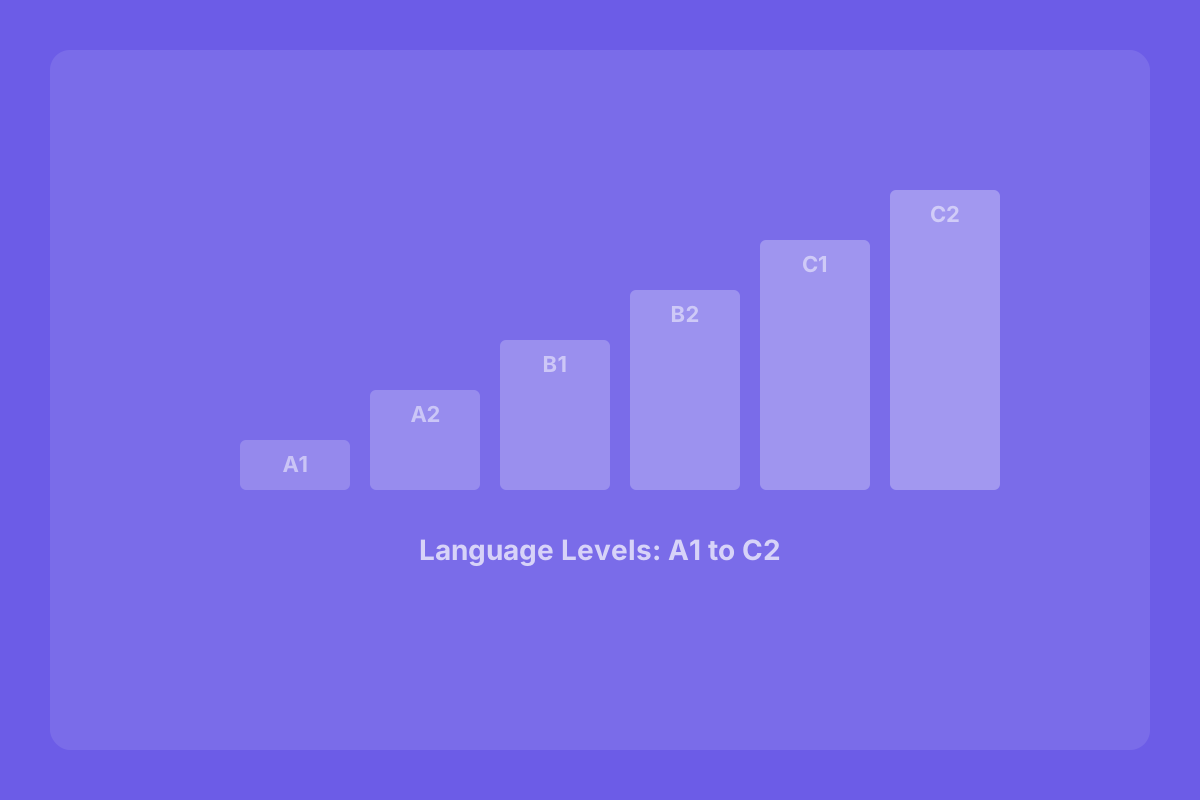
For learners at the A1 and A2 levels, graded readers are almost always the best choice. Authentic texts, even simple ones like children's books, often contain idiomatic language, cultural references, and irregular structures that can confuse beginners. Graded readers eliminate these obstacles while still providing meaningful, engaging content. As you move into the B1 and B2 range, you can begin mixing graded readers with simplified authentic texts: young adult novels, straightforward journalism, or blogs written in clear, accessible language. By the C1 level, most learners can handle authentic literature, though they may still prefer to start with contemporary fiction rather than classical works, which often use archaic vocabulary and complex syntax.
Another useful strategy is to read books you have already read in your native language. If you already know the plot of "Harry Potter" or "The Hunger Games," you can follow the story in translation without needing to understand every single word. Your existing knowledge of the plot fills in the gaps, allowing you to focus on the language rather than the content. This technique is particularly effective for intermediate learners who are making the transition from graded readers to authentic texts.
Pay attention to genre as well. Dialogue-heavy genres like romance novels and thrillers tend to use simpler, more conversational language than literary fiction or historical novels. A detective story by Agatha Christie, for example, uses far more accessible English than a novel by Virginia Woolf. Similarly, a contemporary Spanish thriller will be easier to read than a 19th-century literary classic. Start with genres you enjoy and that use relatively straightforward language, then gradually expand into more challenging territory as your confidence grows.
Extensive Reading vs Intensive Reading for Language Learning
The language learning world draws a clear distinction between two approaches to reading, and understanding the difference can transform your study routine. Extensive reading means reading large quantities of text at or slightly below your current level, primarily for enjoyment and general comprehension. Intensive reading means working through shorter texts in detail, analyzing grammar structures, looking up every unknown word, and often translating passages into your native language. Both approaches have value, but they serve different purposes and produce different results.
Extensive reading is about volume and flow. The idea is to read as much as possible, as quickly as possible, without stopping to look up every unfamiliar word. When you read extensively, you are training your brain to process language automatically, building reading speed and developing the kind of fluent, unconscious comprehension that characterizes advanced language users. Rob Waring recommends that learners aim to read at least one graded reader per week, and ideally more. The key principle is that you should be reading material that feels easy, material where you understand at least 95 percent of the words on the page. If you are constantly stopping to consult a dictionary, you are not doing extensive reading.
Intensive reading, by contrast, is about depth. You take a short text, perhaps a single paragraph or a brief article, and you dissect it. You look up every unknown word, analyze the grammar of each sentence, and try to understand not just what the text says but how the language works to convey that meaning. Intensive reading is valuable for building explicit knowledge of grammar rules, learning new vocabulary in a structured way, and developing the ability to read complex, academic, or literary texts. Many language courses rely heavily on intensive reading, and it has its place in a balanced study program.
The problem arises when learners do only intensive reading and never engage with extensive reading. Intensive reading alone does not build fluency. It does not develop the automatic word recognition and rapid comprehension that allow you to read comfortably in another language. It is a bit like learning to drive by studying the mechanics of an engine. You gain knowledge, but you do not develop the instinctive, hands-on skill of actually driving. Extensive reading provides that practical, experiential learning. The two approaches complement each other beautifully, and the most effective readers use both.
A practical ratio that many language teachers recommend is roughly 80 percent extensive reading and 20 percent intensive reading. Spend most of your reading time with material that flows easily, that you enjoy, and that you can read without a dictionary close at hand. Then set aside a smaller portion of your study time for intensive work with more challenging texts, where you slow down and analyze the language carefully. This balanced approach gives you both the volume needed for fluency development and the detailed analysis needed for accuracy.
Best Books for Learning English Spanish French German and Italian
Choosing specific books for language learning depends on your level, interests, and goals, but certain titles have proven themselves again and again as effective stepping stones for learners. For English, the path from beginner to advanced is particularly well-trodden. At the early intermediate level, Roald Dahl's short stories and children's novels offer wonderfully vivid, engaging prose written in clear, relatively simple English. "Charlie and the Chocolate Factory" and "Matilda" use everyday vocabulary and short sentences that make them accessible to B1 learners, while the stories are entertaining enough for adults. As you progress, you might move to young adult fiction like "The Curious Incident of the Dog in the Night-Time" by Mark Haddon, which is written in deliberately simple first-person narration. For advanced learners, George Orwell's "Animal Farm" is a perennial favorite. It uses clear, precise English to tell a story that works on multiple levels, and at roughly 30,000 words, it is short enough to finish in a week or two.
Spanish learners have a rich literary tradition to draw from. At the beginner level, simplified editions of classic works are widely available, and publishers like SGEL offer adapted versions of stories by authors such as Garcia Marquez. "Cronica de una muerte anunciada" in its simplified form is accessible to B1 learners and introduces the rhythms of Latin American Spanish beautifully. For intermediate learners, the novels of Isabel Allende, particularly "La casa de los espiritus," use vivid but relatively accessible prose. At the advanced level, few experiences compare to reading Garcia Marquez's "Cien anos de soledad" in the original. The language is rich and complex, but the storytelling is so compelling that it pulls you through even the most challenging passages. Contemporary authors like Carlos Ruiz Zafon, whose "La sombra del viento" reads like a literary thriller, offer excellent material for upper-intermediate learners.
French learners often begin with Antoine de Saint-Exupery's "Le Petit Prince," and for good reason. The language is simple yet elegant, the story is engaging for adults, and the book is short enough to finish without losing momentum. At around 17,000 words, it is an ideal bridge between graded readers and authentic literature. From there, intermediate learners might tackle Albert Camus's "L'Etranger," which uses deliberately spare, straightforward prose that mirrors its protagonist's detached worldview. The sentences are short, the vocabulary is manageable, and the story is gripping. For more advanced readers, Amelie Nothomb's contemporary novels are excellent: they are typically short, written in crisp modern French, and wildly entertaining.
German literature has a reputation for difficulty, but there are accessible entry points. Simplified versions of Franz Kafka's shorter works, particularly "Die Verwandlung" (The Metamorphosis), are available from publishers like Klett and Reclam. The original text itself, while challenging, uses relatively controlled vocabulary and simple sentence structures compared to many German literary works. For intermediate learners, the detective novels of Bernhard Schlink, especially "Der Vorleser" (The Reader), offer contemporary prose that is literary but not overwhelming. Children's and young adult literature in German is also excellent. Erich Kastner's "Emil und die Detektive" remains a favorite for its clear, engaging style, and Michael Ende's "Momo" offers a slightly more challenging but deeply rewarding reading experience.
Italian literature offers its own pleasures. At the beginning and lower-intermediate levels, Gianni Rodari's children's stories provide charming, accessible Italian. For intermediate learners, Italo Calvino's "Il barone rampante" uses imaginative storytelling with relatively accessible prose. The contemporary phenomenon of Elena Ferrante, whose Neapolitan novels have been translated worldwide, works beautifully in the original Italian. "L'amica geniale," the first book in the series, uses straightforward modern Italian to tell a compelling story of friendship, ambition, and life in mid-20th century Naples. The dialogue is natural and conversational, making it excellent material for learners at the B2 level and above.
How to Read a Foreign Language Newspaper Without Getting Overwhelmed
Newspaper reading is one of the most practical skills a language learner can develop, but it is also one of the most intimidating. Open the front page of El Pais, Le Monde, Die Zeit, or Corriere della Sera and you are immediately confronted with dense text, specialized vocabulary, complex sentence structures, and references to cultural and political contexts that may be unfamiliar. Many learners try to read a newspaper article, give up after the first paragraph, and conclude that they are "not ready yet." But with the right approach, newspaper reading can be accessible even at the intermediate level.
The first strategy is to stop trying to read the entire newspaper. Instead, pick one section that aligns with your interests and stick with it. If you follow sports, read the sports section. If you are interested in technology, find the tech column. Background knowledge is your greatest ally when reading in a foreign language, and if you already know something about the topic, you can fill in vocabulary gaps through context. A Spanish learner who follows European football can read El Pais's sports coverage with far less difficulty than someone trying to decode an editorial about Spanish constitutional law.
Start with headlines and subheadings before diving into the article text. Newspaper headlines in most languages follow predictable patterns and use high-frequency vocabulary related to the topic. Reading the headline and any subheadings gives you a framework for understanding the article before you encounter the details. Then read the first paragraph carefully, as journalistic writing almost always front-loads the key information. In most European newspapers, the first paragraph answers the basic questions of who, what, when, where, and why. If you can understand the first paragraph, you have the gist of the story, and the remaining paragraphs provide context, quotes, and analysis that you can read more selectively.
Digital editions of newspapers offer advantages that print editions do not. You can click on words to look them up, adjust text size, and use browser extensions like Readlang or Language Reactor that provide instant translations when you hover over unfamiliar words. Many newspapers also offer simplified or summary versions of their content. Le Monde publishes simplified news content aimed at learners, and there are independent sites like News in Slow Spanish, News in Slow French, and News in Slow German that present current events in simplified language at a reduced speaking speed, often with accompanying transcripts that you can read alongside.
Build a daily or weekly routine rather than trying to read for hours at a stretch. Ten to fifteen minutes of focused newspaper reading each day is far more effective than an hour-long session once a week. Over time, you will notice that the same vocabulary reappears across articles on similar topics, and words that seemed impossible in your first week will become familiar by your fourth or fifth. The key is consistency, not intensity.
Comics and Graphic Novels for Language Learning at Every Level
Comics and graphic novels occupy a unique and valuable space in the language learner's toolkit. The combination of visual storytelling and text creates a reading experience where images provide constant context for the language, making comprehension far easier than text-only formats. When you see a character's facial expression, the setting of a scene, and the action taking place in a panel, you can often guess the meaning of unfamiliar words without reaching for a dictionary. This visual scaffolding makes comics an excellent bridge between graded readers and authentic prose literature.
The Franco-Belgian comic tradition offers some of the best material for French learners. Herge's "Tintin" series uses clear, well-structured French with a wide range of vocabulary covering travel, adventure, science, and politics. The dialogue is natural and conversational, and the artwork provides abundant visual context. "Asterix," by Rene Goscinny and Albert Uderzo, is equally beloved and presents an entertaining challenge: the humor relies heavily on wordplay, puns, and cultural references that reward careful reading. For more advanced French learners, the graphic novels of Marjane Satrapi, particularly "Persepolis," offer sophisticated storytelling in accessible, modern French.
Spanish-language comics include the beloved Argentinian series "Mafalda" by Quino, which uses everyday conversational Spanish to deliver sharp social and political commentary. The strips are short, which makes them perfect for daily reading practice, and the humor ensures that you keep coming back. For longer-form reading, the growing market of Spanish-language graphic novels includes translations of international works as well as original Spanish and Latin American productions.
For Japanese learners, manga is an extraordinary resource. The visual storytelling tradition in Japan means that manga covers every conceivable genre and difficulty level. Simple manga aimed at younger readers, like "Doraemon" or "Yotsuba&!," use basic vocabulary and grammar structures that are accessible to lower-intermediate learners. The furigana readings printed above kanji characters in many manga make them far more accessible than standard Japanese prose. As learners advance, they can move to more complex series, with the vast range of genres ensuring that there is always something to match their interests.
German and Italian learners can also benefit from comics, though the options are somewhat more limited in terms of original-language production. Both languages have strong traditions of translating international comics, so you can often find your favorite series available in German or Italian. The "Asterix" series, for instance, is available in virtually every European language, and reading a familiar story in your target language provides the same benefits as reading a translated novel: your knowledge of the content supports your comprehension of the language.
How to Build Vocabulary by Reading in a Foreign Language
Vocabulary acquisition through reading operates on a fundamentally different mechanism than vocabulary learning through flashcards or word lists. When you encounter a new word in a book, you meet it in context, surrounded by other words and ideas that help define its meaning, register, and usage. You learn not just what the word means but how it behaves: which words it typically appears with, what grammatical patterns it fits into, and what connotations it carries. This contextual knowledge is what allows you to use the word naturally in your own speech and writing, rather than producing the awkward, dictionary-definition sentences that characterize learners who have memorized vocabulary in isolation.
The process works through what researchers call "incidental vocabulary acquisition," which means picking up new words as a byproduct of reading for meaning rather than studying them deliberately. Studies by Paul Nation, one of the leading researchers in vocabulary acquisition, have shown that learners can acquire approximately one new word for every 50 to 100 words of running text they read, provided that the text is at the right difficulty level. This may sound slow, but the math is encouraging. If you read 20 pages of a novel per day, roughly 5,000 to 6,000 words of text, you could potentially acquire 50 to 100 new words per week through reading alone. Over a year, that adds up to thousands of words, which is enough to make a substantial difference in your overall proficiency.
The key to vocabulary acquisition through reading is volume. A single encounter with a new word is rarely enough to learn it. Research suggests that most learners need between 10 and 15 encounters with a word in different contexts before it moves from recognition to active use. This is why extensive reading, where you read large quantities of text, is so much more effective for vocabulary building than intensive reading of short passages. The more you read, the more likely you are to encounter the same words repeatedly, and each encounter deepens your understanding of the word's meaning and use.
There are practical strategies that can enhance the vocabulary-building effects of reading. One approach is to keep a reading journal where you note down words that you encounter multiple times but cannot quite figure out from context. Do not write down every unfamiliar word, as this will slow your reading to a crawl and turn an enjoyable activity into a chore. Instead, focus on words that seem important, words you keep seeing, or words whose meaning you are genuinely curious about. After your reading session, look up a handful of these words and add them to your review system, whether that is a notebook, a flashcard app, or simply a list that you review periodically.
Another effective technique is to read multiple books on the same topic or by the same author. When you read several detective novels in Spanish, for instance, you will encounter crime-related vocabulary repeatedly across different stories. An author who uses certain favorite words and phrases will reinforce that vocabulary through natural repetition across their books. This "narrow reading" approach, where you stay within a genre or topic area for a sustained period, accelerates vocabulary acquisition because it concentrates your exposure to relevant vocabulary.
Online Reading Resources and Websites for Language Learners
The internet has transformed the landscape of reading for language learners, making it possible to access texts in virtually any language at any level without leaving your desk. Several platforms and tools stand out for their quality, accessibility, and effectiveness. LingQ, founded by polyglot Steve Kaufmann, offers a comprehensive reading platform where you can import any text and use built-in tools to look up words, save vocabulary, and track your progress. The platform includes a library of content in dozens of languages, graded by difficulty, and the integrated vocabulary system helps you build a personal word bank from your reading.
Readlang is another powerful tool that takes a slightly different approach. It works as a browser extension that allows you to read any web page in your target language with instant word and phrase translations. Click on a word and you see its definition; click and drag across a phrase and you get the whole phrase translated. The words you look up are automatically saved to flashcards that you can review later using a spaced repetition system. This means that your reading and your vocabulary review are seamlessly connected. You read what interests you, the tool captures the words you are learning, and it brings them back at optimal intervals for long-term retention.
Project Gutenberg deserves special mention as a treasure trove of free reading material. The site hosts over 70,000 public domain books in multiple languages, including substantial collections in French, German, Spanish, Italian, Portuguese, and many other languages. For advanced learners who want to tackle classic literature, Project Gutenberg offers the complete works of authors like Victor Hugo, Johann Wolfgang von Goethe, Dante Alighieri, and Miguel de Cervantes, all free and available in multiple digital formats. The texts are unmodified originals, so they are best suited for upper-intermediate and advanced learners, but the sheer breadth of material available makes it an invaluable resource.
For learners who prefer news content, the "News in Slow" family of websites and podcasts covers several major languages. News in Slow Spanish, News in Slow French, News in Slow German, and News in Slow Italian all present current events in simplified language spoken at a reduced pace, with transcripts that you can read alongside the audio. This combination of reading and listening is particularly powerful because it reinforces vocabulary and pronunciation simultaneously. The sites also grade their content by difficulty level, making it easy to find material that matches your proficiency.
Other notable resources include Beelinguapp, which presents texts in two languages side by side for easy comparison, and Lingua.com, which offers free reading comprehension texts at multiple levels in several languages. The key is to experiment with different platforms and find the ones that fit your learning style and routine. The best reading resource is the one you actually use consistently, not the one with the most features or the highest ratings.
Reading Strategies That Accelerate Language Acquisition
Not all reading is created equal, and how you read matters almost as much as what you read. Several evidence-based strategies can significantly accelerate the language acquisition benefits of your reading practice. The first and perhaps most important is chunking, which means reading in meaningful phrase groups rather than word by word. Instead of processing each word individually, train yourself to see phrases as single units of meaning. When you read "por otro lado" in Spanish, you should process it as a single chunk meaning "on the other hand," not as three separate words. Chunking dramatically increases reading speed and comprehension because it mirrors how fluent readers actually process text.
Shadow reading is another powerful technique that combines reading with listening. The method is simple: play an audiobook or a read-aloud recording and follow along in the text at the same time. As you listen and read simultaneously, you are creating connections between the written and spoken forms of words, which strengthens both your reading comprehension and your listening skills. Shadow reading is particularly valuable for languages where the spelling system does not closely match pronunciation, such as French and English. Hearing a word pronounced while seeing it on the page helps you internalize the relationship between spelling and sound, which makes both reading and listening easier in the long run.
Rereading is an underappreciated strategy that many learners overlook. When you read a text for the second or third time, your comprehension improves dramatically because you already know the plot, the characters, and the general context. This frees up cognitive resources to focus on the language itself. Words that you guessed at during the first reading become clearer on the second pass. Sentence structures that seemed confusing reveal their logic when you already know what the sentence is trying to say. Many successful language learners report that rereading a favorite book in their target language is one of the most effective things they have ever done for their fluency.
Pre-reading preparation can also make a significant difference, especially when tackling more challenging texts. Before you start reading an article or a chapter, spend a few minutes activating your background knowledge about the topic. If you are about to read a newspaper article about climate change in French, think about what you already know about the topic and what vocabulary you might expect to encounter. Skim the headings, look at any images, and read the first sentence of each paragraph. This kind of preview gives your brain a framework for processing the text, and research in reading psychology shows that activated background knowledge significantly improves comprehension.
Finally, set a reading speed that is comfortable. Many language learners read too slowly because they are trying to understand every word perfectly. This word-by-word approach actually hinders comprehension because by the time you reach the end of a sentence, you have forgotten how it began. Push yourself to read a little faster than feels entirely comfortable, tolerating some ambiguity and trusting that your brain will fill in the gaps. Speed and comprehension are not enemies; in fact, research shows that reading at a reasonable pace often produces better comprehension than painfully slow, word-by-word decoding because it encourages you to process language in meaningful chunks rather than isolated fragments.
How to Use a Dictionary Effectively While Reading in Another Language
The dictionary is a language learner's best friend and worst enemy, and the difference between the two often comes down to how and how often you use it. Over-reliance on the dictionary turns reading into a tedious exercise in translation, destroying both enjoyment and flow. Under-use means missing opportunities to learn important words and risking persistent misunderstandings. Finding the right balance is a skill in itself, and it requires a deliberate approach rather than a reflexive one.
The first rule of dictionary use during reading is restraint. When you encounter an unknown word, your first instinct should not be to reach for the dictionary. Instead, try to infer the word's meaning from context. Look at the surrounding sentences. Consider what the paragraph is about. Think about what word would make sense in that position. Often, you can get a reasonable approximation of a word's meaning without looking it up, and this act of inference is itself a powerful learning strategy. When you work to figure out a word's meaning from context, you engage with the word more deeply than when you simply read a dictionary definition, and this deeper processing leads to better retention.
Reserve dictionary lookups for words that you cannot figure out from context and that seem important to the meaning of the passage. If an unknown word appears in a descriptive aside and the story makes sense without it, let it go. If an unknown word is clearly central to the plot or argument, look it up. A useful guideline is to allow yourself no more than three to five dictionary lookups per page during extensive reading. If you find that you need more than this, the text is probably too difficult for extensive reading and would be better suited to intensive study.
When you do use a dictionary, make the most of the lookup. Do not just read the first definition and move on. Notice the word's part of speech, its common collocations, and any example sentences provided. If the dictionary offers multiple definitions, try to determine which one fits the context you are reading. Pay attention to register markers that indicate whether a word is formal, informal, literary, or slang. This additional information takes only a few seconds to absorb but significantly enriches your understanding of the word.
Digital dictionaries and reading tools have changed the economics of dictionary use by reducing the time cost of lookups. When you had to flip through a paper dictionary, each lookup might take 30 seconds or more, creating a strong incentive to minimize lookups. With a digital dictionary or a browser extension, a lookup takes less than a second, which can tempt learners to look up every unfamiliar word. Resist this temptation. The fact that lookups are faster does not mean you should do more of them. The cognitive benefits of inferring from context are lost when you look up every word, and the constant interruption of clicking and reading definitions prevents you from developing the sustained, flowing comprehension that is the ultimate goal of extensive reading.
Consider using monolingual dictionaries as soon as your level permits, which for most learners is around the B2 stage. A monolingual dictionary defines words in the target language, which means that every lookup is itself a reading exercise. You see the word used in a new context, you encounter related vocabulary, and you practice reading comprehension even while looking up a word. The transition from bilingual to monolingual dictionaries is a significant step in language development, and it reinforces the habit of thinking in the target language rather than translating through your native language.
How to Track Your Reading Progress and Set Achievable Goals
Tracking your reading progress serves two important purposes: it keeps you motivated by making your achievements visible, and it helps you calibrate your reading program over time. Without some form of tracking, it is easy to overestimate how much you are reading, lose momentum during busy periods, and miss the gradual improvements that accumulate over weeks and months. A simple tracking system can make the difference between a reading habit that fades after a few weeks and one that becomes a permanent part of your language learning routine.
The simplest approach is a reading log where you record the date, the title of what you read, the number of pages or the time spent reading, and a brief note about difficulty level and enjoyment. This takes less than a minute per session and creates a valuable record over time. When you look back after three months and see that you have read 15 graded readers and two adapted novels, you have concrete evidence of your progress. When you notice that books rated "difficult" three months ago now feel "comfortable," you can see your improvement in a way that no test score can capture.
Setting goals is equally important, but the goals need to be realistic and focused on process rather than outcome. A goal like "read 20 pages per day" or "finish one graded reader per week" is actionable and within your control. A goal like "learn 500 new words this month through reading" is harder to measure and depends on factors you cannot fully control. Process goals keep you reading consistently, and consistency is what drives progress. If 20 pages per day feels like too much, start with 10. If one book per week is overwhelming, aim for one per two weeks. The specific numbers matter less than the regularity of the habit.
Word counts and page counts are straightforward metrics, but they do not capture everything important about your reading development. Consider tracking your reading speed as well, which you can measure by timing yourself reading a standardized passage every few weeks. As your proficiency improves, your reading speed in the target language should gradually increase. Many learners start at 50 to 80 words per minute in their target language, compared to 200 to 300 words per minute in their native language. Over months of regular reading, that gap narrows, and watching your reading speed increase is a powerful motivator.
You might also track the difficulty level of your reading material over time. If you started with Level 2 graded readers and are now comfortable with Level 4, that progression tells a clear story of improvement. At ProLang, students who combine regular reading with structured conversation practice often find that their reading level advances faster than expected, because the skills reinforce each other. Reading builds the vocabulary and grammatical knowledge that makes conversation easier, while conversation practice builds the confidence and fluency that makes reading faster. If you are looking for a structured framework to complement your independent reading, you can explore courses that integrate reading with other skills, or book a trial lesson to discuss your learning goals with an experienced instructor.
Some learners find it helpful to use digital tools for tracking. Goodreads allows you to set reading challenges and log books in any language. LingQ tracks the number of words you have read and the vocabulary you have acquired through the platform. Even a simple spreadsheet or a note on your phone can serve as an effective tracking tool. The format matters less than the habit of recording. Whatever system you choose, keep it simple enough that you will actually use it every day.
Finally, celebrate your milestones. Finishing your first book in a foreign language is a significant achievement. Completing your tenth is a landmark. Reading your first unabridged novel, understanding a newspaper editorial without a dictionary, or finishing a book in a single weekend are all moments worth acknowledging. Language learning is a long journey, and reading progress often feels imperceptibly slow from day to day. A tracking system that makes your cumulative progress visible provides the encouragement you need to keep going through the inevitable plateaus and frustrations. The evidence is clear: people who read regularly in their target language achieve higher levels of proficiency, retain more vocabulary, and develop more natural-sounding language than those who rely on traditional study methods alone. The only question is what you will read first.
Frequently asked questions
How many words do I need to know before I can start reading in a foreign language?
You can start reading with as few as 300 to 500 words if you choose the right materials. Graded readers designed for absolute beginners use limited vocabulary and simple sentence structures. The key is matching your reading material to your current level rather than waiting until you feel ready for native-level texts.
Should I look up every word I do not understand while reading?
No. Looking up every unknown word disrupts the flow of reading and makes the experience frustrating. A better approach is to underline unfamiliar words and try to guess their meaning from context. Only look up words that appear repeatedly or that block your understanding of a key passage. Save vocabulary review for after you finish your reading session.
What is the difference between extensive reading and intensive reading?
Extensive reading means reading large amounts of easy, enjoyable material without stopping to analyze every sentence. The goal is fluency and general comprehension. Intensive reading means reading shorter, more difficult texts carefully, analyzing grammar, vocabulary, and structure. Both approaches are valuable, but extensive reading builds overall fluency faster and is more sustainable as a daily habit.
Are audiobooks useful for language learning or should I stick to printed books?
Combining audiobooks with printed text is one of the most effective reading strategies. Listening while reading simultaneously trains your ear to connect written words with their pronunciation. It also improves reading speed because the audio prevents you from pausing too long on individual words. Many graded reader series include audio recordings specifically for this purpose.
How much time should I spend reading in a foreign language each day?
Even 15 to 20 minutes of daily reading produces measurable results over time. Consistency matters more than duration. A learner who reads for 15 minutes every day will progress faster than someone who reads for two hours once a week. Choose a time that fits naturally into your routine and protect that reading time.
Book your free trial lesson
One to one with a native teacher, on Zoom.
Times shown in your zone: Europe/Madrid
Loading the timetable…
3. Your email for the confirmation and the Zoom link
One-to-one lessons with a native teacher
On Zoom with a qualified teacher from Spain who also speaks English.