How to Learn a Language Together as a Family

Picture this. It is a Saturday afternoon and your family is crowded around the kitchen counter, flour dusting every surface, while your twelve-year-old reads a crepe recipe aloud in French. Your seven-year-old is counting eggs in French too, getting the numbers wrong but laughing about it. You are trying to remember whether "battre" means to beat or to fight, and your partner is already pouring batter into the pan with the confidence of someone who watched three YouTube tutorials that morning. Nobody is conjugating verbs on a worksheet. Nobody is bored. And somehow, everyone is learning.
This is what family language learning looks like when it works. Not a classroom, not a textbook, not a solitary grind through flashcard decks after the kids go to bed. It is a shared project, a collective adventure that brings parents and children closer together while building a skill that will serve every member of the household for decades.
Over the past five years, the idea of learning a language as a family unit has exploded in popularity. Language schools across Europe and Latin America now offer dedicated family programs. Publishers are releasing board games designed for multilingual households. Online communities of "language learning families" have sprung up on every social media platform. The trend is driven by something deeper than educational ambition. Parents are realizing that learning a language together, rather than outsourcing it to a tutor or an app, creates a unique kind of bonding that few other activities can match.
This guide covers everything you need to know to get started, from choosing the right family language course abroad to turning everyday routines into micro-immersion sessions at home.
Why Learning a Language as a Family Works Better Than Solo Study
The research on language learning has long focused on individual learners, but a growing body of evidence suggests that social context matters enormously. When you learn a language with other people, especially people you live with, you create a natural practice environment that no classroom can replicate.
The researchers attributed this to what they called "ambient reinforcement," the way a new word or phrase keeps popping up in daily conversation once someone in the household learns it. If your daughter learns the Spanish word for "spoon" on Monday, she might use it at dinner on Tuesday, remind her brother of it on Wednesday, and correct your pronunciation on Thursday. That kind of spaced repetition happens organically when the whole family is in on the project.
There is also the accountability factor. Anyone who has tried to learn a language solo knows how easy it is to skip a day, then a week, then a month. When your family is learning together, quitting quietly is not really an option. Your eight-year-old will notice if you stop practicing. Your partner will ask why you have not been doing your Duolingo streak. The gentle social pressure of a shared commitment keeps everyone on track in a way that willpower alone rarely can.
Beyond retention and consistency, family language learning taps into something psychologists call "shared flow." This is the state of deep, enjoyable engagement that happens when a group works together on a challenging but achievable task. Think of the feeling you get when your family finishes a jigsaw puzzle together, or when you all cheer at the same moment during a football match. Learning a language together produces similar moments of collective triumph, like the first time your family successfully orders dinner in Italian at a restaurant, or the moment your toddler spontaneously counts to ten in German.
These shared victories create what family therapists call "positive sentiment override," a reservoir of good feeling that helps families weather the inevitable conflicts and stresses of daily life. In other words, learning a language together does not just make your family smarter. It makes your family closer.
Family Language Courses Abroad: What to Expect and How to Choose
One of the most effective ways to jumpstart your family's language learning is to enroll in a family language course abroad. These programs, offered by language schools in countries like Spain, France, Germany, Italy, Costa Rica, and Japan, are designed specifically for parents and children to learn side by side.
A typical family program works like this. In the mornings, the family splits into age-appropriate classes. Parents join an adult group where the instruction is geared toward practical communication skills, like ordering food, asking for directions, and making small talk. Children attend a separate class with other kids their age, where learning happens through games, songs, crafts, and storytelling. In the afternoons, the family reunites for cultural activities, excursions, cooking classes, or city tours, all conducted in the target language. Some schools also offer joint parent-child sessions where families practice together with a teacher.
When choosing a program, consider these factors. First, look at the school's experience with families. A school that primarily serves adult business learners may not have the infrastructure or the teaching expertise to handle a five-year-old. Ask how many families they have hosted, what the children's class sizes are, and whether the children's teachers have specific training in teaching languages to young learners. Second, think about accommodation. Many family programs offer homestay options where your family lives with a local host family. This can be an incredible immersion experience, but it can also be overwhelming for younger children who need more privacy and routine. Self-catering apartments near the school are a popular alternative. Third, check what is included in the price. Some programs bundle accommodation, meals, activities, and airport transfers into a single package. Others charge separately for each component. A program that looks expensive upfront may actually be cheaper than a bare-bones course once you add up all the extras.
Popular destinations for family language programs include Barcelona and Malaga for Spanish, Nice and Montpellier for French, Berlin and Munich for German, Florence and Rome for Italian, and San Jose in Costa Rica for an affordable Latin American Spanish option. Programs in Japan and South Korea are also growing in popularity, though they tend to require a higher baseline commitment due to the complexity of the writing systems.
The sweet spot for most families is a two-week program. One week is often too short to get past the initial adjustment phase, while anything longer than three weeks can strain budgets and school schedules. Two weeks gives the family enough time to settle in, build relationships with teachers and classmates, and experience genuine progress.
One thing that surprises many families is how much the children outpace the parents. Kids, especially those under ten, tend to pick up conversational skills faster in immersion settings because they are less self-conscious about making mistakes and more willing to jump into unstructured social interactions. Do not let this discourage you. Your role as a parent is not to be the best learner in the family. It is to model the courage and curiosity that language learning requires.
Language Learning Games the Whole Family Can Play
Games are the secret weapon of family language learning. They lower the stakes, raise the energy, and create the kind of repetitive, context-rich practice that sticks in long-term memory. The best part is that most of these games require zero preparation and no special materials.
Label the house. This is the classic starter activity, and it works because it is simple. Get a pack of sticky notes and spend an afternoon labeling everything in your home in the target language. The refrigerator, the mirror, the dog's bowl, the ceiling fan. Every time a family member walks past a labeled object, they get a tiny dose of vocabulary reinforcement. After a week, remove the labels and quiz each other. Then relabel with verbs and phrases. The refrigerator is no longer just "le refrigerateur." Now the sticky note says "ouvre le refrigerateur" (open the refrigerator).
Dinner table vocabulary challenge. Each night at dinner, one family member introduces three new words or phrases in the target language. Everyone has to use those words at least once during the meal. If someone forgets, they have to clear the table. If everyone remembers, dessert is guaranteed. This game takes about two minutes of preparation and turns an ordinary meal into a language event.
Scavenger hunts. Write a list of items in the target language and send the family on a scavenger hunt around the house, the yard, or the neighborhood. For younger children, include pictures alongside the words. For older kids and adults, make the clues more complex. Instead of "find a red flower," try "find something that a bird would build its home in."
Board games in the target language. Many popular board games, including Monopoly, Scrabble, Clue, and Ticket to Ride, are available in multiple languages. Playing a familiar game in a new language is a brilliant learning strategy because the rules are already known, so all cognitive effort goes toward processing the language. Scrabble in a foreign language is particularly effective for building spelling skills and vocabulary.
Story chain. Sit in a circle and build a story together, one sentence at a time, in the target language. The first person starts with a sentence like "There was a cat who lived on the moon." The next person adds a sentence, and so on. The story will get silly fast, which is exactly the point. Laughter cements memories.
Charades and Pictionary. The classic party games work beautifully for language learning. The person acting or drawing uses target-language vocabulary, and everyone guesses in the target language. These games are especially good for kinesthetic learners and for family members who feel shy about speaking.
Twenty Questions. One person thinks of an object, and the rest of the family has to figure out what it is by asking yes-or-no questions in the target language. This game forces learners to construct real questions, which is a much more demanding skill than simply answering them.
The key principle behind all of these games is the same. Language learning works best when the learner's attention is on the activity, not on the language itself. When your son is desperately trying to win at Scrabble, he is not thinking about whether he is "studying." He is thinking about whether "zarza" is a real Spanish word (it is, and it means "bramble"). That is exactly the state of mind where deep learning happens.
Cooking Foreign Recipes Together in the Target Language
If there is one family language learning activity that consistently gets rave reviews from parents, it is cooking together in the target language. Cooking checks every box. It is hands-on, it is multisensory, it produces a tangible (and edible) result, and it naturally introduces vocabulary that is useful in real life.
Start by finding a recipe in the target language. If you are learning French, search for "recette crepes" or "recette ratatouille" and pull up a recipe from a French cooking blog. Do not translate it into English. Part of the learning experience is figuring out the recipe together, using context clues, pictures, and a dictionary when necessary. Print out the recipe and go through it as a family, highlighting words you do not know.
Assign roles based on age and ability. A younger child might be in charge of counting and measuring ingredients. An older child might read the instructions aloud. A parent might handle the stove while narrating what they are doing. "Maintenant, je fais chauffer le beurre dans la poele." (Now I am heating the butter in the pan.) Everyone contributes, everyone hears the language, and everyone eats the result.
The vocabulary you pick up from cooking is surprisingly practical. Numbers, measurements, colors, textures, temperatures, sequences (first, then, next, finally), and imperative verbs (stir, pour, chop, wait) all come up naturally. After a few cooking sessions, your family will know dozens of food-related words without ever having opened a vocabulary list.
Some families make this a weekly tradition. Friday night is French cooking night, or Sunday afternoon is Japanese bento-making day. The routine matters because it creates a predictable, low-pressure context for language practice. Over time, the kitchen becomes a space where the target language feels natural and normal.
A few practical tips. Choose recipes that match your family's cooking skill level. A complicated souffle is not the best choice for your first French cooking session. Start with something forgiving, like a salad, a simple soup, or a flatbread. Work your way up to more complex dishes as your language skills and cooking confidence grow together. Also, do not worry about perfect pronunciation while you are cooking. The goal is communication, not perfection. If your daughter calls a whisk a "whisky thing" in German because she cannot remember "Schneebesen," that is fine. She will remember it next time because the mistake made everyone laugh.
International grocery stores are a wonderful resource for this activity. Take the family on a shopping trip and challenge everyone to find five items they can name in the target language. Read the labels. Compare prices. Ask a store employee a question in the target language if you are feeling brave. The shopping trip becomes a language excursion before the cooking even begins.
Watching Movies and TV Shows Together in a New Language
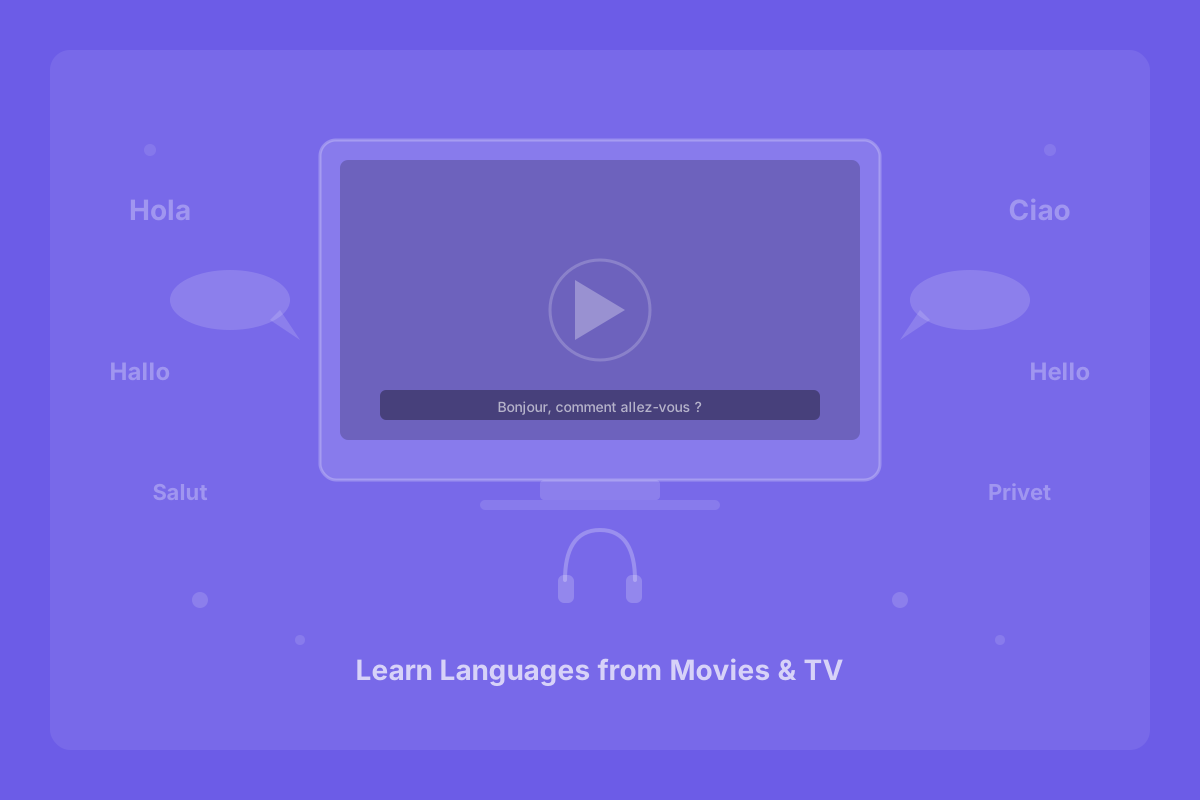
Family movie nights take on a whole new dimension when you watch in the target language. This is one of the easiest family language activities to implement because it requires no preparation, no special materials, and very little persuasion. Most kids are happy to watch a movie on any given evening. The only difference is the language track.
Start with movies your family already knows and loves. Watching "Finding Nemo" in Spanish or "Frozen" in French works beautifully because your children already know the plot, the characters, and many of the lines by heart. This prior knowledge acts as a scaffold, helping them follow the story even when they do not understand every word. The familiar emotional beats, the jokes they have already laughed at, the songs they already know, all of these anchor the new language to existing memories.
For younger children, animated shows work best because the visual storytelling is strong enough to carry comprehension even when the language is challenging. "Peppa Pig," "Bluey," and "Paw Patrol" are available in many languages, and their simple, repetitive dialogue is ideal for beginners. For older children and adults, try shows that are originally produced in the target language rather than dubbed versions. Spanish shows like "La Casa de Papel" (for teens and adults) or French shows like "Miraculous Ladybug" (for younger viewers) give your family authentic exposure to natural speech patterns, slang, and cultural references.
The subtitle question comes up in every family that tries this approach. Here is what the research suggests. If your family is just starting out, use target-language audio with English subtitles. This allows everyone to follow the story while their ears adjust to the sounds of the new language. After a few weeks, switch to target-language audio with target-language subtitles. This combination is the sweet spot for language learning because it pairs the spoken word with its written form, reinforcing both listening and reading skills simultaneously. Eventually, try watching without any subtitles at all, at least for shows you have already seen.
Make the viewing experience interactive. Pause the movie and ask questions. "What did she just say?" "Why is he angry?" "What do you think will happen next?" These brief interruptions might seem annoying, but they dramatically increase comprehension and retention. They also turn a passive activity into an active one, which is the difference between entertainment and learning.
Some families designate one evening per week as "foreign film night." They choose a movie, prepare snacks from that country (popcorn for an American film, crepes for a French one, edamame for a Japanese one), and make an event of it. The ritual builds anticipation and signals to the brain that this is a special, enjoyable activity rather than a chore.
Podcasts and audiobooks are the audio-only cousin of movie nights, and they deserve a mention here because they fit into family life even more easily. Listen to a story podcast in the target language during car rides. Play an audiobook at bedtime. These moments of passive input add up over weeks and months, building listening comprehension in the background of daily life.
Family Language Exchange Groups and Tandem Partners
One of the most powerful, and most overlooked, strategies for family language learning is connecting with another family that speaks the language you want to learn. A family language exchange, sometimes called a tandem family arrangement, pairs two families from different language backgrounds so that each family helps the other practice.
Here is how it typically works. Your English-speaking family meets with a Spanish-speaking family once a week, either in person or over video call. For the first half of the meeting, everyone speaks Spanish. For the second half, everyone switches to English. The children play together, the adults chat, and both families get structured practice in a natural social setting. Some families alternate hosting duties, with each family preparing a snack or activity from their culture.
Finding a tandem family is easier than you might think. Local community centers, libraries, and cultural associations often run family language exchange programs. Facebook groups and apps like Tandem, HelloTalk, and ConversationExchange can connect you with families in your area or around the world for virtual exchanges. International schools and bilingual playgroups are also good places to look.
The benefits of a family language exchange go beyond language skills. Your children develop cross-cultural friendships that broaden their worldview. They see that the language they are learning is not an abstract academic exercise but a real tool that real people use to communicate, tell jokes, and share their lives. This kind of authentic social context is something that no textbook or app can provide.
Some families take the tandem concept further by arranging holiday exchanges. Your family stays with your tandem family in their country for a week, and they stay with you for a week later in the year. This kind of reciprocal immersion is one of the most effective language learning experiences available, and it costs a fraction of what a commercial language program would charge.
A few tips for making a family language exchange work. First, agree on ground rules upfront. How will you split the time between languages? What happens when someone does not understand? Is correction welcome, or do you prefer to focus on communication? Having these conversations early prevents misunderstandings later. Second, keep it fun. The exchange should feel like a playdate, not a lesson. Prepare activities that both families can enjoy, like a craft project, a cooking session, or a trip to the park. Third, be patient. It takes a few sessions for everyone to relax and for the children to warm up to each other. Do not judge the success of the exchange based on the first meeting alone.
Daily Routines and Micro-Immersion at Home
You do not need to book a flight or join a group to immerse your family in a new language. Some of the most effective language learning happens in the small, repeated moments of daily life that most people never think to leverage.
The concept of "micro-immersion" is simple. You take a routine your family already performs every day and you do it in the target language. The routine provides the structure and predictability that makes the language input comprehensible, even for beginners. And because routines happen daily, the repetition drives the language deep into memory.
Breakfast is a natural starting point. Begin by learning the names of common breakfast items in the target language. Milk, juice, bread, butter, eggs, cereal. Then expand to simple phrases. "Pass the milk, please." "Do you want toast?" "The coffee is hot." Within a few weeks, your family can handle an entire breakfast conversation in the target language, even if the rest of the day happens in English.
Bedtime routines are another goldmine. Reading a bedtime story in the target language is a well-documented strategy for building comprehension, but you can go further. Say goodnight in the target language. Ask your child about their day in the target language. Sing a lullaby. These quiet, intimate moments are emotionally rich, which means the language associated with them gets encoded in memory especially strongly.
Car rides offer yet another opportunity. Create a playlist of songs in the target language and play it during your commute. Listen to a language-learning podcast as a family. Play "I Spy" in the target language. Practice counting objects you see outside the window. A daily twenty-minute car ride adds up to more than 120 hours of language exposure per year, enough to make a real difference.
Some families designate a specific time of day as "target language time." Maybe it is the hour between dinner and bedtime, or the thirty minutes after school, or all day on Sundays. During that window, the entire family speaks only the target language. Mistakes are expected and welcomed. The point is not fluency but immersion. Over time, the target-language window can expand as the family's skills grow.
The beauty of micro-immersion is that it does not require extra time in your schedule. You are not adding a language lesson on top of an already busy day. You are simply relabeling activities that are already happening. The cognitive effort is real, but the time cost is zero.
Age-Appropriate Strategies for Mixed-Age Families
One of the most common questions parents ask about family language learning is how to handle different ages. If your children are seven and fourteen, their learning needs, attention spans, and interests are wildly different. Forcing everyone into the same activity at the same level is a recipe for frustration.
The good news is that mixed-age learning is not only possible but actually advantageous, as long as you design activities that allow each family member to participate at their own level.
Games with flexible difficulty are your best friend. Take a scavenger hunt, for example. The seven-year-old gets a list with pictures and simple words. The fourteen-year-old gets a list with descriptive clues in full sentences. The parents get a list with riddles. Everyone is doing the same activity, but the linguistic demands are calibrated to each person's level.
Cooking works the same way. The younger child measures and counts in the target language. The older child reads the recipe and gives instructions. The parents handle the complex steps while narrating in the target language. Everyone is in the kitchen together, everyone is hearing the language, but nobody is bored or overwhelmed.
Movie nights can accommodate different ages by choosing films that appeal broadly. Animated movies like those from Pixar or Studio Ghibli tend to work for all ages because they operate on multiple levels, entertaining young viewers with visual humor while engaging older viewers with emotional depth and sophisticated storytelling.
For families with very young children (under three), the key is acceptance that the toddler will not sit through a structured activity. Let them wander, play, and absorb. Young children learn language primarily through exposure, not through instruction. If they are in the room while the rest of the family is playing a vocabulary game in Spanish, they are absorbing far more than you realize. Their brains are mapping the sounds, rhythms, and patterns of the language even when they appear to be paying no attention at all.
Teenagers present a different challenge. They may resist family language activities because they associate them with being "uncool" or childish. The best approach is to give teenagers ownership and autonomy within the family project. Let them choose the movie for movie night. Ask them to find a recipe from a country they are interested in. Put them in charge of the family's language-learning playlist. When teenagers feel like contributors rather than participants, they are far more likely to engage willingly.
A general principle for mixed-age families is to focus on activities where interaction itself is the point, rather than activities with a fixed outcome or right answer. A conversation has no winner or loser. A cooking session produces a meal regardless of anyone's language level. A walk through a foreign market is an experience, not a test. These open-ended activities naturally accommodate different ages and skill levels because there is no single standard of performance.
How to Motivate Reluctant Family Members
Not everyone in your family will greet the language learning project with equal enthusiasm. Maybe your partner thinks it is a waste of time. Maybe your teenager rolls their eyes every time you suggest a French movie night. Maybe your ten-year-old loved the idea for two weeks and then lost interest. Resistance is normal and expected. How you handle it determines whether the project survives or fizzles out.
The first rule is to never make language learning feel like punishment or obligation. The moment it becomes a chore, you have lost. Instead, tie the language to things the reluctant family member already enjoys. If your son loves football, watch a match with commentary in the target language. If your daughter is obsessed with K-pop, suggest learning some Korean so she can understand the lyrics. If your partner loves cooking, let them take the lead on a recipe in the target language. The language is not the activity. The language is the medium through which the activity happens.
Set small, achievable goals rather than big, intimidating ones. "Let us all become fluent in Spanish" is overwhelming. "Let us learn to order dinner in Spanish before our trip to Barcelona" is specific, actionable, and tied to a real payoff. Small wins build momentum. When your reluctant teenager successfully orders paella in Spanish and the waiter responds with a smile, that moment of real-world success is worth more than a hundred flashcard sessions.
Celebrate progress, not perfection. When your seven-year-old mangles a German sentence but gets her point across, that is a victory. When your partner remembers a word they learned last week, acknowledge it. Positive reinforcement is the engine of sustained motivation, especially for learners who are uncertain about their abilities.
Consider creating a family language learning chart or tracker that everyone can see. Put it on the refrigerator. Track streaks, new words learned, movies watched, recipes cooked. Visual evidence of progress is surprisingly motivating, especially for children who respond to concrete markers of achievement.
If one family member truly does not want to participate, do not force it. Coercion will breed resentment and poison the project for everyone else. Instead, keep the door open. Continue doing language activities with the willing members of the family and let the reluctant one observe. More often than not, they will eventually join in on their own terms, especially when they see the rest of the family having fun.
Finally, revisit the "why" regularly. Why did your family decide to learn a language together? Was it for an upcoming trip? For connecting with relatives? For intellectual growth? For fun? Reminding yourselves of the purpose behind the project keeps motivation alive during the inevitable plateaus and dry spells.
Apps and Technology for Family Language Learning
Technology can be a powerful ally in your family's language learning journey, as long as you use it as a supplement rather than a substitute for real interaction.
Duolingo remains the most popular language learning app in the world, and its family-friendly features make it a natural fit for this project. Set up a Duolingo Family Plan so everyone has their own profile. Enable the "friends" feature so family members can see each other's streaks and progress. The gentle competitive element, seeing that your daughter has a longer streak than you, can be surprisingly motivating.
For younger children, apps like Gus on the Go, LingoKids, and Little Pim offer age-appropriate games and activities in dozens of languages. These apps work best in short sessions (ten to fifteen minutes) and are ideal for filling transition moments, like waiting at the doctor's office or riding the bus.
Flashcard apps like Anki and Quizlet allow families to create shared vocabulary decks. After a cooking session, for example, everyone can add the new words they learned to the family deck. This collaborative approach means the flashcards are tied to real experiences, which makes them far more memorable than generic vocabulary lists.
Video calling platforms like Zoom and Skype enable virtual language exchanges with families in other countries. Some families schedule weekly video calls with a tandem family abroad, alternating between languages and activities. The children draw pictures together, show each other their pets, and play simple games, all while practicing the target language.
YouTube is an enormous, free resource for family language learning. Channels like "Easy Spanish," "Easy French," and "Easy German" feature street interviews with subtitles in both languages, making them accessible to intermediate learners. For younger viewers, channels like "Caillou en francais" or "Peppa Pig en espanol" offer familiar characters in the target language.
Smart speakers like Amazon Echo and Google Home can be set to operate in the target language. Ask Alexa to tell a joke in Spanish. Have Google play a trivia game in French. Set alarms and reminders in the target language. These small interactions accumulate over time and normalize the presence of the target language in your home.
A word of caution about screen time. Technology works best when it is part of a broader ecosystem of family language activities, not when it is the only component. An app cannot replace the social, emotional, and cognitive richness of cooking together, playing a board game, or having a conversation over dinner. Think of apps and devices as the seasoning, not the main dish.
Travel Immersion: Taking Your Family Language Project on the Road
There is no substitute for the intensity of learning a language in a place where it is spoken all around you. A family trip to a country where the target language is dominant can accelerate your progress by months, create unforgettable memories, and give every family member a powerful reason to keep learning long after you return home.
The key to a successful language immersion trip is planning activities that require your family to use the target language rather than retreat into English. Stay in accommodations where the hosts do not speak English fluently, like a rural guesthouse or a small family-run pension. Shop at local markets where English is not an option. Eat at restaurants that do not have English menus. Enroll your children in a local summer camp or activity program for a few days. These situations force the whole family to rely on the language skills you have been building together, and they reveal just how much you have actually learned.
Prepare before you go. Spend the weeks leading up to the trip learning practical phrases. How to ask for directions, how to order food, how to buy train tickets, how to ask for help, how to say "my child is allergic to nuts." Role-play these scenarios at home so they feel familiar when you encounter them for real. The preparation itself is a valuable learning activity.
During the trip, keep a family travel journal in the target language. Each evening, everyone writes (or draws, for younger children) one thing they experienced that day, using as much of the target language as they can. This ritual reinforces new vocabulary while creating a keepsake that your family will treasure for years.
After you return home, the trip becomes a reference point that gives your continued learning emotional weight and meaning. "Remember when we ordered those pastries in Lisbon?" "Remember the man at the market in Oaxaca who taught us how to say 'mango'?" These shared memories keep the language alive and give reluctant learners a concrete reminder of why the effort is worthwhile.
Not every family can afford an international trip, of course. But immersion experiences exist closer to home than you might think. Many cities have ethnic neighborhoods where the target language is widely spoken. A day trip to a Chinatown, a Little Italy, or a Spanish-speaking neighborhood can provide a taste of immersion without the cost of airfare. Cultural festivals, international food fairs, and heritage celebrations offer similar opportunities.
Some families organize "staycation immersion weekends" where the entire household commits to speaking only the target language for 48 hours. You eat food from that culture, watch movies in that language, play music from that country, and struggle through conversations in the target language from breakfast to bedtime. It is exhausting, hilarious, and remarkably effective.
The journey of learning a language as a family is not about reaching a destination called "fluency." It is about the hundreds of small moments along the way, the mispronounced words that become inside jokes, the first time your child surprises you by understanding a stranger, the shared pride of navigating a foreign city together. These moments weave the new language into the fabric of your family life, turning it from an external skill into a part of who you are as a family.
Start small. Pick one activity from this guide and try it this week. Label your kitchen in Spanish. Cook a French recipe together on Saturday. Watch your family's favorite movie in German. The language you choose matters less than the decision to learn it together. Because in the end, the greatest benefit is not the language itself. It is the time you spend together learning it.
Frequently asked questions
Can a whole family learn a language together even if the kids are different ages?
Yes. Mixed-age families actually benefit from diverse learning styles. Younger children absorb pronunciation naturally, while older kids and parents can explain grammar concepts. The key is choosing activities with flexible difficulty, like board games, cooking, or watching movies, where each person participates at their own level.
What is the best language for a family to learn together?
The best choice depends on your family's goals. Spanish, French, and Mandarin are popular because of their global reach. Consider practical factors like travel plans, heritage connections, and available resources in your area. The most important thing is that the whole family feels excited about the choice.
How much time per day should a family spend learning a language together?
Even 15 to 20 minutes of focused daily practice can produce meaningful results over time. Many families find success by weaving the target language into activities they already do together, like meals, car rides, or bedtime routines, rather than setting aside a formal study block.
Are family language courses abroad worth the cost?
Family language immersion programs typically range from 500 to 2000 euros per week depending on the destination and inclusions. Most families report that the combination of structured classes, cultural immersion, and shared adventure makes the investment worthwhile, especially compared to years of individual tutoring at home.
How do you keep kids motivated to learn a language as a family?
The biggest motivator is making it fun and social rather than academic. Play games, cook together, watch entertaining shows, and connect with other families who speak the language. Children stay engaged when language learning feels like a family adventure rather than homework.
Book your free trial lesson
One to one with a native teacher, on Zoom.
Times shown in your zone: Europe/Madrid
Loading the timetable…
3. Your email for the confirmation and the Zoom link
One-to-one lessons with a native teacher
On Zoom with a qualified teacher from Spain who also speaks English.