Electricity bill in Spain explained, plus gas and water
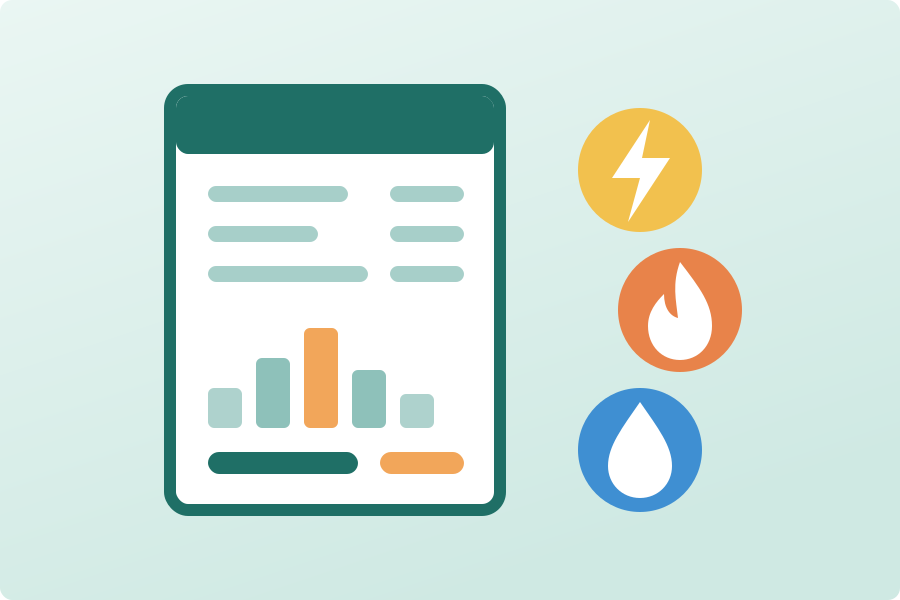
Your first Spanish electricity bill can be two pages of terms nobody explained: término de potencia, peajes, P1, P3, CUPS, impuesto eléctrico. The gas bill speaks of TUR and cubic metres turned into kWh, and the water bill may come from the town hall every two or three months. This guide explains how household bills in Spain are built, which tariff types exist, and how to read each line, with the Spanish words you will hear on the phone.
If you are still looking for a flat, our guide to renting a flat in Spain in Spanish covers what to ask the landlord about the bills before you sign. If you are used to a UK bill, think of the término de potencia as a standing charge that depends on how much power you reserve; the rest is closer to what you know.
Who sends the bills: the supplier, the distributor or the water company?
Electricity and gas bills come from your supplier, the comercializadora, which sells you energy and sets your price. The cables and pipes belong to the distribuidora, which you cannot choose: it depends on your address, it reads the meter and it fixes faults.
So when the power goes, you call the distribuidora (its emergency number is printed on the bill), and when the price or a payment is wrong, you call the comercializadora. Every electricity supply point has a CUPS, a code that starts with ES and identifies your meter whatever company you use. You will need it to change supplier or to put the contract in your name (cambio de titular).
Water works differently. It is a municipal service, run by the town hall or by a public or private company on its behalf, so there is no supplier to choose and the tariff is set locally.
PVPC or free market: which electricity tariff is better?
Spain has two kinds of electricity contract. The regulated tariff, PVPC (precio voluntario para el pequeño consumidor), is available only for supplies of up to 10 kW and only from a comercializadora de referencia; the free market (mercado libre) is everything else, with prices each company sets.
The PVPC price changes every hour. Since 2024 part of it follows the futures markets instead of only the daily market, and in 2026 that share is 55% (Real Decreto 446/2023). It has no permanence and no extras, and it is the only tariff that gives access to the bono social. Its drawback: the bill moves with the market, so a cold, windless month can cost noticeably more.
Free-market offers are usually a fixed price per kWh for 12 months, sometimes with different prices by time of day, or an indexed price. Some include extras you do not need, such as maintenance services.
Neither is better for everyone. The fair test is the official CNMC comparator, which shows PVPC, TUR and free-market offers for your postcode, power and annual consumption. Under the electricity supply regulation of 2026 (Real Decreto 88/2026), a household on the standard 2.0TD tariff can leave a free-market contract at any time; a penalty is only allowed on fixed-price contracts before the first annual renewal, and it cannot exceed 5% of the estimated energy still to be supplied.
Utility bill myths and facts
- MythChanging supplier means a technician visit and a power cut.FactThe meter and cables stay the same. The new supplier handles the switch with the distributor, and there is no switching fee.
- MythThe regulated PVPC is always the cheapest option.FactIt follows the market, with 55% linked to futures in 2026. Some months it wins, some months it loses; compare with the CNMC comparator.
- MythLeaving a free-market contract always costs a big penalty.FactA household on 2.0TD can leave at any time. A penalty is only allowed on fixed-price contracts before the first annual renewal, capped at 5% of the estimated energy still to be supplied.
- MythYou can get the bono social with any electricity company.FactOnly with a PVPC contract from a comercializadora de referencia, for your main home and up to 10 kW.
What is potencia contratada and how much do you need?
Potencia contratada is the maximum power, in kW, you can use at the same moment before the meter cuts the supply. You pay for it every day whether or not you use any electricity, so it is the fixed part of your bill.
Many flats run on 3.3 to 4.6 kW. More is needed if the oven, dishwasher, washing machine and an electric heater often run together, or if you charge a car at home. If the power trips (salta el automático) only once in a while, the solution is usually to stagger appliances, not to pay more every day.
Since 2021 you can contract two different powers: P1 for the punta and llano hours, P2 for the valle hours. That suits people who charge a car at night. Changing your power is requested through the supplier, but the distribuidora may charge fees for it, so ask about the cost first and do not change it every month.
What are punta, llano and valle hours?
On the standard household tariff, 2.0TD, energy has three periods with different regulated tolls. On weekdays on the mainland, the Balearic and the Canary Islands, they are:
| Period | Name | Weekday hours |
|---|---|---|
| P1 | punta (peak) | 10:00-14:00 and 18:00-22:00 |
| P2 | llano (shoulder) | 08:00-10:00, 14:00-18:00, 22:00-24:00 |
| P3 | valle (off-peak) | 00:00-08:00 |
Weekends and national public holidays are valle all day. Ceuta and Melilla shift the punta and llano hours one hour later. The periods are set by the CNMC (Circular 3/2020). On PVPC and on time-of-use free-market tariffs, moving the washing machine and dishwasher to the evening after 22:00 or to the weekend lowers the bill. On a flat-price offer, the tolls still differ by period, but you usually pay the same price for every kWh.
How to read a Spanish electricity bill line by line
The first page summarises the total; the detail is on the second page. Every electricity bill has the same building blocks, whatever the company:
- Datos del contrato: titular, supply address, CUPS, potencia contratada in P1 and P2, peaje de acceso 2.0TD, end date of the contract.
- Término de potencia: kW × days × price per kW and day, once for P1 and once for P2.
- Término de energía: kWh used in P1, P2 and P3 × price. On PVPC bills the peajes y cargos (regulated network costs and charges, the same with every supplier) are shown apart from the energy cost.
- Lectura: real (actual) or estimada (estimated). Smart meters are read remotely; if a reading is estimated, check it against your meter.
- Descuento bono social, if you have it.
- Impuesto sobre la electricidad (IEE), a percentage of the power and energy terms. Its general rate is 5.11269632%; it was temporarily cut to 0.5% from 22 March 2026 (Agencia Tributaria) and has applied again at the general rate since 1 June 2026.
- Alquiler de equipos de medida: a small monthly fee for the meter.
- IVA: 21% on everything above, including the electricity tax. In the Canary Islands the bill carries IGIC instead.
Below you will find the payment method (usually domiciliación bancaria, a direct debit; our guide to Spanish for the bank and the gestor explains the words), the energy mix and a consumption history. Tax rates have been changed by decree several times in recent years, so trust the percentage printed on your own bill rather than any article.
Gas bills in Spain: TUR or free market?
Natural gas also has a regulated tariff, the TUR (tarifa de último recurso), sold by comercializadoras de último recurso, and a free market. The household TUR has three bands by annual consumption: TUR 1 up to 5,000 kWh, TUR 2 from 5,000 to 15,000 kWh and TUR 3 from 15,000 to 50,000 kWh.
The TUR price is reviewed every quarter, on 1 January, April, July and October, by a resolution published in the BOE. A gas bill usually covers about two months and has:
- Término fijo: a fixed amount per day or month.
- Término variable: your consumption. The meter counts cubic metres; the bill converts them into kWh with a factor de conversión.
- Impuesto especial sobre hidrocarburos, the meter rental and IVA.
Many flats have no mains gas at all. Then the hot water and cooker run on a butane cylinder (bombona de butano), bought from a distributor, or everything is electric.
How do water bills work in Spain?
Water is billed by your municipality or its water company, usually every two or three months rather than monthly. The tariff, the blocks and the extra charges are decided locally, so the same consumption costs different amounts in different cities.
A typical water bill has a cuota de servicio (fixed fee), consumo charged in blocks (the more you use, the dearer each cubic metre), and charges for alcantarillado (sewers) and depuración (treatment), often with a regional water levy (canon). Some towns add the waste collection fee (tasa de basuras). Drinking water carries IVA at 10%. In many rented flats the water stays in the landlord's name and is passed on to you, or it is included in the community fees; ask before signing.
Bono social: who can get a discount on electricity?
The bono social is a discount on the electricity bill for vulnerable households. It applies only to a PVPC contract with a comercializadora de referencia, for your main home, with up to 10 kW.
According to the Ministry for the Ecological Transition, the discount is 42.5% for vulnerable consumers and 57.5% for severely vulnerable ones until 31 December 2026; after that the rates fall to 35% and 50% unless the government extends them. The discount covers consumption only up to an annual limit set by household size.
You may qualify through household income (from 1.5 times the IPREM index, rising with each extra member), as a large family (familia numerosa), as a minimum pensioner or as a recipient of the ingreso mínimo vital. You apply to the comercializadora de referencia, online or on paper, with the documents of every household member; the official site is bonosocial.gob.es. Those who have the bono social on 31 December also receive the bono social térmico, a once-a-year payment for heating made by the regional government, without a separate application.
How to change electricity or gas supplier in Spain
You change supplier by signing with the new company; it handles the switch with the distributor and your old contract ends automatically. Nobody visits, the meter and cables stay the same, and there is no switching fee.
Under Real Decreto 88/2026, an electricity switch must be completed within ten working days, and the old supplier must send you a final bill within 42 days. The same regulation bans unsolicited sales calls to households. If someone phones offering "a discount from your company", you are free to hang up.
Have these ready:
- your CUPS (on any bill);
- your NIE or DNI and the contract holder's details;
- your IBAN for the direct debit;
- the potencia contratada you want to keep.
If the contract is still in the previous tenant's or the landlord's name, you first need a cambio de titular, which the new supplier can usually process at the same time. To complain, use the supplier's customer service first; it has to answer within 15 working days, and then you can go to consumer arbitration (junta arbitral de consumo).
How to put the electricity contract in your name when you rent a flat
If you rent a flat, the supply is usually already connected, so you do not need a new connection (alta), only a change of contract holder (cambio de titular). Under Real Decreto 88/2026 (article 31), a person who lawfully occupies the home can take over the existing contract without further formalities, as long as the supply is up to date with payments, and the supplier may not charge for issuing the new contract.
Why bother? While the contract stays in the landlord's or the previous tenant's name, you cannot change tariff, lower the power, apply for the bono social or complain in your own name. Some landlords prefer to keep the contract and pass the cost on to you; that is legal if it is written in the rental contract, but then ask for a copy of each bill, not just a total.
A practical order of steps:
- Find the CUPS on an old bill, or ask the landlord to send you a photo of the first page.
- Read the meter on the day you move in and take a photo of it with the date. Do the same for gas and water.
- Choose the supplier. You can keep the current one (simplest) or sign directly with a new one, which can process the change of holder and the switch together.
- Prepare the documents: your NIE or passport, the rental contract (contrato de alquiler), your IBAN and, if possible, the previous holder's name.
- Check the first bill: it must show your name, the same CUPS and the power you agreed.
What you say on the phone or in the shop:
You: Buenos días. Acabo de alquilar un piso y quiero poner el contrato de la luz a mi nombre. Agent: Muy bien. ¿Me dice el CUPS, por favor? You: Sí: E-S, cero, cero, dos, uno... (read it in groups) Agent: ¿Es usted el nuevo inquilino? You: Sí, tengo el contrato de alquiler. Le puedo enviar una copia por correo electrónico. Agent: ¿Quiere mantener la misma potencia y la misma tarifa? You: De momento, sí. ¿Tiene algún coste el cambio de titular? Agent: No, no tiene coste. Necesito su NIE y su número de cuenta.
If the supply was cut or the contract was cancelled (dado de baja) long ago, it is no longer a change of holder but a new connection or reconnection, and the distributor may charge regulated connection fees. Ask before you sign: ¿Es un cambio de titular o un alta nueva?
What to say when you call your electricity company: three sample dialogues
The three calls newcomers make most often are to switch tariff, to correct an estimated reading and to report a power cut. In each one, say first who you are and what you want, then give the CUPS or the contract number; agents work from those codes, not from your address.
1. Switching to the regulated tariff (PVPC)
You: Hola, soy el titular del contrato. Quiero pasarme a la tarifa regulada, el PVPC. Agent: Para eso tiene que contratar con una comercializadora de referencia. Nosotros somos de mercado libre. You: Entendido. ¿Mi contrato actual tiene permanencia o penalización? Agent: No, puede darse de baja cuando quiera. You: Perfecto. Entonces contrataré el PVPC con la comercializadora de referencia. Gracias.
Note that you do not need to cancel the old contract yourself: when the new company activates the switch, the old one ends.
2. Correcting an estimated reading
You: Buenas tardes. En la última factura la lectura es estimada y el consumo es muy alto. Agent: ¿Tiene a mano la lectura del contador? You: Sí, tengo una foto de hoy. La lectura real es 12 430 kilovatios hora. Agent: La registro y le emitiremos una factura rectificativa. You: ¿Me puede dar un número de reclamación, por favor?
Always ask for the número de reclamación or número de incidencia and write down the date and the agent's name. If you later go to consumer arbitration, that number is your proof.
3. Power cut: call the distributor, not the supplier
You: Hola, llamo para avisar de una avería. No hay luz en mi piso desde hace una hora. Agent: ¿Me da la dirección o el CUPS? You: Calle Mayor 15, tercero B. ¿Es un corte general en la zona? Agent: Sí, hay una incidencia en la zona. Calculamos que se resolverá en dos horas.
Before you call, check your own fuse box (cuadro eléctrico). If only your flat is dark and the main switch (el automático or el ICP) is down, you probably exceeded the contracted power: switch off a big appliance and push it back up.
Worked example: how to check a monthly electricity bill
The quickest check is to multiply the power by the days, the kWh by the price, and then add the tax, the meter rental and the IVA in that order. The prices below are invented round numbers to show the arithmetic, not current market prices; use the figures printed on your own bill.
Imagine a flat with 4.6 kW of contracted power, a 30-day billing period and 250 kWh of consumption:
| Line | Calculation | Amount |
|---|---|---|
| Término de potencia | 4.6 kW × 30 days × €0.10 | €13.80 |
| Término de energía | 250 kWh × €0.15 | €37.50 |
| Subtotal | 13.80 + 37.50 | €51.30 |
| Impuesto eléctrico | 51.30 × 5.11269632% | €2.62 |
| Alquiler del contador | example | €0.81 |
| Base imponible | 51.30 + 2.62 + 0.81 | €54.73 |
| IVA 21% | 54.73 × 21% | €11.49 |
| Total | €66.22 |
Three things this example teaches. First, the power term is paid even if you are away for the whole month, so a holiday flat with 6.9 kW and no consumption still produces a bill. Second, the tax and the IVA are calculated on top of each other, so every euro saved on energy saves a little more than a euro. Third, if your bill has P1 and P2 powers or P1, P2 and P3 energy, do the same multiplication for each line and add them.
If your total does not match, look for a line you skipped: a discount, a services charge (servicios adicionales, for example a maintenance plan) or a regularisation (regularización) of earlier estimated readings. Services you never asked for can be cancelled with a phone call: Quiero dar de baja el servicio de mantenimiento.
Common mistakes newcomers make with Spanish bills
Most problems come from the same few mix-ups: calling the wrong company, ignoring the word estimada, or signing an offer on the doorstep. The table shows each mistake with what to do instead.
| Mistake | What to do instead |
|---|---|
| Calling the supplier about a power cut | Call the distribuidora; its emergency number is on the bill |
| Paying estimated bills for months without checking | Photograph the meter and give the real reading (lectura real) |
| Contracting 6.9 kW "to be safe" | Start with the power the flat already has; lower it only if it never trips |
| Signing with a salesperson at the door or after an unsolicited call | Hang up or close the door; compare on the CNMC comparator first |
| Leaving the contract in the landlord's name without seeing the bills | Ask for copies or do the cambio de titular |
| Believing the bono social works with any company | It needs PVPC with a comercializadora de referencia |
| Cancelling (dar de baja) when you move out of a rented flat | Usually do a change of holder instead; after a baja the next occupant needs a new connection, which may carry fees |
One language trap deserves its own line: la luz in everyday Spanish means the electricity service, not only the light. Me han cortado la luz means they cut my electricity, and la factura de la luz is the electricity bill even if most of it is heating.
Spanish vocabulary for utility bills
| Spanish | English |
|---|---|
| la factura de la luz / del gas / del agua | electricity / gas / water bill |
| comercializadora | supplier |
| distribuidora | distributor (network company) |
| CUPS | supply point code |
| potencia contratada | contracted power |
| término de potencia / término de energía | power charge / energy charge |
| término fijo / término variable | fixed / variable charge |
| peajes y cargos | network tolls and regulated charges |
| punta, llano, valle | peak, shoulder, off-peak |
| lectura real / estimada | actual / estimated reading |
| contador | meter |
| alta / baja | new connection / cancellation |
| cambio de titular | change of contract holder |
| domiciliación bancaria | direct debit |
| permanencia | minimum contract term |
| avería / corte de suministro | fault / supply cut |
| saltar el automático | the circuit breaker trips |
Phrases for the phone:
- Quiero cambiarme a la tarifa regulada (PVPC). - I want to switch to the regulated tariff.
- ¿Mi contrato tiene permanencia? - Does my contract have a minimum term?
- La lectura es estimada; le doy la lectura real. - The reading is estimated; here is the actual one.
- Quiero bajar la potencia contratada. - I want to lower my contracted power.
- No me ha llegado la factura de cierre. - I haven't received the final bill.
The bills themselves are the easy part; the hard part is a phone call with a call centre that speaks fast and uses these words without explaining them. If that is where your Spanish runs out, our course Spanish for moving to Spain practises the real phone calls and paperwork of a new life in Spain one-to-one with a teacher, at your pace. And once your first salary arrives, our guide to the Spanish payslip shows how much of it is actually left for the bills.
Can you read a Spanish utility bill?
The power goes off in your flat. Whom do you call?
Frequently asked questions
Is PVPC or a free-market tariff cheaper in Spain?
It depends on your consumption and on market prices. The PVPC follows the wholesale market hour by hour (55% linked to futures in 2026), while most free-market offers fix a price for 12 months. Compare both with the CNMC's official comparator using your postcode, power and annual kWh.
How much potencia contratada do I need for a flat?
Many flats run on 3.3 to 4.6 kW. You need more if several big appliances or an electric heater often run at the same time, or if you charge a car at home. If the breaker trips only occasionally, staggering appliances is usually cheaper than raising the power.
What is the CUPS on a Spanish electricity bill?
The CUPS (código universal del punto de suministro) is a code starting with ES that identifies your supply point. It stays the same when you change supplier, and you need it to switch, to put the contract in your name or to apply for the bono social.
Can a foreigner get the bono social in Spain?
The rules do not depend on nationality but on the household's situation: a PVPC contract with a comercializadora de referencia for your main home of up to 10 kW, plus an income, large-family, minimum-pension or ingreso mínimo vital criterion. Every household member must provide documents.
How long does it take to change electricity supplier in Spain?
Under Real Decreto 88/2026 the switch must be completed within ten working days. The new supplier handles it, there is no switching fee, the meter stays the same and the old supplier must send a final bill within 42 days.
Why does my water bill come every two or three months?
Water is a municipal service and each town hall or its water company sets the billing period and tariff. Bimonthly or quarterly bills are common, with a fixed fee, consumption in blocks and sewer and treatment charges.
Does it cost anything to put the electricity contract in my name?
No. Under Real Decreto 88/2026 a person who lawfully occupies the home can take over the existing contract if the supply is up to date with payments, and the supplier may not charge for the new contract. If the supply was cancelled, it becomes a new connection and the distributor may charge regulated fees.
Book your free trial lesson
One to one with a native teacher, on Zoom.
Times shown in your zone: Europe/Madrid
1. Pick a day
Loading the timetable…
3. Your email for the confirmation and the Zoom link
One-to-one lessons with a native teacher
On Zoom with a qualified teacher from Spain who also speaks English.