How Long Does It Really Take to Learn a Language?

Picture this. You just got back from a week in Barcelona. You managed to order coffee, say thank you, and ask for directions to the metro. You felt proud of yourself. But when the airport announcer rattled off a gate change at full speed, you didn't catch a single word. And then the question hit you, the one everyone asks at some point: "If I actually committed to this, how long would it take me to really speak the language?"
It is the million-dollar question. It is also one of the most poorly answered questions on the internet. Search Google and you will find headlines like "Learn French in 30 Days" or "Fluency in 3 Months." Sounds great. Sells great. But reality is quite a bit more complicated, and it deserves an honest answer.
What we are going to do in this guide is give you real data, verified studies, and most importantly, a practical framework so you can figure out how long it will take you, with your life, your circumstances, and your specific goals. No magic shortcuts, but no unnecessary drama either.
First things first: what does "learning a language" actually mean?
Before we talk about timelines, we need to define what we are measuring. Because ordering a beer in Berlin is not the same thing as negotiating a rental contract in German, defending a thesis in French, or understanding the jokes in an Italian comedy show.
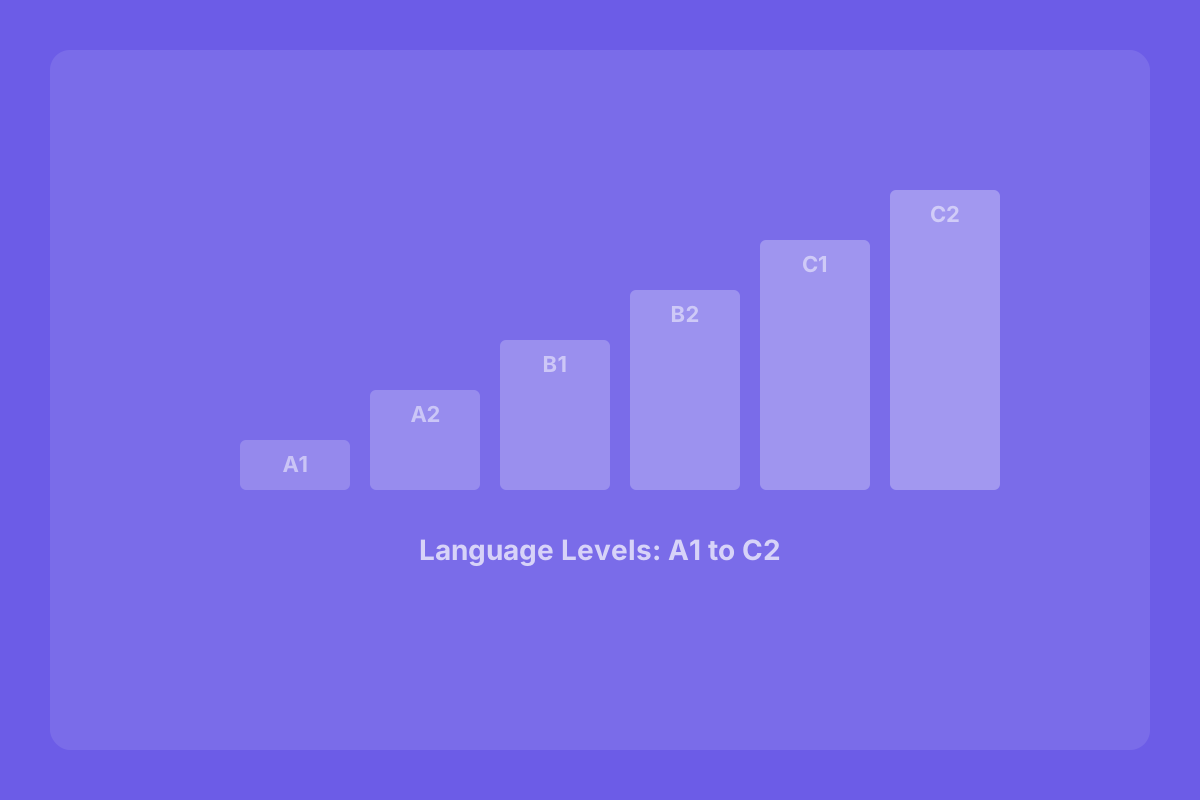
The most widely used reference in Europe is the Common European Framework of Reference for Languages, known as CEFR. It establishes six levels, from A1 to C2, and each one describes in quite a bit of detail what you are able to do. If you want to dive deeper into each level, we have a full guide on language proficiency levels. But here is a quick version with situations you will probably recognize.
A1: The tourist who survives
You can introduce yourself, order food at a restaurant, ask where the bathroom is, and understand basic signs. If someone speaks slowly and patiently, you catch the general idea. This is the "I get by on vacation, but please do not ask me anything complicated" level. Think back to that first week in Barcelona. That is roughly it.
A2: The dinner conversation
You can hold short conversations about everyday topics. You can talk about your family, explain what you do for work, recount what you did over the weekend, and understand directions. If your foreign neighbor invites you to dinner, you can keep up an enjoyable chat as long as nobody brings up politics or philosophy.
B1: The turning point
This is the level most people have in mind when they say "I want to speak a language." You can get around traveling solo, understand the gist of a movie (even if you miss details), write emails without too many mistakes, and tell a story with a beginning, middle, and end. You still make errors, but communication flows.
B2: The competent professional
Here things change. You can participate in work meetings and contribute ideas, watch the news and follow along, read contemporary novels, argue with the repair technician who says the warranty does not cover the problem. Many professionals need this level to work in another country. Companies usually require at least a B2 for positions that demand the language.
C1: The expert
You speak with fluency and precision about complex topics. You catch irony, wordplay, and cultural nuances. You can write detailed reports, participate in academic debates, and understand a native speaker even when they talk fast or use slang. This is the level many European universities require from international students.
C2: The master
Practically indistinguishable from an educated native speaker. You understand absolutely everything, including complex literary texts, regional humor, and conversations between natives speaking at full speed. Very few people need to reach this level, except professional translators, diplomats, philologists, or those who aspire to teach the language.
The hours you need: real data, not marketing
Now for the concrete question: how many study hours does each level require? The data below is based on research from Cambridge Assessment, the Goethe-Institut, the Alliance Francaise, and several European universities. These are averages for languages of medium difficulty (think French, Italian, Portuguese, or German for an English speaker).
| Level | Cumulative hours from zero | What can you do? |
|---|---|---|
| A1 | 60 to 100 | Basic tourist survival |
| A2 | 180 to 250 | Simple everyday conversations |
| B1 | 350 to 500 | Communicate comfortably in common situations |
| B2 | 550 to 750 | Work and study in the language |
| C1 | 800 to 1,100 | Professional and academic fluency |
| C2 | 1,200 or more | Near-native mastery |
Let us translate this into a real calendar. If you study 3 hours per week (the most common pace for people who work full time), an A1 level takes about 2 to 3 months. A B1, between 2 and 3 years. A B2, between 3.5 and 5 years. Those are long timelines, yes. But they are honest. And knowing the truth from the start is much better than getting excited about false promises and quitting after three months because "this is not working."
If you dedicate more time, the timelines shrink proportionally. With 10 hours per week (a university student or someone in an intensive program), a B1 can be reached in 9 to 12 months. With full immersion, even faster.
The FSI classification: not all languages are equal
The Foreign Service Institute (FSI) of the U.S. Department of State has been training diplomats in foreign languages for decades. They have accumulated data from thousands of students and classify languages into four categories based on difficulty for an English speaker.
Category I (600 to 750 class hours). Languages closely related to English: Spanish, French, Italian, Portuguese, Romanian, Dutch, Swedish, Norwegian, Danish. These are languages that share roots, similar grammatical structures, and thousands of cognate words.
Category II (900 class hours). German, Indonesian, Malay, Swahili. Languages with additional complexity but that use the Latin alphabet or have accessible structures. An English speaker tackling German will immediately notice the differences: grammatical cases, verbs at the end of sentences, extremely long compound words. But the alphabet is the same and there are plenty of cognates.
Category III (1,100 class hours). This is where languages like Russian, Greek, Hindi, Turkish, Polish, Czech, and Hebrew come in. Different alphabets in some cases, more distant grammars, phonetics that require training new sounds. An English speaker studying Russian first needs to learn the Cyrillic alphabet, then get used to a system of six grammatical cases, and then discover that Russians do not use articles. It is a whole new world.
Category IV (2,200 class hours). The hardest languages for speakers of European languages: Mandarin Chinese, Cantonese, Japanese, Korean, and Arabic. Here everything changes. Completely different writing systems (Chinese characters, kanji, hangul, Arabic script), tones in Chinese, levels of politeness in Japanese, grammar that operates on entirely different rules. An English speaker studying Japanese needs to learn three separate writing systems before being able to read a menu.
These figures are for classes with a teacher plus self-study. They do not include informal exposure (TV shows, podcasts, casual conversations), which also adds up. The key takeaway is that the distance between your mother tongue and the target language is probably the single most important factor in determining how long you will need.
The factors that speed up or slow down your progress
The hours in the previous section are statistical averages. Your individual case can vary enormously depending on a number of factors worth analyzing in detail.
Linguistic proximity
We have already mentioned it, but it deserves a deeper look. An English speaker studying Dutch has a huge advantage. Many words are nearly identical, the grammar follows similar patterns, and the phonetics are manageable. That same English speaker studying Korean starts from practically zero in everything: alphabet, grammar, vocabulary, phonetics, politeness system.
The interesting thing is that this advantage works like a chain. If you already speak English and French, learning Italian will be even easier because you have two reference languages to draw on. Every language you learn makes the next one a bit easier, especially if they belong to the same language family.
Your age
Let us be direct: children have a biological advantage for pronunciation and the natural absorption of phonetic patterns. A five-year-old child exposed to a language for a year will probably end up speaking it without an accent. A forty-year-old adult, probably not.
But that does not mean adults cannot learn languages. In fact, adults have advantages that children do not. They already know what a verb, an adjective, and a conditional are. They can understand abstract grammar explanations. They have discipline, they can plan their study, and they apply metacognitive strategies that a five-year-old cannot dream of. Researchers at MIT published a study in 2018 with over 600,000 participants that confirmed you can reach a very high level of competence in a second language even if you start at 50 or 60. Perfect pronunciation? Maybe not. The ability to communicate fluently, read, write, and work in that language? Absolutely yes.
If you are 35, 45, or 55 and think it is too late, it is not. Period.
Motivation (the real kind, not the Monday morning kind)
There is a huge difference between studying French because your boss told you to and learning it because you fell in love with someone who only speaks French. There is a huge difference between learning German "just in case I move someday" and needing it because you already have a job offer in Munich and you start in September.
Genuine motivation, the kind that makes you look for excuses to practice instead of excuses to skip class, is probably the most determining factor after linguistic proximity. Studies in learning psychology distinguish between integrative motivation (you want to become part of a community that speaks the language) and instrumental motivation (you need the language for a specific purpose). Both work, but integrative motivation tends to produce better long-term results because it does not disappear once you achieve your immediate goal.
Students with a personal, concrete reason for learning advance noticeably faster than those studying out of vague obligation. If your motivation is weak, the best thing you can do is find a reason that truly matters to you. Plan a trip, make a friend who speaks the language, commit to reading your favorite novel in the original version.
Consistency: the worst-kept secret
Thirty minutes every day beats four hours on Saturday. This is not a cliche: it is basic neuroscience. Your brain consolidates memory during sleep and needs repeated, spaced exposure to move information from working memory to long-term memory.
Think of it like going to the gym. Nobody gets fit by training 8 hours once a month. Muscles need regular stimulus and rest between sessions. Languages work exactly the same way. A person who studies 20 minutes every day for a year will have accumulated more knowledge than someone who studies 3 hours every Sunday, even if the total hours are similar. The difference is retention.
Spaced repetition, a technique that involves reviewing material just before you forget it, is one of the most powerful tools for learning vocabulary. Apps like Anki are built on this principle. It is not glamorous, but it works.
Immersion: powerful but not magical
Living in the country where the language is spoken changes the game. When every interaction, from buying bread to arguing with the neighbor about noise at three in the morning, happens in the target language, your brain has no escape. You are exposed to real, constant, varied input. And that accelerates learning significantly.
But there is an important myth to bust: living in a country does not guarantee learning the language. We all know someone who has been living in another country for 10 or 15 years and still does not speak the local language well. How is that possible? Because they surrounded themselves with compatriots, work in an environment that uses their mother tongue, watch TV from their home country, and only interact in the local language to buy groceries. Immersion without conscious effort produces mediocre results.
Immersion really works when it is combined with structured study. It is the combination of both that produces spectacular results: class gives you the framework, the grammar, the correction. The street gives you practice, speed, and real vocabulary.
Prior experience with other languages
A person who already speaks three languages will learn the fourth faster than a monolingual person learning their second language. Not because polyglots have a special gene, but because they have developed transferable skills: they know how a grammar different from their own works, they recognize patterns, they tolerate ambiguity better, and they have discovered which study techniques work for them.
This effect is cumulative. The jump from the first to the second language is the hardest. From the third onward, each new language is learned more efficiently.
The learning method
Not all methods produce the same results in the same time. A communicative approach, where you speak and listen from day one, produces faster results in comprehension and oral expression than a method based exclusively on grammar and translation. That does not mean grammar does not matter. It means grammar is learned better when it arises from the need to communicate something, not as an abstract exercise.
At ProLang, our courses are designed with this approach: you speak from the very first class. Grammar is introduced when you need it to say what you want to say, not because it is on page 47 of the textbook.
Five myths that need to be buried once and for all
"You can learn a language in 30 days"
The internet is full of these headlines. They are clickbait. In 30 days of intensive study, you can reach a solid A1: introduce yourself, order at restaurants, understand basic phrases. And that is a real, useful achievement. But it is not "speaking a language." You will not hold a deep conversation, understand the news, or read a book. If someone promises you fluency in a month, they are selling you something. Probably an expensive course with disappointing results.
What you can do in 30 days is build a solid foundation and, most importantly, create the study habit. And that has enormous value, because the habit is what will keep you studying during the months and years you actually need.
"Adults cannot learn languages well"
We have already discussed this, but it is so damaging that it deserves repeating. This myth has stopped millions of people from even trying. Yes, an adult will probably not achieve pronunciation indistinguishable from a native speaker. So what? Communication does not depend on having a perfect accent. It depends on having vocabulary, grammar, and the confidence to use them. And in all three of those areas, adults can reach excellent levels.
Think of all the people you know who speak a second language with an accent and yet communicate perfectly, work in that language, have social relationships, and even tell jokes. An accent is not a failure. It is a mark of identity.
"You need talent or a special ear"
Linguistic aptitude exists. Some people have a greater natural facility for distinguishing sounds, memorizing vocabulary, or grasping grammatical patterns. But the research is clear: natural aptitude accounts for between 15 and 20 percent of the variation in results among students. The remaining 80 percent is effort, method, consistency, and motivation.
It is like music. There are people with perfect pitch who never learn to play an instrument, and people with no special talent who, through sheer practice, end up playing in orchestras. Talent gives you a head start, but it does not determine the final outcome.
"An app is enough"
Language apps are useful tools. Duolingo, Babbel, Busuu, and others are good for maintaining the habit, reviewing vocabulary, and practicing basic patterns. But trying to learn a language with just an app is like trying to learn to swim by watching YouTube videos. At some point, you need to jump in the water.
Why? Because an app cannot replicate the complexity of a real conversation. It cannot improvise, it does not genuinely react to what you say, it does not teach you how to handle the discomfort of not understanding something, and it does not correct the nuance of an expression that is technically correct but that no native speaker would use that way. For that, you need a real teacher and real conversations. A trial lesson with a teacher will show you the difference in five minutes.
"Immersion solves everything"
We have already mentioned it, but the myth is so persistent it deserves its own section. "Move to France and you will speak French in six months." Sounds logical, but reality is more nuanced. Without structured study, immersion produces a plateau at a low-intermediate level. You learn to get by in everyday situations, but your grammar fossilizes, your vocabulary is limited to the functional, and you never develop the ability to express complex ideas.
Immersion is a fantastic accelerator, but it needs an engine. That engine is formal study: classes, books, exercises, correction. The combination of both is unbeatable. Either one alone has clear limits.
Practical strategies to progress faster
Beyond hours and methods, there are concrete techniques you can incorporate into your routine that have a real, measurable impact on your learning speed.
Active vs. passive learning
Watching a series in another language with English subtitles is passive learning. Watching that same series with subtitles in the target language and pausing to write down new words is somewhat more active. But what is truly active is trying to summarize the episode out loud, in the target language, after watching it. Or writing a paragraph about what happened. Or discussing the episode with your teacher in the next class.
Passive learning has its place: it accustoms you to the sound of the language, exposes you to vocabulary in context, and it is relaxing. But if you want to progress fast, you need to complement it with active production. Speaking, writing, building sentences. The effort of searching for the right word in your head, of constructing a sentence from scratch, is what truly consolidates learning.
Extensive reading
Reading in the language you are studying is one of the most efficient ways to acquire vocabulary and grammatical structures naturally. But there is an important detail: the material has to be at your level or slightly above it. If every sentence has five words you do not know, you will get frustrated and give up. If you understand 90 to 95 percent of the text, you can deduce the remaining 5 to 10 percent from context, and that is authentic learning.
Start with graded readers, move to young adult novels, then to press and contemporary literature. Do not try to read Dostoevsky in Russian when you have been studying for six months. Read a children's story, enjoy understanding it, and level up gradually.
The shadowing technique
This involves listening to audio in the target language and trying to repeat it in real time, like a sound shadow. It improves pronunciation, intonation, processing speed, and fluency. It is exhausting at first, but the results after 2 to 3 months are remarkable. You can do it with podcasts, audiobooks, or even movie dialogue.
Speak from day one
Do not wait until you feel "ready." You will never feel completely ready. Mistakes are part of learning, not an obstacle. Students who start speaking early, even if they speak poorly, even if they make errors in every sentence, progress significantly faster than those who wait until their grammar is perfect before opening their mouths. Speaking with errors and getting corrected is infinitely more productive than studying grammar in silence for months.
Set concrete, measurable goals
"I want to speak French" is too vague. "I want to be able to hold a 10-minute conversation about my job in French by September" is a goal you can plan for, measure, and celebrate when you achieve it. Concrete goals generate concrete plans, and concrete plans generate results.
How different learning formats compare
Not all ways of studying a language produce the same results or suit the same people. Here is an honest comparison.
Self-study
It is flexible, inexpensive, and you can do it at your own pace. It works well for disciplined people who already have experience learning languages. The problem is that you have nobody to correct you, explain what you do not understand, or force you to speak. Many self-learners develop good reading comprehension but very poor oral expression. Self-study works best as a complement to classes, not as a substitute.
Group classes
They give you structure, a teacher, classmates to practice with, and a regular pace. They are more affordable than private lessons, and the social component helps maintain motivation. The downside is that the teacher cannot tailor everything to your individual needs, and the group's pace may be too fast or too slow for you.
Private lessons
This is the most efficient format in terms of progress per hour. A good tutor adapts every minute to your level, your errors, and your goals. If you make a mistake, they correct it immediately. If a topic is easy for you, they move on. If you need more practice on something, they slow down. It is like having a personal trainer versus going to the gym alone. The downside is cost, although online classes have made it much more accessible today than it used to be.
Immersion programs
Intensive courses in the country where the language is spoken. They combine daily classes with natural exposure and usually produce the fastest progress. In 4 weeks of intensive immersion, you can advance what would normally take 4 to 6 months of regular classes. The downside is that they require time (you need to be able to take weeks off) and they can be expensive.
The best strategy is usually a combination. Regular classes as a foundation, self-study and natural exposure as a complement, and if you can manage it, a period of immersion to make a qualitative leap.
Real scenarios: how long do YOU need?
Averages are fine, but your life is not an average. Let us look at some concrete profiles.
Maria, 34, works full time. She wants to learn French for a possible promotion. She can dedicate 3 hours per week: one hour of private class and 2 hours of self-study (podcasts on the train, Anki in the evenings, reading articles on Sundays). At this pace, she will reach an A2 in about 8 months and a B1 in approximately 2 years. If she stays consistent, in 3 to 4 years she will reach a functional B2, enough to work in a French-speaking environment.
Carlos, 22, university student. He has more free time and is very motivated because he wants to do an exchange year in Germany. He dedicates 10 hours per week: 4 hours of group classes, 2 hours of tandem with a German partner, and 4 hours of intensive self-study. At this pace, he can reach a B1 in 9 to 10 months and a B2 in 18 months. Right on time for his exchange.
Elena, 48, early retiree. She always dreamed of speaking Italian. She has all the time in the world and a deeply personal motivation: she wants to read Italian poets in the original. She dedicates 15 hours per week between classes, study, and consuming Italian media. With that commitment, she reaches a B2 in one year and can get to a C1 in less than 2 years. At 50, she reads Montale in Italian. Whoever says it is too late does not know what they are talking about.
Javier, 29, wants to learn Japanese. Here things change. Japanese is a Category IV language. The 2,200 hours the FSI estimates are not an exaggeration. With 5 hours per week, Javier will need between 8 and 9 years to reach professional competence. Is that a lot? Yes. Is it impossible? No. Is it worth it? Only Javier can decide. What he should know is that with consistent effort he will see real progress from the very first months, even if the road to fluency is long.
The plateau effect: when you feel stuck
There is a phenomenon every language student experiences that few guides mention. It is called the plateau effect, and it usually hits hard between B1 and B2.
It goes like this. During the first months, progress is fast and visible. Every week you learn new words, new conjugations, new expressions. You go from understanding nothing to understanding quite a lot. It is exciting. But past a certain point, progress becomes invisible. You already understand the essentials, so improvements are incremental: a nuance here, an expression there, a slightly more sophisticated grammar structure. It feels like you have stalled.
You have not stalled. You are in the phase where learning shifts from the quantitative (more words, more rules) to the qualitative (more precision, more naturalness, more speed). This is the phase where an A2 becomes a B1 and a B1 becomes a B2. But because the changes are subtle, you do not perceive them.
What should you do when you hit the plateau?
Change your materials. If you have been using the same textbook for months, try something different: a novel, a new podcast, a series that forces you to work harder.
Raise the bar. If you always talk about the same topics, seek out conversations about topics you do not know well. Talk about economics, science, cooking, cinema. Every new topic brings new vocabulary.
Measure your progress objectively. Take a level test every 3 to 4 months. Sometimes the feeling of stagnation does not match reality. At ProLang, you can book a trial lesson at any time so a teacher can assess your current level and show you exactly where you have improved.
Seek specific feedback. Not just "you are doing well" or "you are doing badly." Ask for concrete error patterns to be identified. Maybe you always confuse the subjunctive with the indicative, or you misuse prepositions, or your pronunciation of a specific sound needs work. When you know exactly what to fix, you can focus on it.
How ProLang structures its courses to maximize your progress
At ProLang, we understand that efficiency matters. The courses are built for people with jobs, families, and busy lives. They do not have 15 hours a week to dedicate to study. That is why we have designed our courses around three principles.
First, communication from the very first minute. You do not spend the first weeks memorizing conjugation tables. From the first class you speak, you listen, you interact. Grammar is introduced when you need it to communicate what you want to say.
Second, real personalization. Our teachers adapt content to your interests and needs. If you work in marketing, you will practice marketing scenarios. If you travel frequently, we will work with travel situations. The language you learn has to be the language you are going to use.
Third, constant progress tracking. We regularly assess your level objectively so you always know where you stand and what you are missing. No subjective feelings: concrete data.
How long do you need? Calculate your estimate
Every person is different. To get a personalized estimate, use our interactive calculator that you will find alongside this article. Answer a few questions about your target language, your prior experience, and the time you can dedicate, and you will receive a realistic, personalized estimate.
The truth nobody wants to hear (but you need to know)
Learning a language takes time. More than Instagram ads promise and less than you imagine when you have been stuck on the German subjunctive for two weeks. The path is not linear. There will be weeks when you feel like you are flying and weeks when it seems like you have forgotten everything you ever knew.
But here is the good news. You do not need to reach C2 for a language to change your life. With a B1, you can travel with confidence, make friends in another country, and access content that was previously completely out of your reach. With a B2, you can work abroad, pursue a master's degree, negotiate with international clients, and fall in love in another language.
The other truth nobody tells you is that the process itself is valuable. Learning a language changes you as a person. It makes you more patient, more empathetic, more flexible. It forces you to tolerate ambiguity, to communicate with limited resources, to see the world from a different perspective. It is not just a skill you acquire. It is an experience that transforms you.
The most important thing is not how long it takes, but that you start. And that you do not give up when things get hard, because they will get hard. But every hour you invest is worth it. Every sentence you build, every mistake you make, every conversation you hold brings you a little closer to that version of yourself that speaks another language with confidence.
If you want to know exactly where you stand and how far you have to go, book a free trial lesson at ProLang. In 30 minutes, a teacher will assess your real level and propose a personalized study plan. No commitment, no pressure. Just the truth about where you are and a clear map of where to go.
Frequently asked questions
How many hours does it take to reach B1 in a language?
Counting from zero, roughly 350 to 500 hours for a language of medium difficulty. At three hours a week, the pace most people with a full-time job manage, that works out to two or three years. At ten hours a week it comes down to nine to twelve months. B2 sits higher again, at 550 to 750 hours.
Can you really learn a language in 30 days?
In thirty days of intensive work you can reach a solid A1: introducing yourself, ordering in a restaurant, following simple phrases. That is a genuine result, but it is not speaking the language. You will not follow the news or hold a real conversation. What a month does give you is the study habit, which is what carries you through the years that actually follow.
Why does Spanish take less time than Japanese to learn?
Distance from your own language is the single biggest factor. The US Foreign Service Institute puts Spanish, French and Italian in its easiest category at roughly 600 to 750 class hours, German at 900, Russian and Polish at 1,100, and Japanese, Chinese, Korean and Arabic at 2,200. Japanese asks you to learn three writing systems before you can read a menu.
Is 50 too old to start learning a new language?
No. Adults lose the child's advantage in accent, but they gain others: they already understand grammatical concepts, they can plan their study and they know how they learn. An MIT study published in 2018 with over 600,000 participants found high competence is still reachable when you start at 50 or 60. You may keep an accent; you will still read, write and work in the language.
Book your free trial lesson
One to one with a native teacher, on Zoom.
Times shown in your zone: Europe/Madrid
Loading the timetable…
3. Your email for the confirmation and the Zoom link
One-to-one lessons with a native teacher
On Zoom with a qualified teacher from Spain who also speaks English.