How Not to Quit a Language: Motivation and Habits That Actually Work

Marcos signed up for an English course in January. By March he had stopped showing up. It was not a matter of time or money. He simply stopped going. First he skipped a week because of a heavy workload. Then two weeks. Then he lost count. His textbook is still on the nightstand, a bookmark stuck in lesson 12 since February.
His story is not unusual. It is the norm.
The Dropout Epidemic: Numbers That Sting
The numbers are brutal. According to studies on educational dropout rates, more than 70% of people who start studying a language quit before reaching a functional level. Research firm Busuu published internal data showing that only 5% of users who begin a course actually finish it. Duolingo, with over 500 million downloads, reports that most users drop off within the first two weeks.
In-person settings show better numbers, but they are still concerning. Language schools estimate dropout rates between 40% and 60% during the first year. University foreign language courses lose between a third and half of their enrolled students between the first and second semester.
It is not that people do not want to learn. Survey after survey, "learn a language" ranks among the five most popular New Year's resolutions, right alongside exercising more and eating better. And just like exercising and eating better, the intention rarely survives past March.
The question that matters is not "why do people want to learn languages" (that part is obvious) but "why do people who want to learn languages fail to do so." The answer has more to do with psychology and habit formation than with talent or intelligence.
Why People Really Quit
There are surface-level reasons ("I didn't have time," "it was too expensive," "it wasn't for me") and deep reasons. The surface ones are excuses. The deep ones are what you need to understand if you want to avoid falling into the same pattern.
The Plateau Effect: Why B1 Feels Like a Wall
The first few weeks of any language are thrilling. You learn how to introduce yourself, order a coffee, say the numbers. Every class brings new vocabulary you can use right away. Progress is visible, fast, and addictive. Your brain releases dopamine each time you decode a new sentence or a waiter abroad actually understands you.
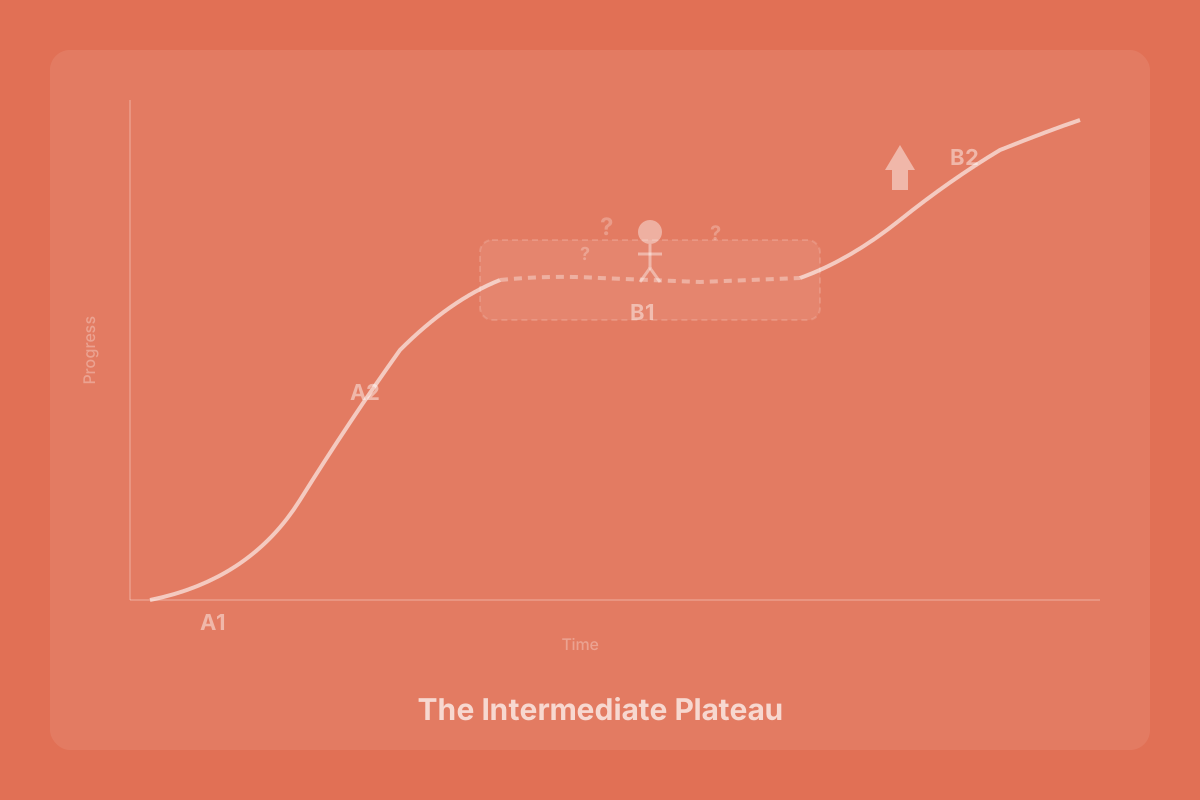
Then the plateau arrives. Around the A2-B1 level, progress turns invisible.
There is a neurological explanation for this. In the early stages, the brain is building entirely new neural networks. Each new word is a new connection, and you can almost physically feel your ability growing. But from the intermediate level onward, the brain stops creating connections at that pace and starts refining the ones it already has. It is consolidating grammatical patterns, automating frequent vocabulary, integrating pronunciation. The work is enormous, but silent. Like the foundations of a building: indispensable, but no one sees them.
Grammar structures get more complex, new words appear less often in daily life, and real conversations remain difficult. It is like climbing a mountain and reaching a flat stretch where the scenery does not change for miles. You keep walking, but it does not feel like you are making progress.
Most dropouts happen right here. Not in the first weeks, when everything is new, but in that intermediate stretch where effort seems to produce no fruit.
Unrealistic Expectations: The Lie of "Fluent in Three Months"
"I want to be fluent in English in three months." This sentence, or some version of it, is the beginning of the end for thousands of students. Language apps, miracle courses, and certain influencers have sold the idea that learning a language is fast if you use the right method. All you need is the perfect app, the secret trick, the technique nobody told you about.
Reality is different. Reaching a B2 level in a new language requires between 500 and 700 hours of study and practice, according to the Common European Framework of Reference. That amounts to two years of studying one hour a day, five days a week. For languages that are more distant from your mother tongue (such as Japanese, Chinese, or Arabic), the U.S. Foreign Service Institute estimates 2,200 hours. When someone expects results in weeks and gets progress in months, frustration kills motivation long before results arrive.
The marketing behind language apps shares part of the blame. They sell the illusion that you can learn by playing five minutes a day. And yes, you can learn something. But the gap between "something" and "being able to hold a real conversation" is a chasm that no amount of gamification alone can bridge.
Isolation: Learning Alone Is Tougher Than It Looks
Studying a language on your own is possible, but it comes with a high emotional cost. Without anyone to practise with, without classmates who share your mistakes and your wins, without a teacher who tells you "you're doing well, keep going," learning becomes a solitary activity that competes with Netflix, social media, and the couch. And the couch always wins when nobody is expecting you.
Human beings are social animals. We learn better in groups. Not by accident, but because positive social pressure, a sense of belonging, and the simple embarrassment of not doing the homework are powerful engines. Group courses exist precisely for this reason: not just to split the cost, but to multiply the motivation.
The Wrong Method for Your Personality
Not everyone learns the same way. An extroverted, social person gets bored to death with a vocabulary flashcard app. An introverted, analytical person feels overwhelmed in a conversational class where improvisation is expected. A visual learner needs diagrams and colour. An auditory learner needs to listen and repeat.
The problem is that many people choose their learning method by price, convenience, or advertising rather than by compatibility with the way they actually learn. When the method does not fit your personality, every study session feels like swimming against the current. And nobody swims against the current for months.
Life Happens: How Disruptions Kill Habits
A move, an urgent project at work, a baby, an illness, a long holiday. Life does not stop because you are learning French. And every interruption is a chance for the habit to break.
The hard part is not the interruption itself but the return. After two weeks without studying, going back feels like starting from zero (even though it is not). The inertia of not doing something is just as powerful as the inertia of doing it. The couch has gotten comfortable again, and the idea of sitting down to conjugate verbs is not exactly appealing.
The "Good Enough" Trap
There is an intermediate level where you can get by. You order food at a restaurant, you understand 60% of a conversation, and you manage at an airport. Many people reach that point and decide, consciously or not, that it is enough. They do not officially quit. They simply stop improving. Their level stalls and becomes their permanent ceiling.
The problem is that this "good enough" level does not let you do the things you actually wanted to do: have a deep conversation, understand a film without subtitles, give a presentation at work without it being obvious that it is not your language. It is a comfortable spot, but a limiting one.
The Science of Motivation: Why "Wanting" Is Not Enough
Intrinsic vs. Extrinsic Motivation
Not all motivation is equal, and understanding the difference changes the game. Psychologists Edward Deci and Richard Ryan developed Self-Determination Theory, which distinguishes between two fundamental types of motivation.
Extrinsic motivation comes from outside. You learn English because you need it for a promotion, because your company demands it, or because you want to pass an exam. It works, but it has a problem: when the external stimulus disappears, the motivation disappears with it. If you get the promotion or pass the exam, why keep studying?
Intrinsic motivation comes from within. You learn because you enjoy it, because you love the process, because you are fascinated by how other languages work, or because you want to connect with people from other cultures. This type of motivation is more resilient because it does not depend on external circumstances.
The Three Pillars: Autonomy, Competence, and Relatedness
Deci and Ryan identified three basic psychological needs that feed intrinsic motivation.
Autonomy. You need to feel that you choose to learn, not that you are forced to. When a student chooses what topics to study, what materials to use, and how to organise their time, motivation goes up. When they feel everything is imposed from outside, they resist.
Competence. You need to feel capable, to feel that you are progressing, that you are improving. That is why micro-wins matter so much. Each small victory ("today I understood a joke in English," "today I wrote an email without using the translator") reinforces the feeling of competence and fuels the desire to keep going.
Relatedness. You need to feel connected to other people in the process. A teacher who knows you, classmates who share your struggle, a community of learners. Isolation kills motivation precisely because it breaks this pillar.
The Phases of Motivation: Honeymoon, Valley, and Gradual Mastery
Motivation is not constant. It passes through predictable phases that every language student will recognise.
The first is the honeymoon. Everything is new, exciting, and fun. You learn fast, you feel smart, and you tell everyone you are learning Italian. This phase lasts between two weeks and two months.
Then comes the valley of despair. Progress slows down, mistakes pile up, grammar gets complicated, and the initial excitement evaporates. This is where most people quit. The valley can last months.
Finally comes gradual mastery. If you survive the valley, you start noticing that you understand more, that you speak more fluently, that you make fewer mistakes. Progress is still slow, but it is no longer invisible. The satisfaction of using the language in real situations replaces the thrill of novelty.
Why Willpower Is Overrated
"You just need discipline." This might be the worst advice you can give someone who is losing motivation. Willpower is a limited resource. It depletes over the course of the day, weakens under stress, and vanishes when you are tired. Relying on willpower to study languages is like relying on luck to pay the rent.
What works is not willpower but systems. A good system makes the right behaviour easy, automatic, and hard to avoid. You do not need motivation to brush your teeth because you have a system: the brush is right there, you do it at the same time every day, and you never ask yourself whether you "feel like it." The same principle can apply to language study.
The Science of Habits Applied to Languages
Cue, Routine, Reward: Charles Duhigg's Model
Charles Duhigg popularised a simple but powerful model for understanding how habits form: cue, routine, reward. Applying it to language learning can be the difference between quitting and going all the way.
The cue is the trigger that activates the behaviour. It can be a time of day, a place, a prior action, or an emotion. For language study to become a habit, it needs a clear and consistent cue. Example: "After I pour my morning coffee, I open my vocabulary notebook." The coffee is the cue. You need neither motivation nor willpower because your brain already associates coffee with study.
The routine is the action itself. This is where most people make a mistake: they make the routine too long or too ambitious. "I'm going to study for an hour a day" sounds great on day 1, but by day 15 it is a torment. The key is to start ridiculously small. Five minutes. Three vocabulary flashcards. One sentence written in the language. So small that you cannot say you do not have time.
The reward closes the loop and tells the brain: "this is worth repeating." The most effective rewards are immediate. "If I study every day this week, I'll buy myself something" works less well than "every time I finish my session, I eat a piece of chocolate." The brain needs the instant connection between effort and pleasure.
Atomic Habits: Four Laws for Language Students
James Clear, in his book Atomic Habits, proposes four principles for building lasting habits. Applied to language learning, they work like this.
Make it obvious. Put your textbook on the breakfast table. Leave your headphones with a loaded podcast next to your keys. Stick a post-it on the bathroom mirror with the word of the day. If study is visible, it is more likely to happen.
Make it attractive. Pair study with something you enjoy. Study at your favourite cafe. Play background music you like. Choose materials about topics that fascinate you. If study is pleasant, you will seek it out instead of avoiding it.
Make it easy. Reduce friction to the minimum. Keep the app open on your phone. Prepare your materials the night before. Start with five-minute sessions. Clear's two-minute rule says: any new habit should be completable in under two minutes. "Study French grammar for an hour" becomes "open the French book." Once you open it, continuing is easier.
Make it satisfying. Track your progress. Use a calendar where you mark the days you study. Celebrate streaks. Share your wins with someone. Immediate satisfaction is the glue that holds the habit together.
Habit Stacking: Anchor the Language to What You Already Do
One especially useful technique is to anchor study to habits you already have in place. The formula is simple: "After [current habit], I will [new language habit]."
After pouring the coffee, I read a page in French. After sitting down on the train, I play a podcast in German. After lunch, I review five vocabulary flashcards. After brushing my teeth at night, I write three sentences in Italian.
The existing habit acts as an anchor. You do not have to remember to study because the trigger is already built into your daily routine.
Environment Design: Your Physical Space Matters
Your physical environment influences your behaviour more than you think. If your desk is full of distractions, studying there demands constant willpower. If you have a clean, tidy corner where you only do things related to the language, your brain shifts into "study mode" automatically when you sit down.
A few simple changes that work: having a dedicated space (even if it is just a corner of the table), keeping study materials visible and accessible, removing distractions (phone in another room or on airplane mode), and using objects from the language as decoration (a map of the country, a calendar with phrases, sticky notes with vocabulary on the furniture).
15 Practical Strategies That Actually Work
1. Micro-goals and the power of small wins
Instead of "I want to speak fluent English," think "this week I'm going to learn how to order food at a restaurant in English." Instead of "I want to pass the B2," think "today I'm going to master the three conditional forms."
Micro-goals do two essential things. First, they give you a constant sense of progress. Each time you complete one, your brain releases dopamine. Second, they eliminate the paralysis that a massive, distant goal produces.
Write five micro-goals every Monday. Cross them off during the week. That act of crossing off is more powerful than it looks.
2. The streak system
Language apps exploit this mechanism, and for good reason: it works. When you have been practising for 15 straight days, breaking the streak hurts. That "pain" is motivation in its purest form.
You do not need an app for this. A wall calendar and a red marker work just as well. Mark an X on each day you study. Your only goal is to not break the chain.
3. The Seinfeld Method
Jerry Seinfeld, the comedian, used exactly this system to write jokes every day. He bought a large wall calendar, and every day he wrote new material, he marked a red X. "After a few weeks you have a chain. Your only job is not to break the chain." They called it "don't break the chain." It works for jokes. It works for languages. It works for almost any creative habit.
4. Accountability partners
Find someone who is learning the same language (or any language) and make a pact: every day you send each other a message confirming that you studied. It is simple, it is free, and it is brutally effective.
The reason: you do not want to look bad. You do not want to be the person who does not follow through. That light social pressure, without being suffocating, is enough to get you off the couch on the days when you have no desire to study.
5. Study groups
Take it a step beyond the individual partner: a group of three to five people who meet (in person or virtually) once a week. Each person shares their progress, their struggles, and their discoveries. The group creates a collective commitment that is far stronger than any personal promise.
At ProLang, students in group courses get this naturally. The group becomes your accountability network without you having to look for it.
6. Change your phone's language
This is perhaps the most underrated strategy and one of the most effective. Switch your phone's language to the language you are learning. Suddenly, every interaction with your phone becomes a micro-lesson.
The first few days are chaotic. You cannot find the settings, you get lost in menus, you get a bit frustrated. But within a week, your brain has adapted. And without realising it, you have learned 50 new words just by using your phone the way you always do.
7. Conquer your screens
After the phone, move on to everything else. Switch Netflix to the original audio with subtitles in the target language. Follow Instagram, TikTok, or YouTube accounts in the language. Look up recipes in French. Read the news in German. Subscribe to newsletters in Italian. Turn your entire digital environment into an extension of your classroom.
A trick that works well for shows and films: start with subtitles in your own language, then switch to subtitles in the target language, and finally remove them altogether. It is a natural progression that does not frustrate.
8. Content-based learning
Do not read news in English if the news bores you in your own language. Find what you already enjoy and switch the language. Podcasts about cooking, YouTube channels about video games, Instagram accounts about travel, novels in the genre you normally read.
The difference between learning "about" the language and learning "through" the language is enormous. The first means studying grammar and vocabulary in isolation. The second means using the language as a tool to access content you actually care about. When the content hooks you, the language stops being an obstacle and becomes a vehicle.
9. DIY gamification
You do not need Duolingo to gamify your learning. Create your own points system. 1 point for each study session, 2 points for a conversation with a native speaker, 5 points for watching an entire film without subtitles. When you reach 50 points, you give yourself a reward. At 100, a bigger one.
What matters is that the system is yours, tailored to your circumstances and to what motivates you. The rewards do not have to be material. They can be a day off from studying, a special dinner, or simply the satisfaction of watching the counter climb.
10. Rewards that work (and ones that do not)
Small, immediate rewards work better than large, distant ones. "A piece of chocolate after each session" is more effective than "a trip to London if I pass the B2." The brain needs the quick connection between effort and pleasure.
Rewards that contradict your goal do not work. Rewarding yourself for studying with "today I won't study" is like rewarding yourself for going to the gym with a day on the couch. Look for rewards that are compatible with your goal or, better yet, that reinforce it: a new podcast in the language, a film in the original version, a book you wanted to read.
11. 30-day challenges
Challenges with an end date are powerful because the finish line is visible. "I'm going to study 30 minutes a day for a month" is psychologically more manageable than "I'm going to study 30 minutes a day forever." Thirty days is enough for the habit to start solidifying, yet short enough that your brain does not panic.
Share your challenge on social media if that motivates you. Public accountability adds an extra layer of commitment. And if you miss a day, do not reset the counter. Just keep going the next day.
12. Find your "why" and revisit it
Why did you start learning this language? Not the polite answer ("to improve professionally") but the real answer. Maybe it is because you fell in love with someone who speaks that language. Or because a film hit you hard and you wanted to understand it without subtitles. Or because you want to live in another country. Or because your grandmother spoke that language and you want to reconnect with your roots.
That deep reason is your anchor. Write it on a piece of paper and stick it where you can see it. When motivation dips (and it will), come back to it. Update it if it changes. Your "why" does not have to stay the same forever, but you need to have one.
13. Journal in the language
Write three or four sentences a day in the language you are learning. It does not have to be perfect. It does not have to be long. Just three sentences about your day: what you did, what you ate, how you feel. This habit does three things at once. It practises writing, reinforces everyday vocabulary, and creates a progress record you can reread later to see how far you have come.
14. The two-minute rule
When you do not feel like studying (and there will be many such days), apply the two-minute rule. Commit to just two minutes of study. Open the book, read a sentence, review a flashcard. The magic is that once you start, you almost always continue. The hard part is not studying: it is starting to study.
15. Professional feedback at key moments
There are moments in learning where a pair of expert eyes makes all the difference. When you have been stuck for weeks, when you are not sure if your pronunciation is right, when grammar turns into a labyrinth. In those moments, a teacher is not a luxury; it is a necessity. They save you weeks of frustration, correct errors you are fossilising without knowing it, and give you direction when you are lost.
How to Get Through the Intermediate Plateau
The plateau is the most dangerous moment in learning. It deserves its own section because this is where most linguistic dreams die.
Why progress becomes invisible
In the early stages, every new word expands your ability noticeably. Learning "table" when you only know ten words is a 10% jump. Learning "table" when you already know 3,000 words is a 0.03% change. The progress is real, but imperceptible.
How to measure micro-progress
Stop measuring yourself by what you do not know and start measuring by what you do know. Record yourself speaking today and compare it with a recording from three months ago. The difference will surprise you. Keep a "first times" notebook: the first time you understood a joke, the first time you dreamed in the language, the first time you thought a sentence without mentally translating it. Those milestones matter more than any exam grade.
Strategies to break through the plateau
Switch formats. If you have been using the same textbook for months, put it down. Read a young-adult novel in the language. Watch a documentary. Play a video game with the audio switched. A format change breaks the monotony and exposes your brain to new vocabulary and structures.
Add production. If you have only been consuming (reading, listening), start producing. Write, speak, record voice notes. Production activates parts of the brain that passive reception does not touch.
Seek specific challenges. Sign up for an exam, even if you do not need it for anything. The deadline creates artificial urgency, and urgency is fuel for motivation. A B1 exam in three months forces you to study in a way that "I want to improve my English" never will.
Get professional feedback. On the plateau, the mistakes you make are more subtle and harder to catch on your own. A teacher identifies error patterns you cannot see and gives you targeted exercises to correct them.
Talk to native speakers. On the plateau, what you need most is to use the language in real situations. No more fill-in-the-blank exercises. Real conversations, with real people, about real topics.
When to push and when to rest
Not every lack of motivation is a sign that you need more discipline. Sometimes it is a sign that you need a break. If you have been forcing yourself to study for weeks and every session feels like torture, take a few days off. Do not quit: plan the break. "I'm going to rest this week and pick it back up on Monday" is very different from "I can't do this anymore, I'm done." The first is strategic. The second is giving up.
The sign that you need to push: you feel lazy but not exhausted. The sign that you need to rest: you feel active rejection toward the language. Learn to tell them apart.
Why Classes Beat Self-Study for Most People
Self-study has obvious advantages: flexibility, low cost, and the freedom to follow your own pace. But it has one enormous weak point when it comes to motivation: nobody is waiting for you.
The accountability factor
When you have a class on Tuesday at 6:00 pm, you show up. Even if you do not feel like it. Even if you have had a terrible day. You go because someone is expecting you, because you have paid, and because your group is counting on you. That soft obligation is, for many people, the difference between continuing and quitting.
Social comparison (the positive side)
Seeing a classmate in your group make progress motivates you to try harder. Not out of envy, but out of imitation. If she can do it, so can I. If he has managed it, I keep trying. Social comparison, used in a healthy way, is a powerful engine.
The teacher as coach and motivator
A good teacher does not just teach grammar. They notice when you are losing interest and switch the activity. They challenge you when you get comfortable. They encourage you when you get frustrated. They celebrate your progress when you cannot see it yourself. They are a coach, not just an instructor.
The group bond and the shared struggle
There is something deeply human about sharing a difficulty with others. When your whole group laughs because nobody understands the subjunctive, the subjunctive becomes less terrifying. When you celebrate together that someone held their first real conversation, the victory multiplies. Shared struggle creates bonds. And those bonds are what bring you back the following week.
The Digital Overload Paradox: When Too Many Apps Kill Motivation
We live in an era of tool abundance. Duolingo, Babbel, Anki, Memrise, HelloTalk, Tandem, italki, YouTube, podcasts, flashcard apps, online courses, AI chatbots. The problem is not a lack of resources but an excess of them.
When you have 12 language apps installed, four half-started courses, and an endless list of resources "you should try," analysis paralysis stops you from making progress. You spend more time searching for the perfect method than practising with any method. And each new tool you add dilutes your commitment to the previous ones.
The solution is radical: pick one main method and two supplementary ones. Your main method can be a class, a textbook, or an online course. The supplementary ones can be a vocabulary app and a podcast. Everything else, drop it. Fewer options mean more focus. More focus means more progress. More progress means more motivation.
How ProLang Keeps Its Students Motivated
At ProLang, the programme structure is designed around everything science tells us about motivation and habits.
Groups are small (a maximum of eight people), which creates the sense of belonging and responsibility that research identifies as essential. If you miss a class, it shows. If you make progress, it gets celebrated.
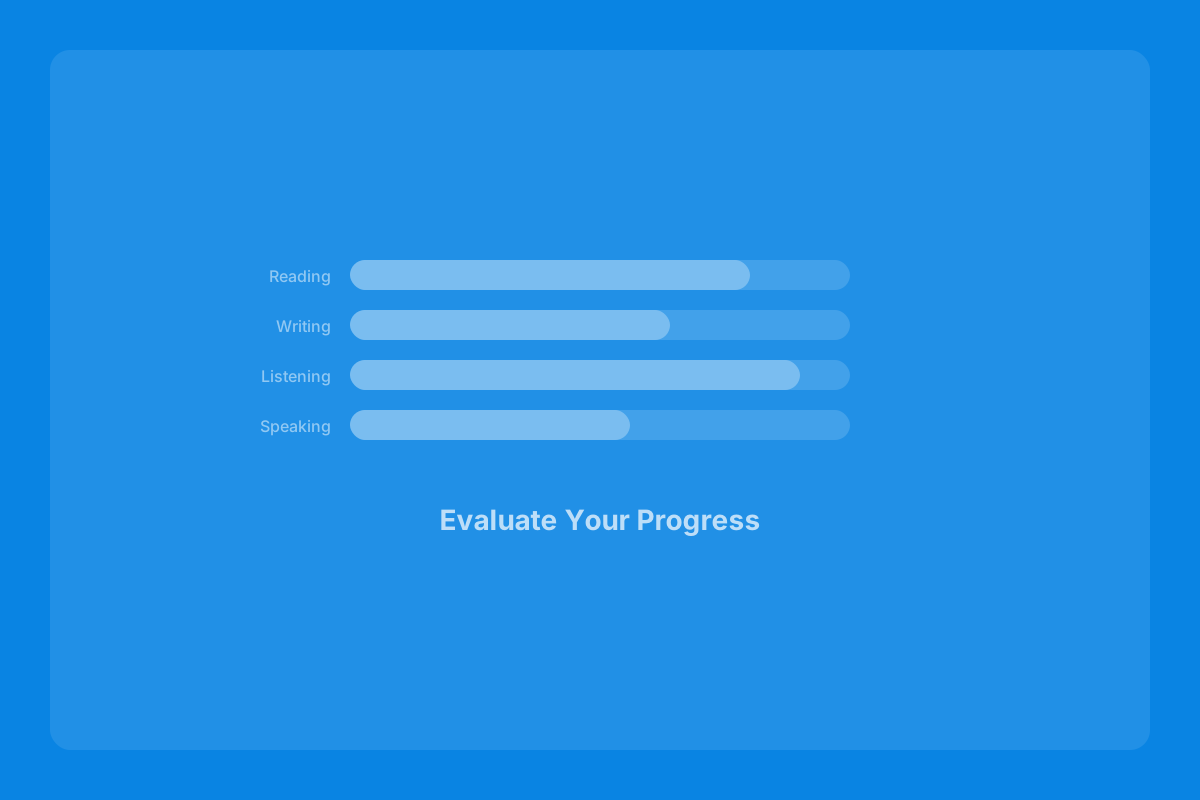
Every student has a visible progress tracker: you can see exactly where you were a month ago and where you are now, even when the plateau makes you believe you have not advanced. Those concrete data points are an antidote to intermediate-level despair.
Teachers know their students by name, know their goals, and adapt classes to the group's needs. You are not a number or an anonymous user. You are a person with a specific "why," and the teacher keeps it in mind.
And the combination of regular classes with independent work between sessions covers both pillars: the structure you need to stay on track and the autonomy you need to feel that the process is yours.
Discover Your Motivation Profile
Not everyone is motivated the same way. Some people need a clear goal, others need company, others need intellectual curiosity. Knowing your profile helps you choose the strategies that will work for you, not the ones that work for someone else.
Answer the 10 questions in the interactive quiz below to discover your motivation type and get personalised advice. The questionnaire analyses whether your main driver is concrete goals, social connection, intellectual curiosity, or career advancement, and offers recommendations tailored to your profile.
The Pact with Yourself
There is no trick that eliminates the bad days. There will be Tuesday nights when you do not feel like studying. There will be weeks when you feel like you are not moving forward. There will be moments when you wonder why you got into this in the first place.
That is normal. It is not a sign that you should quit. It is a sign that you are human.
What separates the people who make it to the end from the ones who quit is not talent, not constant motivation, not a secret method. It is the ability to keep showing up on the hard days. To study for five minutes when you do not feel like studying for an hour. To open the book even if it is just to read one page. To go to class even though you would rather stay on the couch.
Motivation comes and goes. Systems stay. Create a cue. Establish a small routine. Give yourself an immediate reward. Find someone to walk with you. Measure your progress in a way you can see it. And when the plateau arrives, because it will, remember that it is temporary. On the other side there is a version of you who holds conversations in another language, who understands films without subtitles, who reads books in their original version.
The language is on the other side of consistency. Not perfection, not perpetual motivation, not the perfect method. Consistency.
And if you need help maintaining it, you are not alone. At ProLang we work with teachers who know you by name, small groups where your absence is noticed, and a tracking system that shows your progress even when you cannot see it yourself. Book a trial lesson and see what changes when you have someone on your side.
Book your free trial lesson
One to one with a native teacher, on Zoom.
Times shown in your zone: Europe/Madrid
Loading the timetable…
3. Your email for the confirmation and the Zoom link
One-to-one lessons with a native teacher
On Zoom with a qualified teacher from Spain who also speaks English.