Language Learning with AI: What Works, What Doesn't, and How to Use It Right
A few years ago, Maria Gonzalez, a 34-year-old accountant from Chicago, decided she wanted to learn Japanese. She had always loved anime, dreamed of visiting Tokyo, and figured picking up the language would make the trip more meaningful. She signed up for a community college class, bought a textbook, and downloaded Duolingo on her phone. But something happened that she did not expect. Within six months, she found herself spending more time talking to an AI chatbot than practicing with her classmates. "I could ask it anything at 2 a.m. and it would never judge me for messing up," she said. Maria is not alone. Millions of language learners around the world are turning to artificial intelligence tools to supplement, and in some cases replace, traditional methods of studying a new language. The shift is enormous, and it raises a question that teachers, students, and tech companies are all trying to answer: can a machine really teach you how to speak like a human?
The language learning industry has always been shaped by technology. From vinyl records playing French phrases in the 1950s to CD-ROMs in the 1990s, each generation of tools promised faster, easier fluency. But what is happening now with AI feels fundamentally different. This is not just a new delivery method for the same old flashcards. Modern AI systems can hold conversations, correct your grammar in real time, adapt to your skill level, and even listen to your pronunciation and tell you what sounds off. The question is no longer whether AI will play a role in language education. It already does. The real question is how big that role should be, and where the limits are.
How AI Is Changing Language Learning
The traditional model of language learning has looked roughly the same for centuries. A teacher stands at the front of a room, explains grammar rules, assigns vocabulary lists, and has students practice dialogues in pairs. Students go home, do their homework, and come back the next week hoping they remember what they learned. This model works, but it has obvious weaknesses. Class time is limited. Teachers cannot give every student individual attention. And most learners do not have the time or money to take multiple classes per week.
AI is changing this equation by offering something that was previously impossible: unlimited, personalized practice available around the clock. Apps like Duolingo have used machine learning for years to adjust lesson difficulty based on how well a user is performing. If you keep getting Spanish verb conjugations wrong, the app will serve you more exercises on that topic. If you breeze through vocabulary quizzes, it moves you forward. This kind of adaptive learning used to require a private tutor who knew your strengths and weaknesses intimately.
But the real transformation began when large language models like ChatGPT entered the picture in late 2022 and early 2023. Suddenly, learners could have open-ended conversations with an AI that responded naturally, corrected mistakes, and explained grammar concepts on the fly. A student in Seoul could practice business English at midnight without booking a lesson. A retiree in London could practice Italian small talk without feeling embarrassed about making mistakes in front of other people.
The data supports the trend. Babbel reported similar spikes in daily active users after launching its AI chat function. Language learning apps were already one of the fastest-growing categories in app stores before the AI revolution, and the new features have accelerated that growth.
What makes AI particularly powerful for language learning is its patience. A human tutor might get frustrated if you ask the same question for the tenth time. An AI never does. It will explain the difference between "ser" and "estar" in Spanish as many times as you need, using different examples each time if you ask. For many learners, especially those who struggle with anxiety or self-consciousness, this is a game changer. There is no social pressure, no fear of judgment, and no clock ticking down to the end of a paid session.
Best AI Tools for Learning a New Language
The market for AI-powered language learning tools has exploded, and choosing the right ones can feel overwhelming. Here is a look at some of the most popular and effective options available right now, along with what each one does best.
Duolingo remains the most downloaded language learning app in the world, with over 100 million monthly active users. Its free tier offers gamified lessons in more than 40 languages, and its premium subscription, Duolingo Max, includes two AI-powered features: Explain My Answer, which breaks down why you got something right or wrong, and Roleplay, which lets you practice conversations in simulated real-world scenarios like ordering coffee or checking into a hotel. The AI adapts to your level and provides feedback after each exchange.
ChatGPT, developed by OpenAI, is not specifically a language learning tool, but millions of people use it as one. You can ask it to have a conversation in French, correct your German essay, explain a tricky grammar rule in Korean, or generate vocabulary lists organized by topic. Its strength lies in flexibility. Unlike structured apps, ChatGPT lets you practice whatever you want, whenever you want. The downside is that it requires some self-direction. You need to know what to ask for.
Google Translate has evolved far beyond its early days of producing awkward, sometimes hilarious translations. Its neural machine translation engine now handles many language pairs with impressive accuracy. While it is not a learning tool in the traditional sense, many learners use it as a quick reference, and its camera translation feature, which translates text you point your phone at in real time, is remarkably useful for travelers.
Babbel takes a more structured approach than Duolingo, with courses designed by linguists and organized around practical conversation skills. Its AI components focus on speech recognition and personalized review sessions that target your weak spots. Many users find that Babbel feels more like a traditional course than a game, which can be either a plus or a minus depending on your learning style.
Elsa Speak specializes in pronunciation training using AI speech recognition. It analyzes your spoken English and gives detailed feedback on individual sounds, telling you exactly which phonemes you are mispronouncing and how to fix them. It is particularly popular among non-native English speakers preparing for job interviews or professional presentations.
Pimsleur, now owned by Simon and Schuster, combines audio-based lessons with AI-driven speech analysis. Its method focuses heavily on listening and repeating, which many linguists consider one of the most effective ways to build conversational skills. The AI component evaluates your pronunciation and adjusts the pace of lessons accordingly.
For those willing to invest more, platforms like italki and Preply connect learners with human tutors but increasingly incorporate AI tools into the experience, such as automated homework correction and AI-generated conversation prompts. The hybrid approach, using AI for daily practice and a human tutor for periodic check-ins, is becoming one of the most popular strategies among serious language learners.
Can AI Replace a Human Language Teacher
This is the question that sparks the most heated debates in language education circles. Some enthusiasts argue that AI will eventually make human teachers obsolete. Others insist that no machine can replicate the nuance, cultural knowledge, and emotional intelligence that a skilled teacher brings to the classroom. The truth, as usual, lies somewhere in between.
There are things AI does exceptionally well. It provides instant feedback, never loses patience, is available 24 hours a day, and can simulate an almost infinite variety of conversation scenarios. For learners who need to build foundational vocabulary, practice basic sentence structures, or drill grammar rules, AI tools are often more efficient than a human teacher. A private tutor might cost $30 to $80 per hour. An AI app costs nothing or a few dollars per month.
But there are critical areas where AI still falls short. Language is not just grammar and vocabulary. It is culture, context, body language, humor, sarcasm, and the thousand subtle cues that humans use to communicate meaning beyond the literal words they say. When a Japanese teacher explains that the phrase "chotto muzukashii" literally means "a little difficult" but is actually used to politely decline a request, they are teaching you something about Japanese culture that an AI might mention but cannot truly make you feel and understand in the same way.
Human teachers also excel at motivation and accountability. A good teacher notices when a student is losing interest, adjusts their approach, tells a funny story to break the tension, or assigns a project that connects the language to something the student cares about. AI can mimic some of these behaviors, but it does not truly understand boredom, frustration, or the spark of curiosity that a well-timed question can ignite.
Teachers also bring authentic human connection to the learning process. Many language learners say that their relationship with a teacher or conversation partner is what keeps them going when the initial excitement wears off. Learning a language is a long, often frustrating process, and having someone who genuinely cares about your progress makes a real difference.
The most realistic assessment is that AI will not replace good teachers, but it will replace some of the tasks that teachers currently perform. Vocabulary drilling, grammar exercises, pronunciation practice, and basic conversation simulation can all be handled effectively by AI, freeing up teachers to focus on higher-level skills like cultural instruction, complex conversation, error analysis, and mentorship. In this model, AI becomes a powerful assistant to teachers rather than a competitor.
How ChatGPT and AI Tutors Help with Language Practice
One of the most transformative aspects of modern AI for language learners is the ability to practice conversation without scheduling a lesson, paying for a tutor, or finding a willing conversation partner. ChatGPT and similar AI language models have become the practice partners that millions of learners never had access to before.
Consider a typical scenario. A Brazilian student named Lucas is preparing for the IELTS exam and needs to improve his spoken English. He cannot afford a private tutor, and there are no native English speakers in his small town. Before AI chatbots, his options were limited to practicing with recordings, watching YouTube videos, or traveling to an English-speaking country. Now, he opens ChatGPT and types: "Let's practice an IELTS speaking test. Ask me Part 2 questions about hobbies and give me feedback on my answers." Within seconds, he has a patient, knowledgeable practice partner.
The versatility of AI tutors is remarkable. You can ask ChatGPT to play the role of a hotel receptionist in Paris so you can practice booking a room in French. You can ask it to be a strict grammar teacher who corrects every mistake, or a casual conversation partner who only points out errors that affect understanding. You can paste an entire paragraph you wrote in German and ask for corrections with explanations. You can request vocabulary related to a specific topic, like medical terminology or cooking, and get a curated list with example sentences.
Several platforms have built dedicated AI tutor experiences on top of large language models. Speak, a Korean-made app focused on English learning, uses AI to create interactive speaking lessons where you respond verbally and the AI evaluates both your content and your pronunciation. The app became one of the top-grossing education apps in South Korea and Japan, demonstrating the enormous demand for AI-powered speaking practice.
Replika, originally designed as an AI companion, is used by some language learners for casual conversation practice. While it was not built for language education, its ability to maintain natural, ongoing conversations makes it useful for learners who want to practice chatting rather than completing structured exercises.
One particularly effective strategy is using AI tutors for "deliberate practice," a concept borrowed from performance psychology. Instead of having random conversations, learners can ask the AI to focus on specific weaknesses. "Only use the subjunctive mood in your responses so I can get used to hearing it." "Speak to me as if I were a child learning my first words, using simple sentences." "Ask me questions that require me to use the past tense." This level of targeted practice was previously only available through expensive private tutoring.
Teachers who have embraced AI tutors report that their students come to class better prepared, having already practiced the basics on their own. The class time can then be devoted to discussion, cultural exploration, and the kind of complex, spontaneous interaction that AI still struggles with.
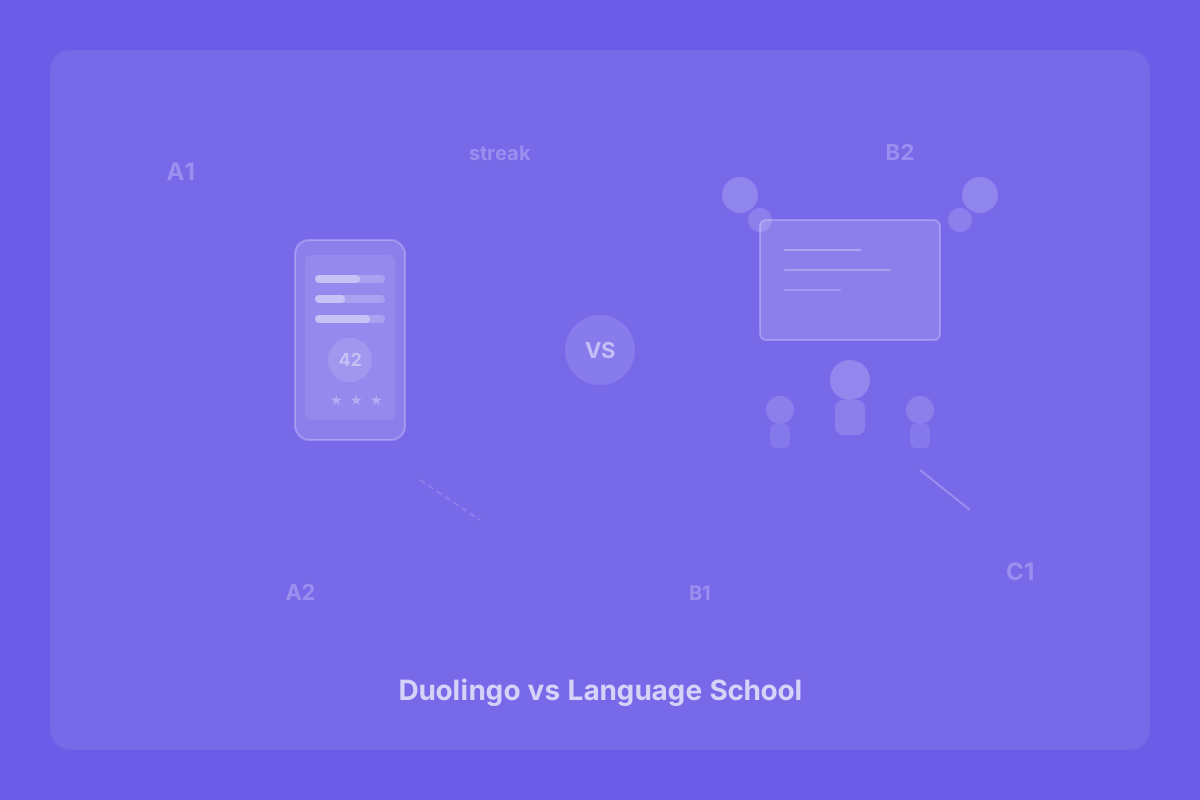
AI-Powered Apps vs Traditional Language Courses
The debate between app-based learning and traditional courses has been going on since Rosetta Stone first shipped its yellow boxes in the 1990s. But the arrival of AI has sharpened the debate because the apps have gotten so much better. So which approach is actually more effective?
Traditional language courses, whether at a university, a community college, or a private language school, offer structure, accountability, and human interaction. You show up at a set time, follow a curriculum designed by professionals, interact with classmates, and receive feedback from a trained teacher. Research consistently shows that structured, immersive learning environments produce the best outcomes for most learners.
But that comparison is not entirely fair. App-only learners in the study spent an average of 15 minutes per day on their phones, while classroom students had three hours of instruction per week plus homework. When researchers controlled for total study time, the gap narrowed significantly. The real advantage of traditional courses is not the method itself but the commitment and consistency that a structured schedule enforces.
AI-powered apps have several clear advantages over traditional courses. They are dramatically cheaper. A year of Duolingo Plus costs about $84, while a semester of community college language classes might cost $500 to $2,000 or more. Apps are also infinitely more convenient. You can study on the bus, during your lunch break, or at midnight when you cannot sleep. And AI-driven apps adapt to your level automatically, which means you are never bored by material that is too easy or overwhelmed by material that is too hard.
Traditional courses have their own distinct advantages. The social aspect of learning with other people is powerful. You hear different accents, learn from others' mistakes, and build friendships around a shared goal. Group activities like role-playing, debates, and collaborative projects create the kind of dynamic, unpredictable language use that AI cannot fully replicate. And the physical presence of a teacher creates a level of engagement and accountability that a phone notification simply cannot match.
The emerging consensus among language educators is that the best approach combines both. Use AI apps for daily vocabulary practice, grammar drilling, and casual conversation. Use traditional courses or human tutors for cultural immersion, complex speaking practice, and the social motivation that keeps you going over the months and years it takes to achieve fluency. This blended approach gives learners the efficiency and convenience of AI alongside the depth and richness of human instruction.
Many language schools are already adopting this model. The Goethe-Institut, one of the world's most respected German language education organizations, now integrates AI tools into its courses, using them for homework assignments and self-study while reserving classroom time for interactive activities and cultural discussions.
Using AI for Grammar Correction and Writing Practice
Writing in a foreign language is one of the most challenging skills to develop, and it is also one of the areas where AI has made the biggest impact. The ability to get instant, detailed feedback on your writing without waiting days for a teacher to grade your essay has transformed how people practice.
Grammarly, one of the most well-known AI writing tools, supports grammar and style checking in English and has expanded to other languages. While it was designed primarily for native speakers, many English learners use it as a constant companion, catching errors in emails, essays, and social media posts. The tool explains why a correction was made, which turns every mistake into a learning opportunity.
ChatGPT and similar language models take writing practice even further. You can write a paragraph in Spanish and ask the AI to correct it, explain each correction, rate your writing on a scale of 1 to 10, and suggest ways to make it sound more natural. You can ask it to rewrite your text at a higher proficiency level so you can see what more advanced writing looks like. You can even ask it to identify patterns in your mistakes, helping you focus on the grammar rules that give you the most trouble.
LanguageTool is an open-source alternative to Grammarly that supports over 30 languages. It catches grammar, spelling, and style errors and provides explanations in plain language. For learners of less commonly studied languages, tools like LanguageTool can fill a gap that commercial apps often ignore.
One particularly effective writing exercise involves using AI as a revision partner. A learner writes a journal entry in their target language, submits it to an AI for correction, reviews the corrections, and then rewrites the entry from scratch the next day without looking at the AI's feedback. This process forces active learning rather than passive consumption of corrections.
Writing teachers have noticed that AI correction tools are changing how students approach errors. In the past, many students would submit an essay and simply accept the grade without carefully reviewing the teacher's corrections. With AI, the feedback loop is immediate and interactive. Students can ask follow-up questions about why a particular word choice is wrong or request additional examples of the correct usage. This kind of interactive feedback encourages deeper engagement with the material.
However, there is a legitimate concern about over-reliance on AI correction tools. If learners always write with Grammarly or ChatGPT watching over their shoulder, they may not develop the internal sense of correctness that comes from making mistakes and learning to catch them yourself. Some teachers now assign "unplugged" writing exercises where students must write without any digital assistance, followed by sessions where they use AI to review and learn from their errors. This balanced approach helps build both independent writing skills and the ability to use AI as a learning resource.
Another concern is accuracy. While AI grammar tools are impressively good, they are not perfect. They occasionally suggest corrections that are wrong, miss errors that a human teacher would catch, or fail to understand the context of what you are trying to say. Learners should treat AI corrections as helpful suggestions rather than infallible rules, and verify corrections they are unsure about with a teacher or a trusted reference source.
AI Speech Recognition for Pronunciation Training
Pronunciation is one of the hardest aspects of language learning, and it is also one of the areas where learners have traditionally had the least support. Unless you have access to a native speaker who is patient enough to correct you repeatedly, it is difficult to know whether your pronunciation is accurate. AI speech recognition technology is changing that.
Modern AI pronunciation tools go far beyond simple "right or wrong" assessments. Elsa Speak, for example, analyzes your spoken English at the phoneme level, identifying exactly which sounds you are struggling with. If you are a Mandarin speaker learning English, it might notice that you consistently confuse the "l" and "r" sounds and give you targeted exercises to practice the distinction. If you are a Spanish speaker, it might flag your pronunciation of the "th" sound in words like "think" and "the."
The technology behind these tools has improved dramatically in recent years. Speech recognition systems now use deep learning models trained on millions of hours of spoken language from speakers with various accents and proficiency levels. This means they can understand non-native speech much better than older systems, which often failed to recognize anything that did not sound like a textbook recording.
Google's speech recognition technology, which powers the voice input feature on Android phones and Google Translate, has become remarkably accurate across dozens of languages. Many learners use it as a simple but effective pronunciation check: if Google accurately transcribes what you said, your pronunciation is probably clear enough to be understood. If it consistently misinterprets a particular word, you know that word needs work.
Speechling is another platform focused specifically on pronunciation. It combines AI analysis with feedback from human coaches, offering a hybrid approach that catches errors the AI might miss. Users record themselves speaking, receive AI-generated scores, and then get additional feedback from a native speaker within 24 hours. This dual-feedback model addresses one of the key limitations of AI-only pronunciation training: the inability to assess more nuanced aspects of speech like intonation, rhythm, and emotional expression.
For tonal languages like Mandarin Chinese, Thai, and Vietnamese, AI pronunciation tools are particularly valuable. Getting the tones right in Mandarin is essential because the same syllable pronounced with different tones can mean completely different things. The word "ma" can mean mother, hemp, horse, or scold depending on the tone. AI tools that visualize your tone contours and compare them to native speaker patterns give learners the kind of precise, visual feedback that is difficult to get any other way.
One important caveat about AI pronunciation training is that "correct" pronunciation is a more complicated concept than it might seem. Every language has regional accents, dialects, and variations. British English sounds different from American English, which sounds different from Australian English. All of them are "correct." Some AI tools default to a single standard accent, which can give learners a misleadingly narrow idea of what acceptable pronunciation sounds like. The best tools acknowledge this diversity and let users choose which accent they want to target.
The Limits of AI in Language Learning
For all the excitement around AI language tools, it is important to be honest about their limitations. AI can do many things well, but there are aspects of language learning that it still handles poorly or not at all.
The most fundamental limitation is that AI does not truly understand language in the way humans do. Large language models like GPT-4 are extraordinarily good at predicting what word should come next in a sequence. They can generate grammatically correct, contextually appropriate text in dozens of languages. But they do not understand meaning the way a human does. They do not have experiences, emotions, or cultural knowledge in any genuine sense. They simulate understanding based on patterns in their training data.
This matters for language learning because so much of communication depends on context, culture, and shared human experience. When a French person says "bon courage" to you before a difficult task, the phrase carries cultural weight that goes beyond its literal translation of "good courage." It is an expression of solidarity, encouragement, and empathy that reflects French cultural values around work and perseverance. An AI can tell you what the phrase means, but it cannot convey the feeling of hearing it from a friend who genuinely cares about you.
AI also struggles with several specific aspects of language. Idiomatic expressions are one challenge. While AI has gotten better at recognizing and explaining idioms, it sometimes uses them incorrectly or fails to understand when a learner is using one. Humor is another weak spot. Jokes, wordplay, and sarcasm depend heavily on cultural context and shared knowledge, and AI often misses the mark when trying to be funny or when interpreting humor in a learner's writing.
Register and formality present another challenge. Every language has different levels of formality, and choosing the right one depends on complex social factors that AI does not always navigate well. In Japanese, the difference between casual speech, polite speech, and honorific speech is enormous, and using the wrong register can cause real social problems. While AI can explain these differences in theory, it does not always model them correctly in conversation.
AI tools can also create a false sense of progress. Getting a high score on Duolingo or having a smooth conversation with ChatGPT can make you feel like you are more proficient than you actually are. The controlled, patient environment of AI interaction is very different from a real conversation with a native speaker who talks fast, uses slang, interrupts, changes topics abruptly, and expects you to pick up on non-verbal cues. Many learners report being shocked by how much harder real-world conversation is compared to their AI practice sessions.
Privacy and data security are additional concerns. Language learning apps collect enormous amounts of personal data, including recordings of your voice, your writing samples, your location, and your usage patterns. Some apps sell this data to third parties or use it to train their AI models without clearly informing users. Learners should read privacy policies carefully and consider what information they are comfortable sharing.
Finally, there is the issue of language coverage. Most AI language tools focus on widely spoken languages like English, Spanish, French, Mandarin, and Japanese. If you want to learn Welsh, Swahili, Tagalog, or one of the thousands of less commonly studied languages, your AI options are much more limited. This creates a digital divide where speakers of major languages have access to cutting-edge tools while speakers of smaller languages are left behind.
How to Combine AI Tools with Human Instruction
The most effective language learners in 2026 are not choosing between AI and human instruction. They are using both strategically, leveraging the strengths of each approach while compensating for the weaknesses. Here is a practical framework for combining AI tools with human instruction.
Start by using AI for daily vocabulary and grammar practice. Spend 15 to 20 minutes each day on an app like Duolingo or Babbel to build and maintain your foundational knowledge. These apps excel at spaced repetition, a learning technique that shows you information at increasing intervals to maximize retention. The AI handles the scheduling so you do not have to think about when to review what.
Use ChatGPT or a similar AI chatbot for writing practice and conversation simulation. Write a short journal entry in your target language every day and ask the AI to correct it. Have a five-minute conversation about your day, current events, or a topic you are interested in. The key is consistency. Ten minutes of AI conversation practice every day is more effective than one hour-long session per week.
Reserve human instruction for the things AI does poorly. Book a weekly or biweekly session with a tutor on a platform like italki or Preply for conversation practice, cultural questions, and feedback on your overall progress. Use class time to practice the messy, unpredictable aspects of communication that AI cannot replicate: negotiating, arguing, telling stories, and navigating awkward social situations.
Take advantage of AI for test preparation. If you are studying for a language proficiency exam like TOEFL, IELTS, DELF, or JLPT, AI tools can generate unlimited practice questions, simulate test conditions, and provide instant feedback. Use human tutors to review your practice test results, identify patterns in your errors, and develop strategies for the sections that give you the most trouble.
Use AI to fill gaps between lessons. If your teacher assigns a topic and you want extra practice before the next class, use AI tools to generate additional exercises, have conversations on the topic, or research vocabulary you will need. This way, you arrive at each lesson better prepared and can make the most of the limited time with your teacher.
Be honest with yourself about what you need motivation for. Some learners thrive with the gamification and instant feedback of AI apps. Others need the social pressure and personal connection of a human teacher to stay committed. Most people benefit from both. If you find yourself losing motivation with AI practice, that might be a sign that you need more human interaction, not a better app.
Track your progress using a combination of AI assessments and human evaluation. AI tools can measure your vocabulary size, grammar accuracy, and pronunciation scores with impressive precision. But only a human teacher can assess your overall communicative competence, your ability to navigate real conversations, your cultural sensitivity, and your progress toward your personal goals.
The Future of AI in Language Education
The pace of improvement in AI language technology over the past three years has been staggering, and there is every reason to believe it will continue. Several emerging trends suggest where language learning is heading in the near future.
Real-time translation is approaching science fiction levels of quality. Google and Meta have both demonstrated AI systems that can translate spoken language in real time, preserving not just the words but the speaker's voice and emotional tone. Within a few years, it may be possible to have a natural conversation with someone who speaks a completely different language, with AI handling the translation seamlessly through earbuds or smart glasses. This raises a provocative question: if machines can translate everything instantly, why bother learning another language at all?
The answer, according to most linguists and language educators, is that translation and language learning serve fundamentally different purposes. Translation removes a barrier. Language learning builds a bridge. When you learn someone's language, you gain access to their culture, their humor, their way of seeing the world. You build a connection that no translation technology can replicate. The demand for language learning is not going to disappear because of better translation tools. If anything, as the world becomes more interconnected, the desire to understand other cultures deeply will grow.
Multimodal AI systems that combine text, speech, and vision are opening new possibilities for immersive language learning. Imagine pointing your phone at a street scene in Tokyo and having an AI describe everything you see in Japanese, then quiz you on the vocabulary. Or wearing AR glasses that overlay translations and vocabulary hints on real-world objects as you walk through a foreign city. These technologies are already in development and could be widely available within a few years.
Personalization will become much more sophisticated. Future AI language tutors will likely track not just what you know and do not know, but how you learn best, when you are most alert, what topics keep you engaged, and what emotional state you are in. They will adjust their teaching style in real time, becoming more encouraging when you are frustrated and more challenging when you are coasting.
The integration of AI into formal education is accelerating. Universities and language schools are redesigning their curricula to incorporate AI tools rather than compete with them. The role of the human teacher is evolving from information deliverer to learning coach, cultural guide, and motivational mentor. Teachers who embrace this shift are finding that AI makes their work more rewarding, not less, because they can focus on the aspects of teaching that require genuine human connection and expertise.
Virtual reality combined with AI could create fully immersive language learning environments. Instead of practicing ordering food in a text-based chat, you could walk into a virtual restaurant in Rome, interact with AI-powered characters who respond naturally in Italian, and experience the sights and sounds of the environment. Early experiments with VR language learning have shown promising results, particularly for developing the confidence to speak in real-world situations.
The most exciting possibility is that AI will democratize access to high-quality language education. Today, the best language instruction is expensive and geographically concentrated. A student in rural Indonesia has far fewer opportunities to learn English than a student in Singapore or London. AI tools are already leveling this playing field by providing world-class instruction to anyone with a smartphone and an internet connection. As these tools continue to improve, the gap between the language learning haves and have-nots will continue to narrow.
What remains constant amid all this change is the fundamental human desire to communicate, to connect, to understand and be understood across linguistic and cultural boundaries. AI is the most powerful tool we have ever had for pursuing that desire. But it is still just a tool. The motivation, the curiosity, the willingness to make mistakes and keep trying: those come from us. And that is something no algorithm can replace.
Book your free trial lesson
One to one with a native teacher, on Zoom.
Times shown in your zone: Europe/Madrid
Loading the timetable…
3. Your email for the confirmation and the Zoom link
One-to-one lessons with a native teacher
On Zoom with a qualified teacher from Spain who also speaks English.